
Introduction
Sellforte Market Areas (SMAs) are the geographic units Sellforte uses whenever marketing performance is measured below country level. Advertising platforms, analytics tools and business systems each describe geography in their own way, so the same market can arrive as a Nielsen DMA, a Comscore Market, a Google location, a state, a postal code or a store. Sellforte translates all of these into one set of market areas per country before the data is used for modeling, experiments or reporting. This article explains how SMAs are defined, how the definition differs between the US, the UK and the rest of the world, how incoming data is mapped to SMAs, and what this means when you read regional results or plan a geo experiment in Sellforte.
What a Sellforte Market Area is
An SMA is a fixed geographic unit within one country. Every SMA has a stable identifier, a display name, a type and a flag that tells whether it belongs to the country's default set. The identifier is what Sellforte uses internally to join media, sales and experiment data. The display name is what you see in the product.
The SMA layer sits between source geographies and measurement. Source data keeps whatever geography the platform or system delivers. Sellforte then assigns each source location to an SMA, and all regional analysis is done on SMAs. Because the measurement always runs on the same units, a market in the regional MMM results, in an experiment design and in a regional performance view refers to exactly the same area.
The current catalog covers 199 countries and 3 835 market areas, of which 3 806 belong to the default sets. The full list is attached to this article as a downloadable file.
How SMAs are defined in each country
The definition of an SMA depends on how marketing is planned and bought in each country. Three schemes are in use.
| Scheme | Countries | SMA ID format | Example |
|---|---|---|---|
| DMA-aligned markets | United States | US-DMA-{Nielsen DMA code} |
US-DMA-623 Dallas-Ft. Worth, TX |
| GMA-style marketing areas | United Kingdom | GB-GMA-{postcode area} |
GB-GMA-M Manchester |
| ISO 3166-2 first-level subdivisions | All other countries | ISO 3166-2 code | DE-BY Bayern, FR-ARA Auvergne-Rhone-Alpes |
United States: DMA-aligned markets
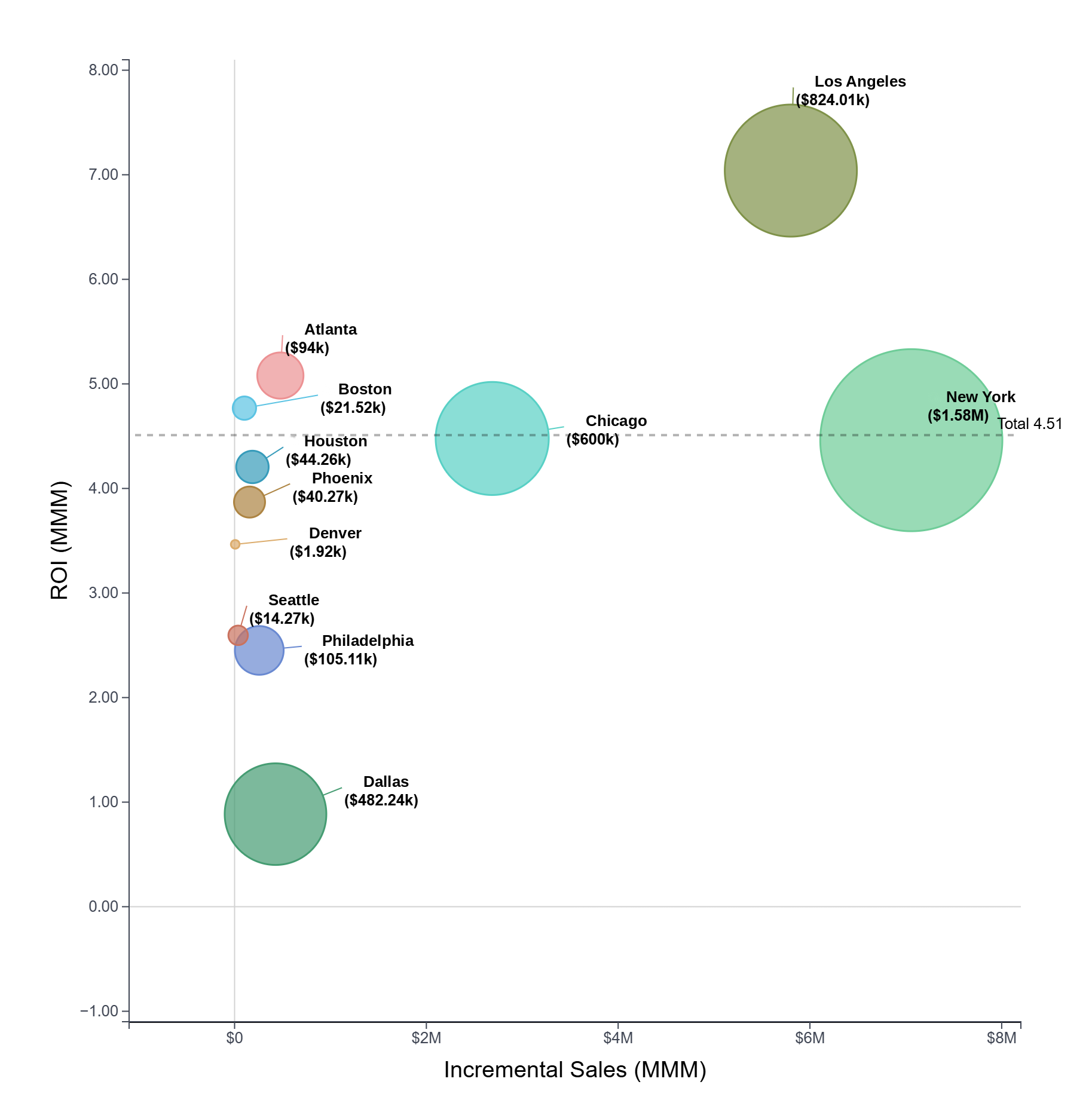
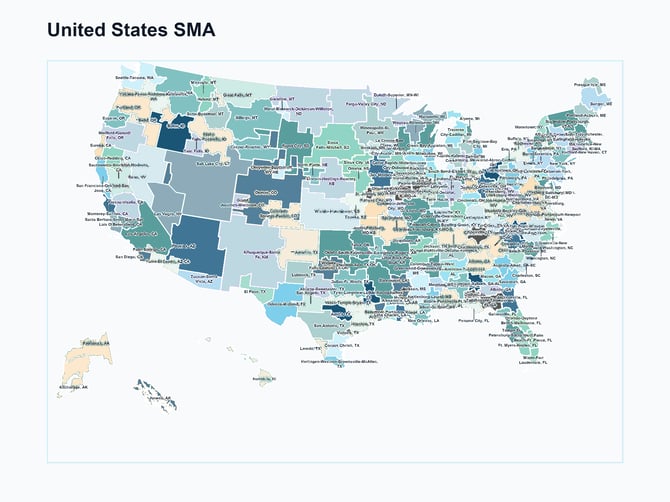
In the US, an SMA is a Designated Market Area (DMA). The 210 DMAs are the standard regional planning unit for US media buying, and most advertisers, agencies and historical datasets already use them. Each US SMA keeps the Nielsen DMA code in its identifier, so US-DMA-501 is New York, NY, US-DMA-803 is Los Angeles, CA and US-DMA-623 is Dallas-Ft. Worth, TX. This means US SMAs can be read directly against any DMA-based plan or report you already have.
Data that arrives at a finer level than DMA, such as ZIP codes in first-party sales data, is rolled up to the DMA the ZIP code belongs to. ZIP code is the most granular level Sellforte works with in the US, and DMAs are built from it.
United Kingdom: GMA-style marketing areas
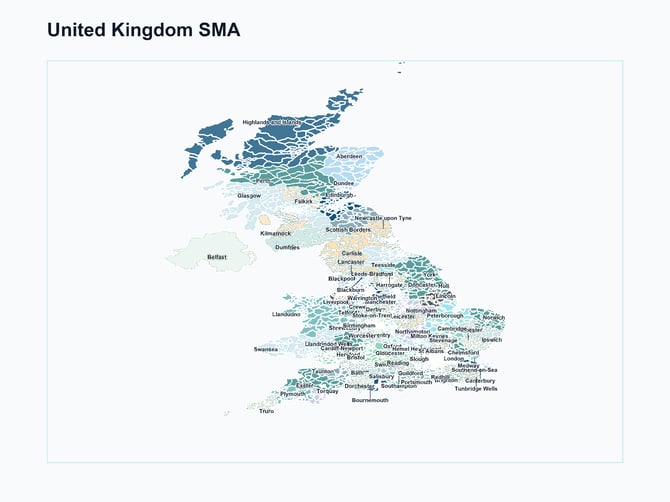
In the UK, SMAs follow the Google Marketing Area concept: market areas built around towns, cities and their commuter belts, which is the level at which digital media can be targeted and tested. Sellforte defines these areas from Royal Mail postcode areas. The UK has 124 postcode areas, and every one of them belongs to exactly one SMA. Most SMAs correspond to a single postcode area, for example GB-GMA-BS Bristol or GB-GMA-CB Cambridge. Where a city and its surroundings form one commuting market, postcode areas are combined into one SMA.
| SMA ID | SMA name | Postcode areas |
|---|---|---|
| GB-GMA-LDN | London | BR, CR, DA, E, EC, EN, HA, IG, KT, N, NW, RM, SE, SM, SW, TW, UB, W, WC, WD |
| GB-GMA-M | Manchester | BL, M, OL, SK, WN |
| GB-GMA-B | Birmingham | B, DY, WS, WV |
| GB-GMA-LS | Leeds-Bradford | BD, HD, HX, LS, WF |
| GB-GMA-G | Glasgow | G, ML, PA |
| GB-GMA-NE | Newcastle upon Tyne | DH, NE, SR |
| GB-GMA-EH | Edinburgh | EH, KY |
| GB-GMA-L | Liverpool | CH, L |
| GB-GMA-TS | Teesside | DL, TS |
| GB-GMA-CF | Cardiff-Newport | CF, NP |
| GB-GMA-IV | Highlands and Islands | HS, IV, KW, ZE |
This gives 82 UK market areas, of which 80 are in the default set. Channel Islands (GB-GMA-GY, postcode areas GY and JE) and Isle of Man (GB-GMA-IM) are Crown Dependencies outside the UK and are only included when a business sells there and wants them in scope.
Because UK SMAs are defined by postcode areas, the postcode list is also what you use to target the same area in ad platforms. Both Google and Meta accept postcode targeting, so an SMA can be reproduced exactly as a campaign location setting.
The UK also has a second, alternative layer: the 14 Google Ads TV regions (for example London, Midlands, North West, Central Scotland), identified as GB-TV-{Google Ads criteria ID}. TV regions are much larger than marketing areas and match how linear TV is bought. They are not part of the default set and are used as an aggregation layer for offline media, for example when an experiment tests TV by region.
All other countries: ISO 3166-2 first-level subdivisions
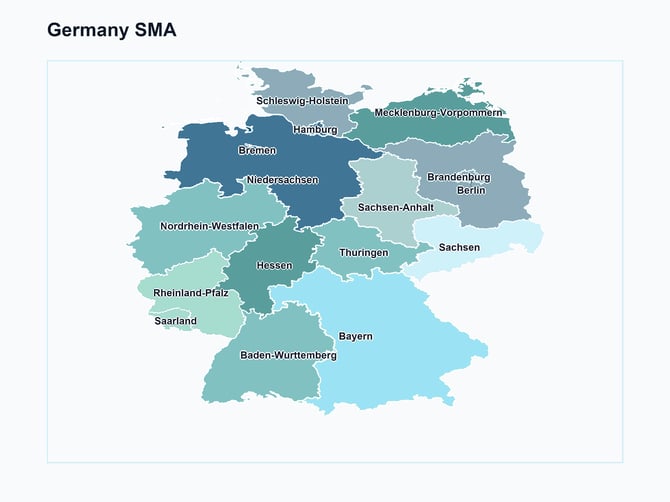
Outside the US and UK, an SMA is a first-level administrative subdivision as defined in the international standard ISO 3166-2: the states, regions, provinces or counties of the country. The SMA ID is the ISO 3166-2 code itself, for example DE-BY for Bayern, IT-25 for Lombardia, ES-AN for Andalucia, SE-AB for Stockholms lan and AU-NSW for New South Wales. These subdivisions are publicly defined and change rarely, which makes them a practical common level for measurement across data sources.
The type of unit therefore varies by country: Länder in Germany, regions in France, regioni in Italy, autonomous communities in Spain, provinces in the Netherlands, counties (län) in Sweden, voivodeships in Poland, and states and territories in Australia. Where a country has territories far from the mainland, those may sit outside the default set. In France, for example, the default set is the 13 metropolitan regions including Corse, while the overseas departments and collectivities are available but not included by default.
How source data is mapped to SMAs
Every incoming location value is mapped to an SMA through a lookup table. Mapping is done in two steps. First the source value is harmonized into a consistent key, for example by normalizing spelling and format. Then the key is looked up in a mapping table that assigns it to an SMA. Because the mapping is a table and not a fixed formula, Sellforte can map any source geography to any SMA, and the mapping can be extended when a platform introduces a new geography or a business uses its own location codes.
Example: Meta Comscore Markets to US DMAs
Meta reports and targets US regional markets as Comscore Markets rather than Nielsen DMAs. Comscore Markets describe the same markets as DMAs, but often under different names. Sellforte maps all 210 Comscore Markets one to one to DMAs, so Meta data lands in the same US SMAs as data from Google and other sources.
| Comscore Market (Meta) | DMA | DMA code | Mapping type |
|---|---|---|---|
| Albany, GA | Albany, GA | 525 | Exact canonical DMA name |
| Amarillo, TX | Amarillo, TX | 634 | Exact canonical DMA name |
| Albany-Schenectady, NY | Albany-Schenectady-Troy, NY | 532 | Comscore alias |
| Albuquerque, NM | Albuquerque-Santa Fe, NM | 790 | Comscore alias |
| Abilene, TX | Abilene-Sweetwater, TX | 662 | Comscore alias |
Of the 210 Comscore Markets, 133 carry exactly the same name as the DMA and 77 use a different name for the same market. Note the two Albanys: Albany, GA and Albany-Schenectady, NY are different markets, which is why the mapping is done against a complete reference table rather than by matching names loosely.
Example: postcode data in the UK
A UK sales file with customer postcodes is mapped by taking the postcode area, the leading letters of the postcode, and assigning it to the SMA that contains that area. An order to M1 1AE belongs to postcode area M and therefore to GB-GMA-M Manchester. An order to SK4 belongs to postcode area SK, which is also part of GB-GMA-M.
Example: region names in the rest of the world
Platforms and business systems often deliver region names rather than codes, and in different spellings or languages. Because the mapping is a lookup table, Bayern and Bavaria can both point to DE-BY, and Andalucía, Andalucia and Andalusia can all point to ES-AN. The SMA ID stays the same regardless of how the name was spelled in the source, and the display name in Sellforte is always the Sellforte SMA name.
Custom market structures
The default SMAs are building blocks. Many businesses plan budgets and review performance in their own regions: sales territories, store trade areas, franchise regions or distribution zones. These can be defined as groups of SMAs. A US retailer might group DMAs into five sales regions, and a German retailer might combine Länder into North, South, East and West. Because each custom region is a set of SMAs, the underlying data, mapping and history stay the same; only the grouping changes.
The same approach works in the other direction for experiment design. A geo experiment needs test and control areas that can be targeted separately in the ad platform and measured separately in sales data. Building test and control groups from SMAs ensures that what you target in the platform and what you measure in the results are the same areas.
How SMAs are used in Sellforte
Regional marketing mix modeling
When a model is built at regional level, media and sales are aggregated to SMAs or to custom regions built from them. Regional models show whether the return of a channel differs between markets, which national results cannot show. The right level of granularity depends on the business: very small markets often carry too little data to be modeled on their own, so the regional structure is agreed as part of the model setup so that every region has enough volume to give reliable results and reflects how you actually plan budgets.
Geo experiments
SMAs are the units used to design geo lift experiments. Test and control groups are selected from SMAs, campaigns are adjusted only in the test SMAs, and sales in test and control are compared. Experiment results can then be used to calibrate the marketing mix model. See How to Design a Geo Lift Experiment for the step by step process.
Regional reporting
Wherever Sellforte shows a regional split, the regions are SMAs or custom groups of SMAs, so regional numbers from different data sources can be compared side by side.
SMA maps for selected countries
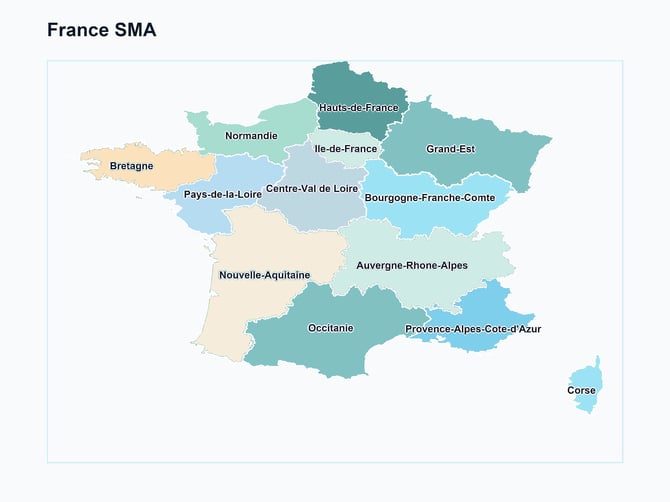
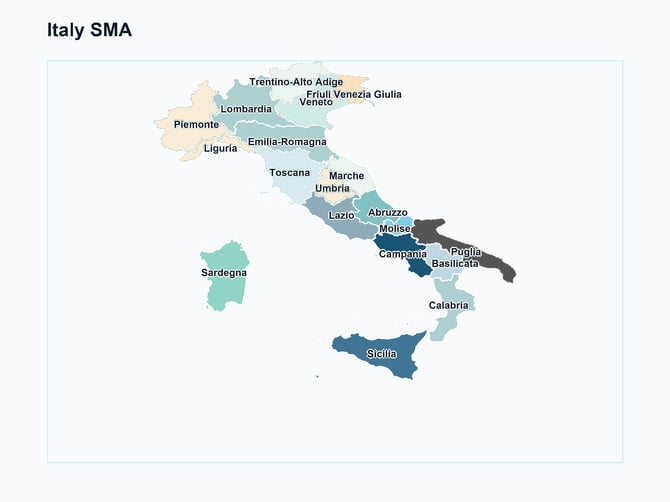
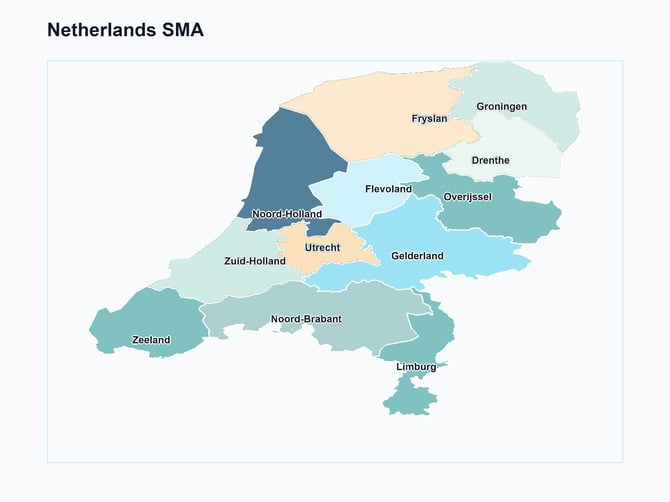
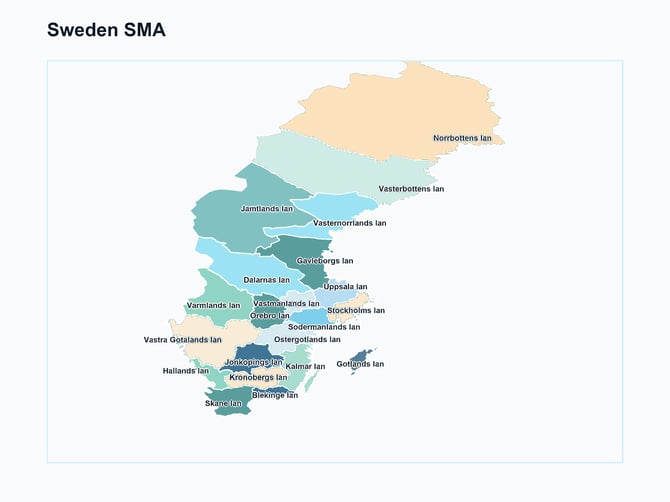
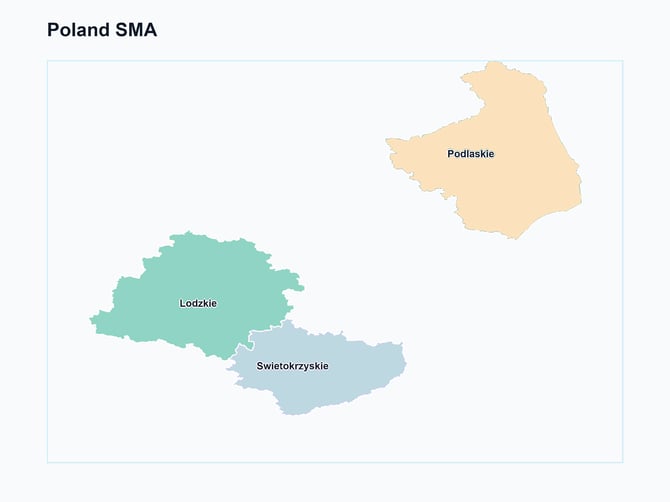
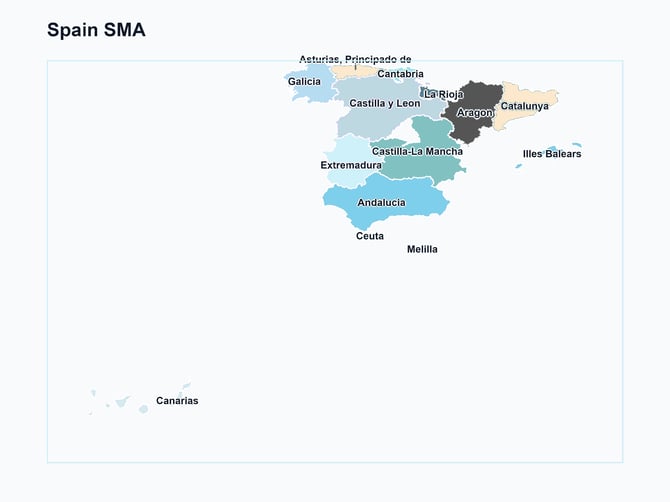
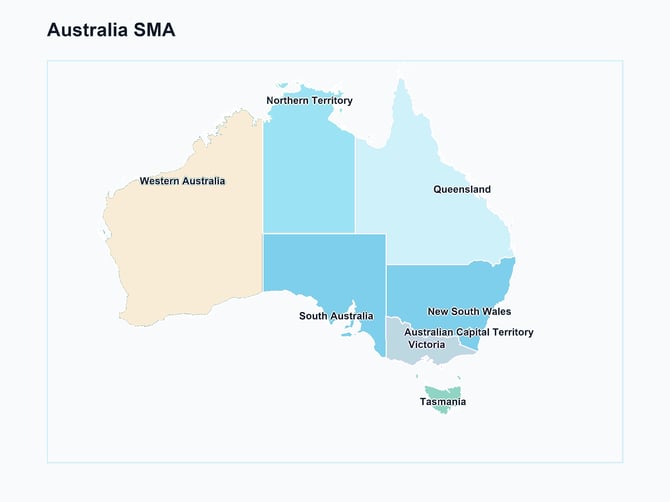
Full SMA catalog
The complete list of SMAs for all countries is available via this Google Sheet: Sellforte Market Areas Catalog
It contains one row per SMA with its SMA ID, Sellforte SMA name, original name, international name where available, SMA type and whether it belongs to the default set, plus a summary of the number of SMAs per country.
SMA definitions are maintained by Sellforte and can be updated when advertising platforms change how they report geography or when new customer needs require a different structure. The SMA ID is the stable reference: if you store or join regional data outside Sellforte, use the SMA ID rather than the name.
How SMA names are formed
SMA names are restricted to printable ASCII characters, and every name must be unique within its country. This keeps names safe to use in exports, spreadsheets, scripts and file names, regardless of keyboard or system locale. The original spelling is never lost: it is kept in a separate column of the catalog.
Names are converted from the original spelling with a fixed set of rules. Accented letters lose their accent through Unicode decomposition, so Baden-Württemberg becomes Baden-Wurttemberg, Île-de-France becomes Ile-de-France and Castilla y León becomes Castilla y Leon. Letters that have no decomposition are replaced through an explicit table: ß becomes ss, ø becomes o, æ becomes ae, ł becomes l, đ becomes d, ð becomes d and curly apostrophes become straight ones. Bracketed duplicates in source names are removed, so Galicia [Galicia] becomes Galicia. After conversion, every name is validated against the pattern ^[\x20-\x7E]+$ and checked again for uniqueness within its country, because two different original names could otherwise collapse into the same ASCII name.