


“SaaS is dead. AI is taking over.”
If you follow SaaS news at the start of 2026, this what you see in the headlines. Share prices of SaaS companies are crashing, as people have started vibe-coding software themselves.
Does this apply to Marketing Mix Modeling (MMM)? Will vibe-coding replace MMM solutions? How are MMM vendors preparing for the AI-first future?
I'll share my view on these topic in this article.
.png?width=900&height=509&name=State%20of%20AI%20in%20MMM%20Only%2013%25%20of%20Vendors%20Implementing%20AI%20(1).png)
Why Marketers Are Not Ready for “Vibe-Coded” MMM
I argue that marketers will not be adopting vibe-coded MMM models in the near future.
Firstly, wrong allocation decisions can cost companies millions. MMM is being used to guide spend allocation of companies with 10s of millions media spend, and in those settings a misinformed budget allocation decision can be costly.
Secondly, MMM is a challenging analytical problem:
- Statistically complex
- Highly sensitive to assumptions
- Prone to bias and overfitting
The analytical core needs rigor, transparency, and robustness. MMM is easy to get wrong, but very challenging to get right.
In this context, the savings from building a quick “AI-generated MMM” do not justify the risk, at least not yet.
What Is Role Of AI In MMM If “Vibe-Coded” MMM Is Not The Future
While I am cautious about AI replacing the modeling layer, I am bullish on AI enhancing the decision layer. This is the distinction many vendors miss.
Here's a few examples
1. AI for Spend Allocation and Scenario Planning
Most MMM platforms include an optimizer. But configuring optimization scenarios can be:
- Time-consuming
- Technically intimidating
- Sensitive to small parameter changes
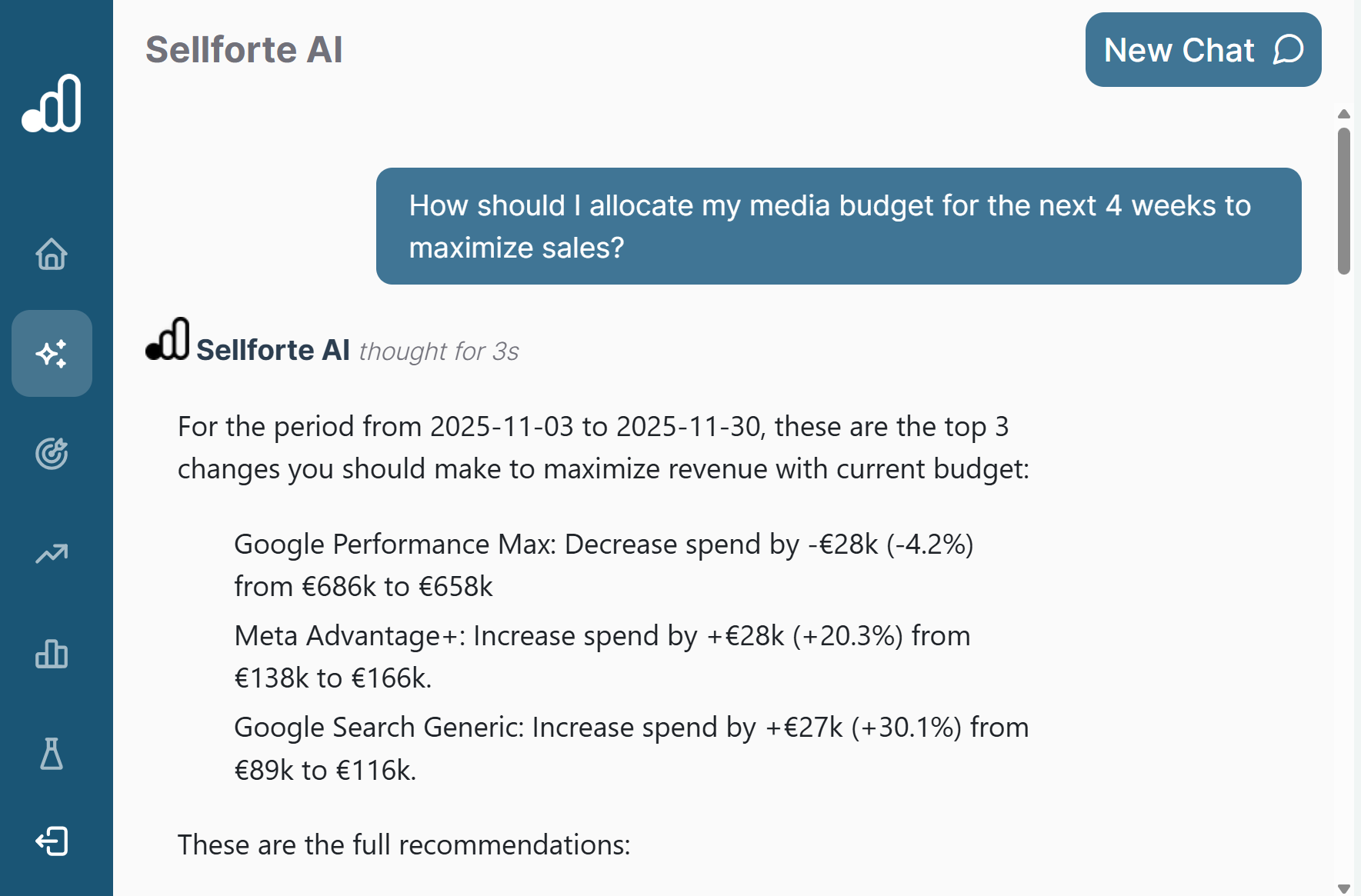
It is often easier to ask: “Given my objectives and constraints, what is the optimal spend allocation for the next four weeks?”
An AI interface can translate business language into technical configuration. Instead of manually adjusting sliders and constraints, the marketer describes the goal:
- Maintain revenue
- Reduce total spend by 10%
- Protect brand investment
- Respect channel minimums
AI can configure the scenario instantly, explain trade-offs, and even suggest alternatives.
This is a clear productivity gain without compromising model integrity.
Here's a simple examples illustrating this in the Sellforte AI.
2. The Media Buying Agent
The more exciting concept is the Media Buying Agent.
Imagine:
- MMM provides high-quality response curves and diminishing returns estimates
- The marketer defines objectives and constraints
- An AI agent continuously optimizes bids and budgets across campaigns and ad sets, operating within the guardrails defined by the MMM
Instead of static quarterly reallocation, you get dynamic optimization aligned with incrementality.
This is where AI has asymmetric upside. Not in replacing the math, but in operationalizing it.
How Is AI Adoption Progressing Among MMM vendors?
If the future of AI in MMM is not vibe-coded MMM, but it's about AI-driven spend optimization powered by robust MMM, you could imagine MMM vendors rushing to implement AI to their platforms.
I investigated this hypothesis by analysing 60 vendors, that Nico Neumann collected a vendor map in 2025 fall (Link).
I went through the websites of the vendors listed on the map, and looked for clear product evidence of AI, not marketing copy. Specifically:
- An AI interface inside the product
- An AI assistant visible in screenshots or demos
- Autonomous agents or AI-driven workflows clearly explained
- Videos showing AI in action
If I could not find concrete proof, I did not count it.
The result:
- 13% of MMM vendors were integrating AI to their platforms
- 87% had no AI in their MMM product
I even found companies with “AI” in their name that did not show any AI in their actual product. And some vendors I consider technically strong appeared publicly skeptical about AI.
I was shocked about the results: only 13% of MMM vendors are implementing MMM.
Why Is AI Adoption In MMM Only 13%?
The low adoption rate signals is likely driven by three things
-
Lack of competence: Many MMM vendors lack the competences to integrate AI MMM.
-
Lack of vision: Many MMM vendors lack the vision how to implement AI into their MMM product
-
Lack of urgency: Awareness of Agentic MMM is among marketers is still at early stages, and all of them have not yet learned to expect AI from MMM vendors
-
Skepticism around AI: Some companies are skeptical around AI, betting that it won't become relevant in MMM
Which MMM Providers Have Integrated AI Into Their Platform?
Sellforte is the leading MMM provider with AI integrated into its platform. Below is an example screenshot from Sellforte AI:
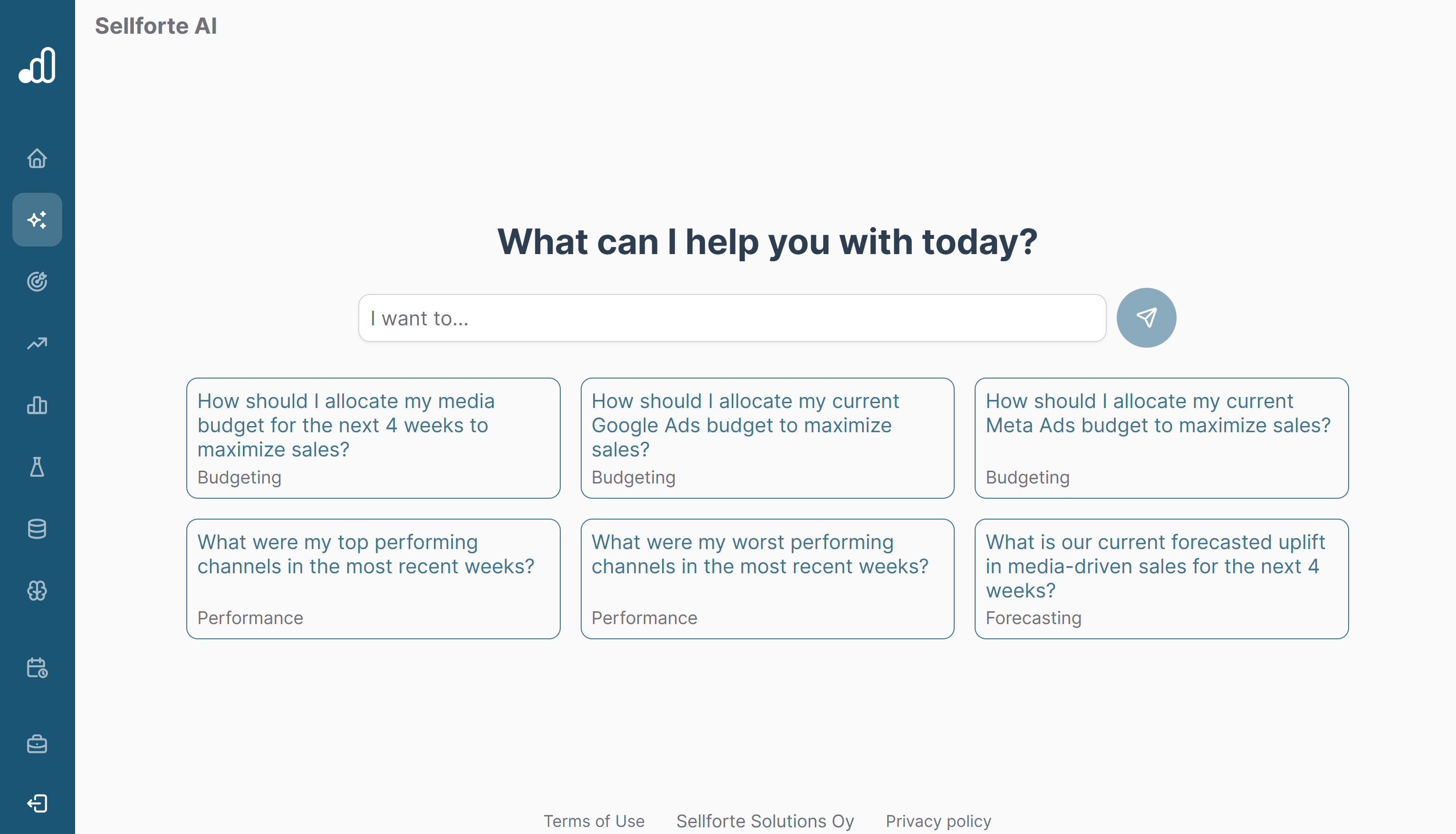
Sellforte AI includes three Agents:
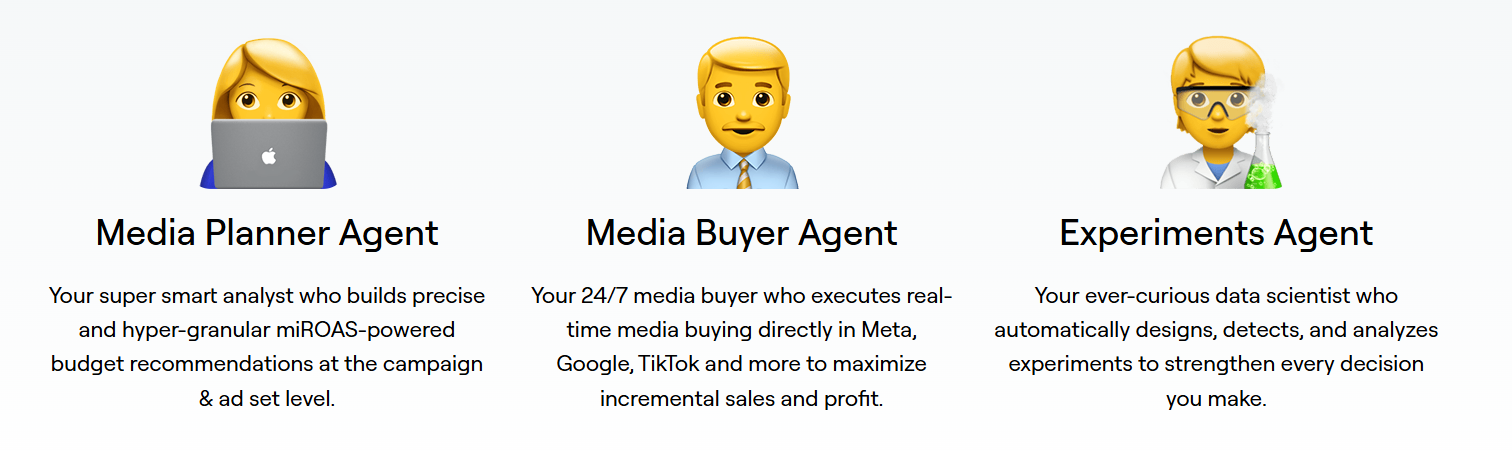
Media Planner Agent helps with all questions related to media spend optimization. It is a super smart analyst that builds precise recommendations for how to allocate budgets across channels, campaigns, and even ad sets.
Media Buyer Agent helps you execute the plans you are building with the Media Planner Agent. It will push the bid value changes directly in Google, Meta, TikTok, and other advertising platforms.
Experiments Agent is your team’s ever-curious data scientist supporting you and the two agents above. It recommends, designs and analyzes incrementality tests for you.
Other example vendors include Triple Whale and Liftlab,.
Which MMM Providers Don't Have AI In Their MMM Platform?
Example vendors who lack AI in their platform include:
- Analytics Partners
- Fospha
- Keen Decision Systems
- Measured
- Recast
- Prescient AI
- Circana
- Ipsos MMA
Does "SaaS is dead, AI is taking over" apply in MMM?
I don't think MMM as an industry is as threatened as some other SaaS categories. But I do think the AI-skeptics in MMM will be at a serious disadvantage.
Even if the modeling core remains rigorous and structured, the user experience will change.
Marketers are getting used to:
- Natural language interfaces
- Autonomous agents
- Real-time recommendations
- Reduced operational friction
If one MMM vendor allows a CMO to interact with their model conversationally and another requires complex scenario configuration, the competitive gap will widen.
Not because the underlying math is worse. But because the experience is.
What This Means for Marketers
If you are evaluating MMM solutions, I would suggest asking:
- How is AI implemented in the product today?
- Is it visible and usable, or just mentioned in marketing?
- What kind of optimization use-cases does AI support?
- Are there plans for agent-based optimization?
Agentic MMM, the combination of AI and MMM, is the next competitive frontier.
To learn more about Sellforte AI, book a demo with Sellforte.
Authors

Lauri Potka is the Chief Operating Officer at Sellforte, with over 15 years of experience in Marketing Mix Modeling, marketing measurement, and media spend optimization. Before joining Sellforte, he worked as a management consultant at the Boston Consulting Group, advising some of the world’s largest advertisers on data-driven marketing optimization. Follow Lauri in LinkedIn, where he is one of the leading voices in MMM and marketing measurement.
The Rise of Agentic MMM (Marketing Mix Modeling): How AI Is Transforming Media Optimization
How Can You Unlock the Full Potential of MMM with Campaign Dimensions?
.png)