


There are many Marketing Mix Modeling (MMM) SaaS vendors out there today, but very few consistently make the shortlist when large enterprises choose their MMM partner.
Why is the gap so wide? Because the needs of a large enterprise are fundamentally different from those of a small D2C brand.
In this article, I’ll break down exactly what it requires for an MMM platform to be considered "Enterprise-Grade", and why is Sellforte such a popular option for large retailers and ecommerce brands. We will cover the 7 requirements of an enterprise-grade MMM:
- A State-of-the-Art Product
- Ability to Model Complex Businesses
- Modeling Quality Driven by Product, Not Humans
- Comprehensive Use-Case Coverage
- Ability to Serve Diverse Stakeholders
- Credibility Proven by Enterprise References
- Enterprise-Grade IT Infrastructure
.png?width=900&height=509&name=Enterprise-grade%20in%20Marketing%20Mix%20Modeling%20(MMM).png)
1. A State-of-the-Art Product
Enterprises have professional marketing analytics teams who follow technological developments in MMM closely. They know what is possible, and they expect it.
If they don't see the latest features in your product demo, you're out of the game. Even before contacting vendors, marketing analytics professional conduct research on product capabilities. Vendors with public demos are best positioned to help them with their evaluation. You can for example test Sellforte public demo here: Link to Sellforte demo.
At the moment there's three state-of-the-art capabilities that are increasingly appearing in requirement lists by enterprises.
Campaign and Ad set Level Optimization
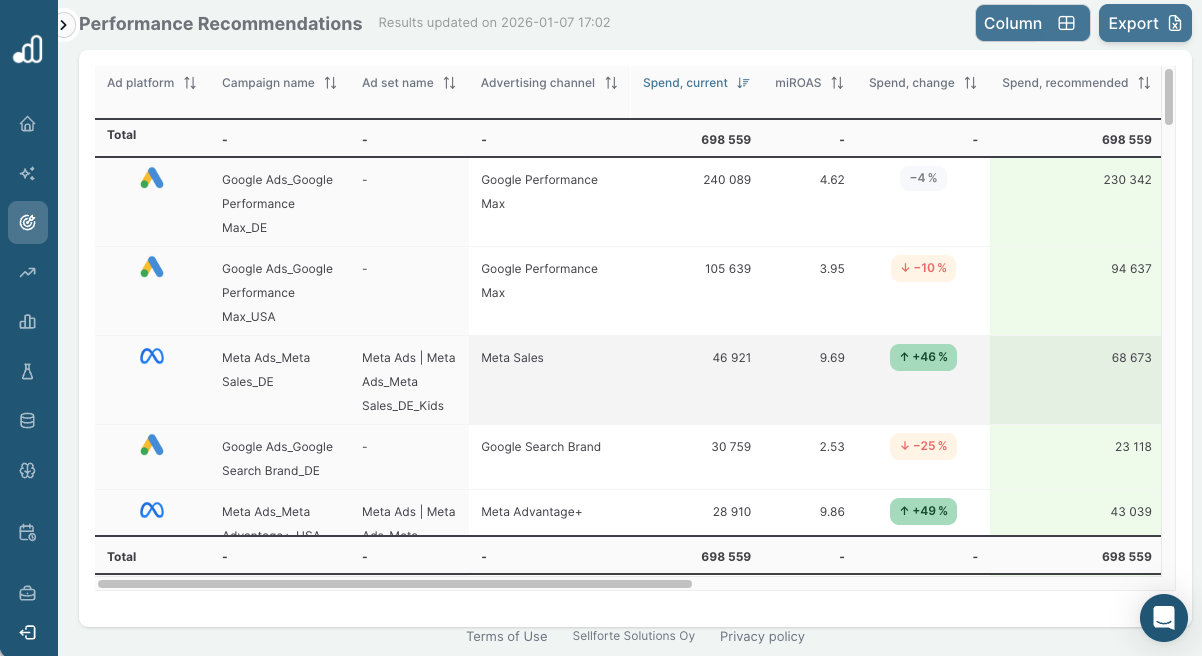
In 2025, Marketing Mix Modeling tools started offering spend optimization at the campaign and ad set level. This is a major shift from the old MMM paradigm, where spend optimization was done on the channel level, or even sometimes on ad platform level.
Today, ecommerce businesses are by default expecting to see campaign and ad set level optimization in the product when they adopt an MMM solution. This already leaves most MMM solutions out from the consideration set.
As an example, below is a screenshot of Sellforte Performance, which measures Marginal Incremental ROAS (miROAS) for each campaign and ad set, and uses miROAS to provide spend and bidding recommendations.
AI Agents
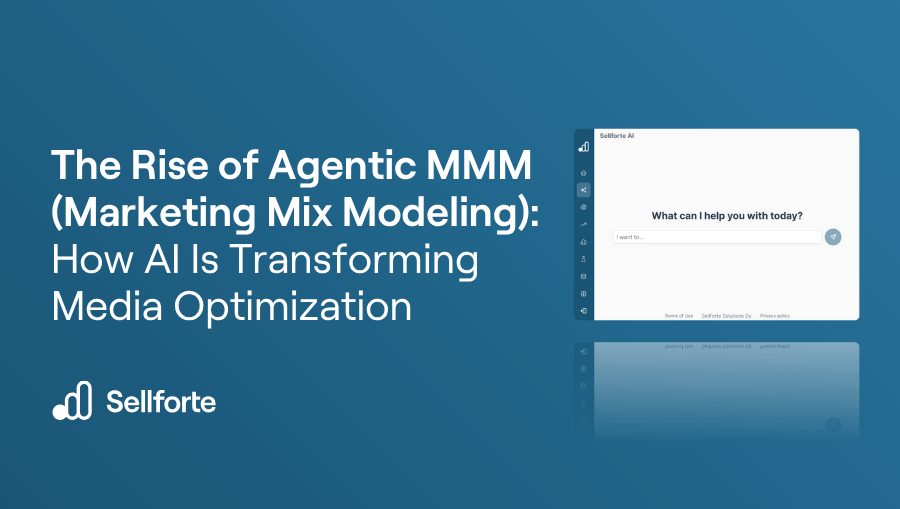
Another major development in 2025 was the rise of Agentic MMM. MMM products started integrating AI Agents into their technology stack.
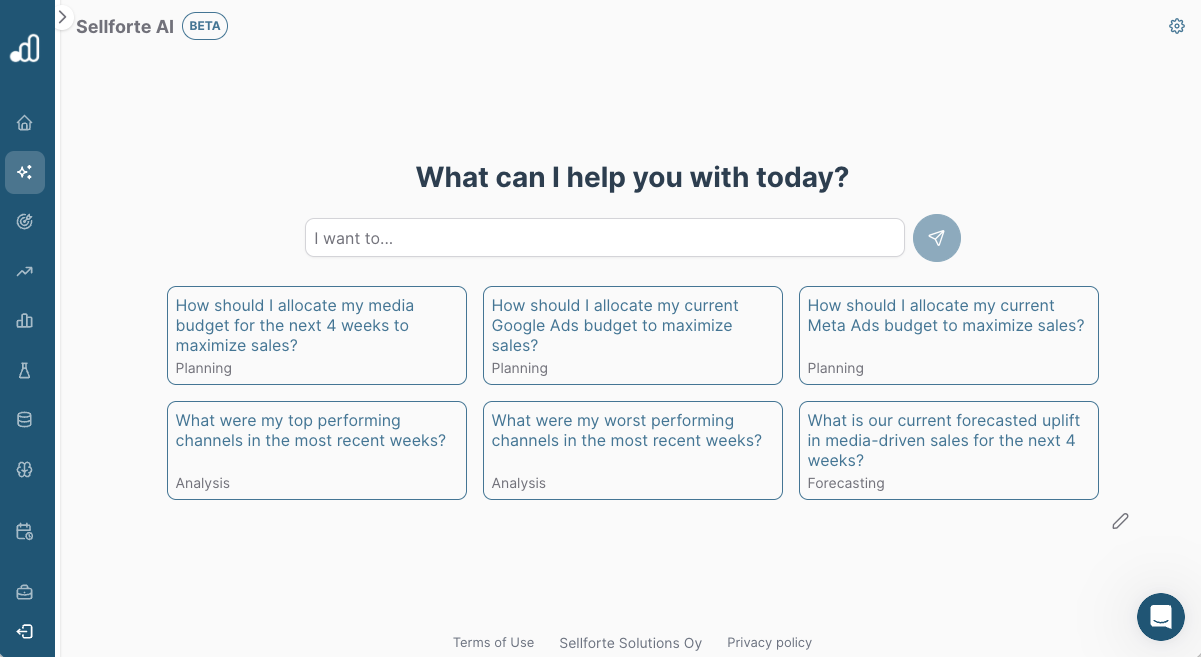
Agentic MMM combines the superpower of MMM to measure media ROI with AI Agents’ superpower to automate workflows so they can help marketers with specific tasks such as media planning, revenue forecasting, and media buying.
As an example marketer can use a chat interface to ask a Media Planner Agent help in finding an optimal spend allocation in annual or quarterly budget planning, or optimal bid values for each campaign & ad set in their weekly optimization sprint.
Below is an example for the Sellforte AI.
Analysis of Experiments and Integration with MMM
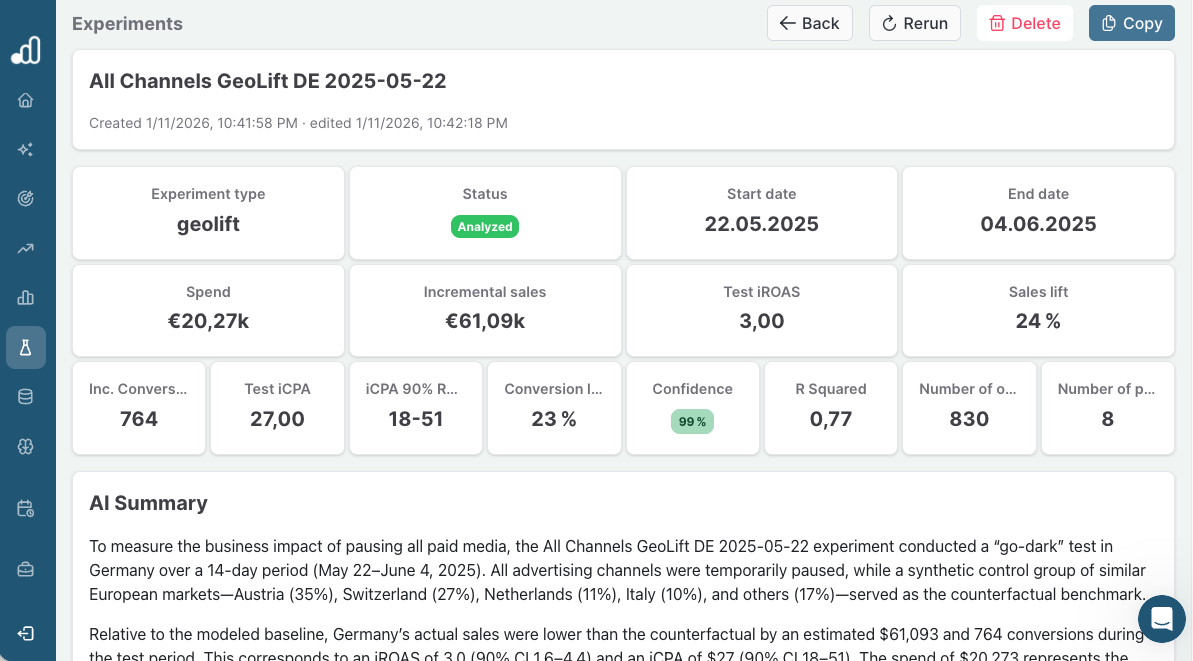
As another trend, enterprises nowadays expect their MMM tool to have capabilities to robustly analyse experiments, e.g., Geolift tests and Conversion lif tests. The tests need to be integrated with MMM to improve result quality.
Below is an example of Sellforte Experiments, summarizing geolift test results.
2. Ability to Model Complex Businesses
Enterprises are inherently complex. They typically operate across:
- Multiple sales channels: eCommerce, physical retail stores, marketplaces, wholesale, etc.
- Several countries: Each with different market dynamics.
- Full media mix: A combination of digital, traditional offline media, and own media channels.
On top of this, there is often a large number of product groups, each affected differently by seasonality, weather, promotions, and other non-media drivers.
Modeling this level of complexity robustly is not an easy task, which is why most MMM vendors focus on smaller and simpler businesses.
3. Modeling Quality Driven by Product, Not Humans
Enterprises often have billions of dollars in revenue and media budgets worth tens or hundreds of millions. In this environment, the cost of media spend optimization mistakes is extremely high. A poor media spend optimization decision leading to millions of lost revenue can lead to layoffs across the organization.
This means the quality of modeling must be exceptionally high. Crucially, this quality needs to be driven by the product, not by the choice of data scientist on the "project". The platform itself must ensure consistency and reliability.
High quality MMM has been built, tested, and improved incrementally with real-world data over time, and can be configured to each new customer in a way where 2 different data scientists conducting the implementation arrive at the same answer.
Unfortunately, many MMM SaaS companies attempting to serve enterprises are consultants in disguise, building highly customer-specific implementations where the selection of the data scientist to the project directly influences the end result. Such models are also difficult to maintain over time, as people building the model move to new roles.
4. Comprehensive Use-Case Coverage
Enterprises don't just optimize media spend once a year. They conduct optimization on multiple levels, and an Enterprise-grade MMM needs to support all of them:
- High-level Planning: Annual budget allocation across markets and brands.
- In-year optimization: Quarterly monthly optimization.
- Tactical optimization: Adjusting bidding for campaigns and ad sets on a weekly or daily basis
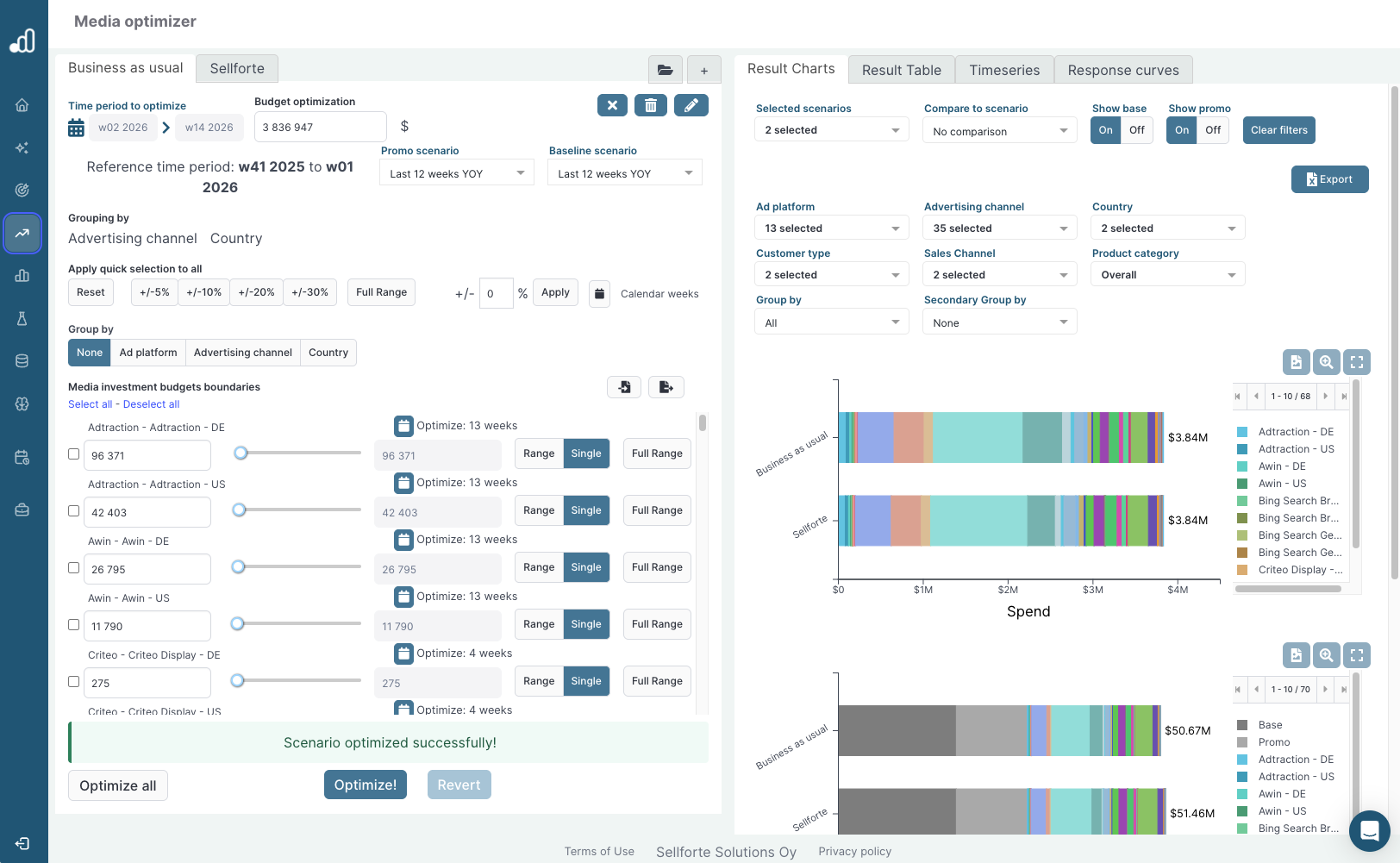
Optimization tools need to support complex scenario planning for the CMO, but also give simple, tactical guidance on how to adjust bidding for the performance marketer. This puts high demands on an MMM solution: it's much easier to build a product for just one simple use case.
Below is an example of Sellforte Optimizer, which is the most comprehensive MMM-based media budget optimization tool in the market:
5. Ability to Serve Diverse Stakeholders
The stakeholder landscape is far more complex within an enterprise.
One day, you could be explaining your product and it insights to the CEO or CFO. The next day, you could be helping a paid social media manager optimize bidding strategies in Meta.
An Enterprise-Grade customer success team is more experienced, more senior, and more rigorously trained than what you typically find in MMM SaaS companies serving smaller brands. They need to speak the language of the C-suite and the technical language of the analyst.
6. Credibility Proven by Enterprise References
Enterprises choose MMM vendors to their buying if they can see that public references that the vendor is serving customers with similar characteristics.
And enterprise buying processes are rigorous: Professional procurement teams will validate every claim in your sales pitch and they will want to see proof. This usually means a reference call with another similar enterprise customer to discuss exactly how they are using your product and the value they are getting. Having a roster of satisfied enterprise clients is the only way to pass this hurdle.
7. Enterprise-Grade IT Infrastructure
Finally, the technical foundation matters. Requirements vary, but at a minimum, you need to prove enterprise-grade data integrations (to data warehouses, ad platforms and other data sources) enterprise-grade IT Security. Enterprises also often have other requirements, such as SSO, but these depend on the policies of the specific enterprise in question.
Conclusion
Building an MMM solution for an SMB ecommerce business is one thing. Building one for an Enterprise is a completely different ballgame. It requires deep investment in product, data science, and service to handle the scale, complexity, and risk involved in enterprise decision-making.
If you are an enterprise buyer evaluating MMM vendors, use this list as your checklist. If a vendor can't tick these boxes, they might not be ready for your scale.
Ready to see enterprise-grade MMM solution in action? Book a demo with Sellforte.
Authors

Lauri Potka is the Chief Operating Officer at Sellforte, with over 15 years of experience in Marketing Mix Modeling, marketing measurement, and media spend optimization. Before joining Sellforte, he worked as a management consultant at the Boston Consulting Group, advising some of the world’s largest advertisers on data-driven marketing optimization. Follow Lauri in LinkedIn, where he is one of the leading voices in MMM and marketing measurement.
The Rise of Agentic MMM (Marketing Mix Modeling): How AI Is Transforming Media Optimization
The Shift in Marketing Mix Modeling: Why Campaign-Level Optimization is Taking Over
.png)