


Quick Verdict
Sellforte scores 39.5 out of 49 in our structured evaluation; Triple Whale scores 31 out of 49.
Triple Whale is an ecommerce-focused AI platform with a conversational AI interface called Moby AI. It scores a perfect 4 out of 4 on agentic execution and autonomy and earns the higher UX score of the two platforms at 7 out of 8. Its main limitations are a lighter analytical backbone compared to full-scale MMM providers, limited causal explanation of past performance, no campaign and ad set-level incrementality measurement and optimization, and significant enterprise platform gaps.
Sellforte is the broader platform: it covers campaign and ad set-level optimization based on true incrementality, all three incrementality test types (geo, A/B, and conversion lift), a fully integrated and calibrated MMM, and meets enterprise IT requirements that Triple Whale does not address.
If you are a small or mid-sized DTC or ecommerce brand that prioritizes agentic execution, a polished conversational UX, and does not yet require enterprise-grade MMM or campaign-level incrementality optimization, Triple Whale is a strong fit. If you need campaign and ad set-level spend and bid optimization grounded in true incrementality, a calibrated MMM with model auditability, incrementality testing, or enterprise-grade IT compliance, Sellforte is the stronger choice.
Introduction and Table of Contents
.png?width=900&height=509&name=Triple%20Whale%20vs%20Sellforte%20Conversational%20AI%20tools%20for%20MMM%20and%20Incrementality%20testing%20compared%20(2026).png)
This article compares Triple Whale and Sellforte head-to-head on conversational AI capabilities for MMM and incrementality testing, using the same 49-criterion framework we developed for our in-depth comparison of all major vendors in this category. Here is what we are covering in this article:
- Quick Verdict
- How We Evaluated
- About the Vendors
- Side-by-Side Scorecard
- Category-by-Category Breakdown
- Marketing Data Reporting via Conversational AI
- Historical Performance Insights and Causal Explanation via Conversational AI
- Channel-Level Optimization with Conversational AI
- Campaign and Ad Set-Level Optimization with Conversational AI
- Incrementality Testing with Conversational AI
- Agentic Execution and Autonomy
- AI UX and Conversational Interface
- Analytical Backbone
- Enterprise-Grade Platform
- Where Triple Whale Wins
- Where Sellforte Wins
- Which Should You Choose?
- Frequently Asked Questions
How We Evaluated
Both platforms are scored against the same 49-criterion, 9-category framework developed for our in-depth comparison of AI tools for MMM and Incrementality Testing in 2026. The criteria and the methodology behind them are presented in full in How to Choose an AI Tool for MMM and Incrementality Testing: 49 Evaluation Criteria. They were derived from more than 1,660 real AI prompts and 700 discussions with marketers and marketing analytics professionals across retail, ecommerce, DTC, travel, and restaurants.
Each criterion is scored 1 (fully supported), 0.5 (partially supported or inconclusive evidence), or 0 (not supported or no public evidence found). Scores are based on public first-party vendor documentation, vendor-disclosed information on third-party platforms, and third-party review sites. Absence of evidence counted as 0.
About the Vendors
About Triple Whale
Triple Whale is an ecommerce analytics and measurement platform built primarily for DTC and ecommerce brands, with a conversational AI interface called Moby AI.
Triple Whale provides a conversational AI layer that spans marketing data reporting, historical performance insights, channel-level spend optimization, and agentic execution. Moby AI supports budget and bidding changes pushed directly to Meta, Google, and TikTok APIs, with configurable autonomy levels from insight-only to fully autonomous execution. Triple Whale's analytical backbone includes a Bayesian MMM calibrated with incrementality tests, though the model configuration is less transparent than full-scale MMM providers.
About Sellforte
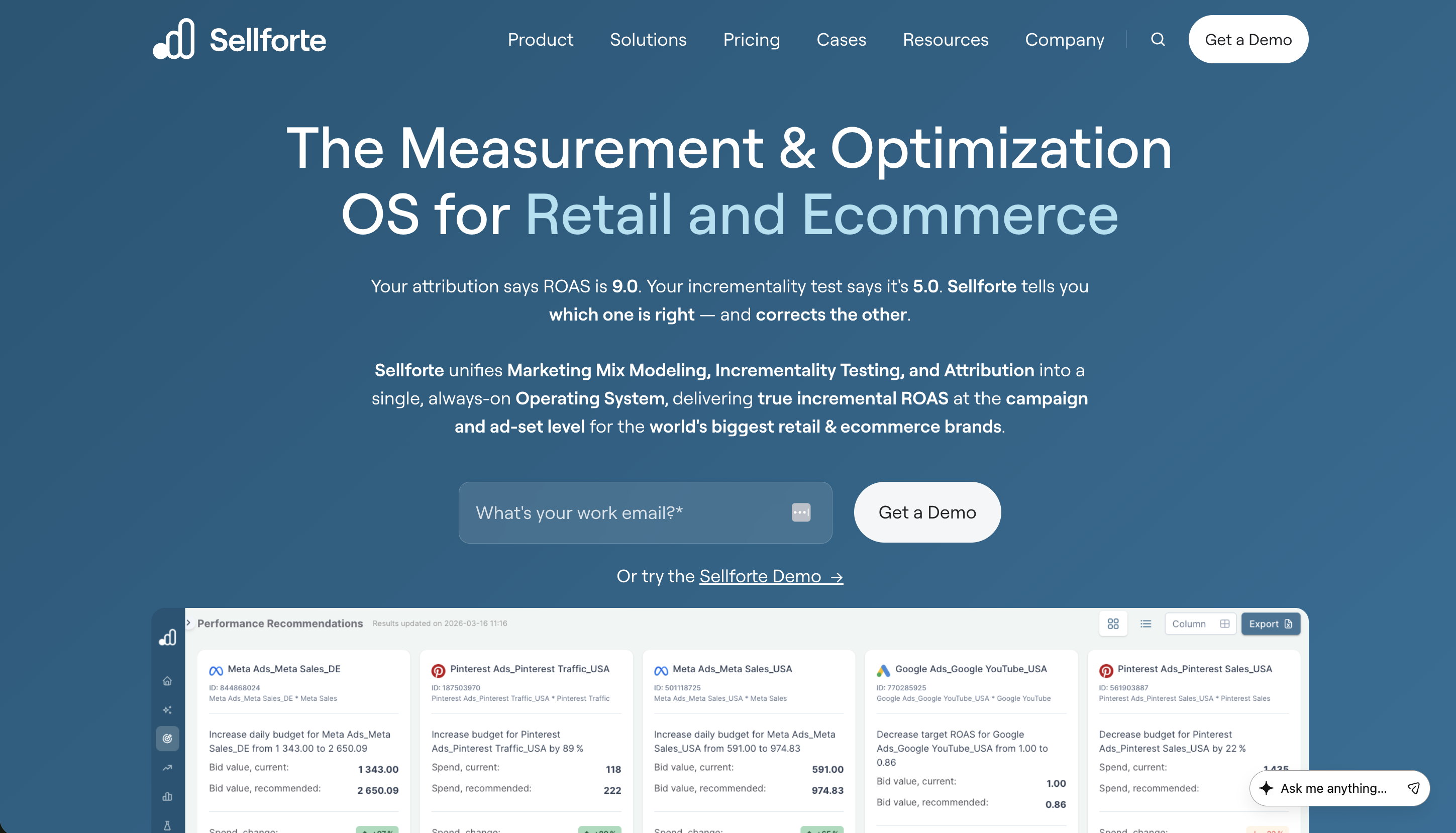
Sellforte is a SaaS platform that unifies Marketing Mix Modeling, Incrementality Testing, and Attribution into a single operating system for retail and ecommerce, with a conversational AI interface covering the full stack.
Unlike most other measurement vendors, Sellforte measures incremental ROAS at the campaign and ad set level, providing spend and bidding recommendations for tactical budget steering. Conversational AI is one major component of the Sellforte platform, alongside Marketing Mix Modeling, incrementality testing, and incrementality-corrected attribution. Sellforte is used by enterprise retailers and ecommerce brands including bonprix, Lidl, C&A, Douglas, and Tchibo. Sellforte's conversational AI can be evaluated through a public demo at demo.sellforte.com without a sales call.
Side-by-Side Scorecard
| Category | Triple Whale | Sellforte |
|---|---|---|
| 1. Marketing Data Reporting via Conversational AI | 3 / 4 | 4 / 4 |
| 2. Historical Performance Insights and Causal Explanation via Conversational AI | 2 / 5 | 5 / 5 |
| 3. Channel-Level Optimization with Conversational AI | 4 / 5 | 4.5 / 5 |
| 4. Campaign and Ad Set-Level Optimization with Conversational AI | 1.5 / 6 | 4 / 6 |
| 5. Incrementality Testing with Conversational AI | 4.5 / 6 | 2.5 / 6 |
| 6. Agentic Execution and Autonomy | 4 / 4 | 2 / 4 |
| 7. AI UX and Conversational Interface | 7 / 8 | 6.5 / 8 |
| 8. Analytical Backbone | 3 / 4 | 4 / 4 |
| 9. Enterprise-Grade Platform | 2 / 7 | 7 / 7 |
| Total score out of 49 | 31 | 39.5 |
Category-by-Category Breakdown
1. Marketing Data Reporting via Conversational AI (Triple Whale: 3/4, Sellforte: 4/4)
| Criterion | Triple Whale | Sellforte |
|---|---|---|
| 1.1 AI reports sales progress for online sales | 1 | 1 |
| 1.2 AI reports sales progress for offline store sales | 0.5 | 1 |
| 1.3 AI reports digital media data (spend, impressions, clicks) | 1 | 1 |
| 1.4 AI reports offline media data | 0.5 | 1 |
| Category total | 3 / 4 | 4 / 4 |
Sellforte takes a narrow lead here, scoring a perfect 4 out of 4 against Triple Whale's 3 out of 4. Both platforms surface online sales data and digital media KPIs across major paid channels through their conversational AI interfaces. Sellforte also covers offline store sales and offline media data in full, while Triple Whale provides partial coverage of both. For purely DTC or ecommerce brands with no offline presence, this gap is unlikely to be a deciding factor. For omnichannel retailers with a mix of online and in-store business, Sellforte's full offline coverage is meaningful.
2. Historical Performance Insights and Causal Explanation via Conversational AI (Triple Whale: 2/5, Sellforte: 5/5)
| Criterion | Triple Whale | Sellforte |
|---|---|---|
| 2.1 AI measures incremental ROAS and incremental revenue for each digital channel | 1 | 1 |
| 2.2 AI measures incremental ROAS and incremental revenue for each offline channel | 0.5 | 1 |
| 2.3 AI-reported incremental ROAS is updated daily | 0 | 1 |
| 2.4 AI reports promotion-driven revenue, in addition to media-driven | 0 | 1 |
| 2.5 AI explains why performance has changed (promotions, seasonality, weather, saturation) | 0.5 | 1 |
| Category total | 2 / 5 | 5 / 5 |
This is one of the sharpest gaps in the comparison. Sellforte scores a perfect 5 out of 5, while Triple Whale scores 2 out of 5.
Triple Whale reports incremental ROAS for digital channels and partially covers offline channels, but its underlying Marketing Mix Model is not updated daily, so incremental ROAS is not available on a daily cadence. The AI also does not surface promotion-driven revenue separately from media-driven revenue, and its ability to tie performance changes to specific causal drivers such as promotions, pricing, seasonality, or weather is limited.
Sellforte matches or exceeds Triple Whale on every criterion in this category. Its AI reports incremental ROAS and incremental revenue for both digital and offline channels, updates those measurements daily, surfaces promotion-driven revenue alongside media-driven revenue, and explains performance changes by tying them to specific causal drivers. For buyers whose use case centers on understanding why performance moved and what drove a sales decline or increase, Sellforte provides a substantially more complete answer.
3. Channel-Level Optimization with Conversational AI (Triple Whale: 4/5, Sellforte: 4.5/5)
| Criterion | Triple Whale | Sellforte |
|---|---|---|
| 3.1 AI recommends optimal budget allocation by channel | 1 | 1 |
| 3.2 AI forecasts total revenue based on optimal budget allocation | 1 | 1 |
| 3.3 AI provides miROAS and response curves for each channel | 0 | 0.5 |
| 3.4 AI supports basic custom scenario planning (e.g., "what if I cut Meta by 20%?") | 1 | 1 |
| 3.5 AI supports advanced scenario planning in natural language (constraints, multi-dimensional optimization) | 1 | 1 |
| Category total | 4 / 5 | 4.5 / 5 |
Both platforms perform strongly on channel-level optimization, with Sellforte at 4.5 out of 5 and Triple Whale at 4 out of 5. Both recommend optimal budget allocation across channels, forecast total revenue under the recommended allocation, and support basic and advanced scenario planning in natural language including constraints and multi-dimensional optimization.
The single gap for Triple Whale is the absence of marginal incremental ROAS (miROAS) and saturation response curves surfaced through the conversational AI interface. Sellforte earns partial credit on the same criterion. For most channel-level planning workflows this is not decisive, and both platforms are strong options in this category.
4. Campaign and Ad Set-Level Optimization with Conversational AI (Triple Whale: 1.5/6, Sellforte: 4/6)
| Criterion | Triple Whale | Sellforte |
|---|---|---|
| 4.1 AI provides incremental ROAS of each campaign and ad set | 0 | 1 |
| 4.2 AI compares incremental ROAS to last-click and ad platform attribution ROAS | 0 | 1 |
| 4.3 AI provides miROAS for each campaign and ad set | 0 | 0.5 |
| 4.4 AI recommends optimal spend for each campaign and ad set | 1 | 0.5 |
| 4.5 AI recommends optimal bid value for each campaign and ad set | 0.5 | 0.5 |
| 4.6 AI provides pre/post analysis for each bidding change | 0 | 0.5 |
| Category total | 1.5 / 6 | 4 / 6 |
This category reveals a fundamental difference in how the two platforms approach campaign-level execution. Triple Whale scores 1.5 out of 6. While its conversational AI can recommend optimal spend per campaign and partially covers bid recommendations, they are not based on incrementality, as Triple Whale does not measure incremental ROAS or miROAS at the campaign and ad set level. Without campaign-level incrementality measurement, spend and bid recommendations are not grounded in true incremental impact, and there is no pre/post analysis to evaluate whether executed bidding changes actually drove incremental revenue.
Sellforte scores 4 out of 6. Its AI surfaces incremental ROAS for each campaign and ad set, compares it to last-click and platform-reported ROAS, and provides partial coverage of miROAS, spend recommendations, bid recommendations, and pre/post analysis at the campaign and ad set level. The practical implication is significant: a budget shift from Meta to TikTok at the channel level is not actionable until it is translated into specific bid and spend changes across individual campaigns and ad sets. Sellforte enables that translation step grounded in incremental measurement; Triple Whale's campaign-level optimization operates without it.
5. Incrementality Testing with Conversational AI (Triple Whale: 4.5/6, Sellforte: 2.5/6)
| Criterion | Triple Whale | Sellforte |
|---|---|---|
| 5.1 Summarizes all incrementality tests done by the company | 0.5 | 0.5 |
| 5.2 Provides in-depth report for geo tests | 1 | 0.5 |
| 5.3 Provides in-depth report for own media A/B tests | 0 | 0.5 |
| 5.4 Provides in-depth report for Conversion Lift tests | 1 | 0.5 |
| 5.5 Provides testing recommendations on which channels to test | 1 | 0.5 |
| 5.6 Provides test design recommendations | 1 | 0 |
| Category total | 4.5 / 6 | 2.5 / 6 |
This is the one category where Triple Whale leads clearly, scoring 4.5 out of 6 against Sellforte's 2.5 out of 6. Triple Whale's Moby AI provides in-depth reporting for geo tests and conversion lift tests through the conversational interface, recommends which channels to test next based on prior results, and provides test design guidance. Own media A/B test reporting is the main gap. Both platforms partially support summarizing the full library of incrementality tests done by the company.
Sellforte scores 2.5 out of 6 in this category. This reflects the fact that Sellforte's broader incrementality testing platform capabilities are still being progressively integrated into the conversational AI interface, with full integration expected during 2026. The underlying Sellforte platform does cover geo tests, A/B tests, and conversion lift tests with a unified experiment library, and the MMM is calibrated with incrementality tests. Buyers who evaluate the broader Sellforte platform rather than just the current AI interface will find these capabilities available today.
6. Agentic Execution and Autonomy (Triple Whale: 4/4, Sellforte: 2/4)
| Criterion | Triple Whale | Sellforte |
|---|---|---|
| 6.1 AI can push budget and bidding changes to Meta, Google, and TikTok APIs | 1 | 0.5 |
| 6.2 AI's level of autonomy for execution can be configured | 1 | 0.5 |
| 6.3 AI has specialized agents for distinct workflows | 1 | 1 |
| 6.4 Proactive insights and alerts via AI | 1 | 0 |
| Category total | 4 / 4 | 2 / 4 |
Triple Whale earns a perfect 4 out of 4 in this category. Its AI can push budget and bidding changes directly to Meta, Google, and TikTok APIs, supports a configurable spectrum from insight-only to fully autonomous execution, runs specialized agents for distinct workflows, and proactively surfaces anomalies and scheduled reports via Slack and email. For teams that want the AI to act, not just advise, Triple Whale is the stronger platform in this comparison on agentic execution.
Sellforte scores 2 out of 4. It has distinct specialized agents for planning, buying, and experimentation workflows, and partially supports ad platform API execution and configurable autonomy levels, with full autonomous agent capabilities yet to be announced. Sellforte does not currently offer proactive alerting via Slack or email through the conversational AI interface. The key distinction between the two platforms is that Triple Whale's agentic execution operates without campaign-level incrementality grounding, while Sellforte's partial agentic capabilities are built on top of incremental ROAS measurement at the campaign and ad set level.
7. AI UX and Conversational Interface (Triple Whale: 7/8, Sellforte: 6.5/8)
| Criterion | Triple Whale | Sellforte |
|---|---|---|
| 7.1 Includes tables and charts inline in AI responses | 1 | 1 |
| 7.2 AI has conversation history and multi-turn context retention | 1 | 1 |
| 7.3 Allows convenient export of AI outputs (e.g., PDF, Slides, CSV) | 0.5 | 0.5 |
| 7.4 AI grounds answers in data, providing links from outputs to deep-dive dashboards | 1 | 1 |
| 7.5 AI operates in embedded and multi-window mode (chat and dashboard side-by-side) | 1 | 1 |
| 7.6 AI shows its reasoning steps and logic while answering | 1 | 1 |
| 7.7 AI handles non-English questions in production | 0.5 | 1 |
| 7.8 AI can be accessed via MCP server or external LLM | 1 | 0 |
| Category total | 7 / 8 | 6.5 / 8 |
Both platforms offer a strong conversational experience, with Triple Whale scoring 7 out of 8 and Sellforte close behind at 6.5 out of 8. The two platforms share the same score on most criteria: inline tables and charts, multi-turn context retention, deep links from AI outputs to dashboards, side-by-side embedded mode, reasoning steps shown while answering, and partial export capabilities.
The differences are on two criteria. Triple Whale exposes data via MCP server, allowing external LLMs such as Claude and ChatGPT to query it directly, which Sellforte does not currently offer. Sellforte supports at least five major languages in production, which is a meaningful differentiator for multi-country retail and ecommerce organizations, while Triple Whale has only partial multilingual support. Both platforms earn partial credit on export convenience. For single-language DTC brands, the practical difference between the two in this category is small. For multi-country retailers, Sellforte's multilingual production support is a relevant advantage.
8. Analytical Backbone (Triple Whale: 3/4, Sellforte: 4/4)
| Criterion | Triple Whale | Sellforte |
|---|---|---|
| 8.1 AI provides deterministic, model-backed answers with Bayesian MMM as backbone | 1 | 1 |
| 8.2 Bayesian MMM used by the AI is calibrated with incrementality tests | 1 | 1 |
| 8.3 AI reports model validation and other modelling KPIs | 1 | 1 |
| 8.4 Model calibration and configuration settings (e.g., priors) are auditable and editable in a self-serve UI | 0 | 1 |
| Category total | 3 / 4 | 4 / 4 |
Both platforms are backed by a Bayesian MMM calibrated with incrementality tests, and both report model validation KPIs. Triple Whale scores 3 out of 4; Sellforte scores a perfect 4 out of 4.
The single gap is model auditability: Triple Whale's model calibration and configuration settings, such as priors, are not auditable or editable in a self-serve UI. Customers cannot inspect or adjust the assumptions behind the AI's recommendations. Sellforte offers full transparency and self-serve editability of model priors and calibration parameters. For enterprise analytics and data science teams that want to configure and verify the model assumptions driving the AI's optimization recommendations, Sellforte's model transparency is a meaningful differentiator. For smaller brands that are less likely to require model-level inspection, the practical impact of this gap is smaller.
9. Enterprise-Grade Platform (Triple Whale: 2/7, Sellforte: 7/7)
| Criterion | Triple Whale | Sellforte |
|---|---|---|
| 9.1 At least 10 public reference customers from $1B+ revenue brands | 0 | 1 |
| 9.2 SOC 2, ISO 27001, or audited IT security by a third-party cyber security auditor | 1 | 1 |
| 9.3 Data residency: geography option between US and EU | 0 | 1 |
| 9.4 Multi-cloud: option between AWS, GCP, and Azure | 0 | 1 |
| 9.5 Supports single sign-on (SSO) for enterprises | 0 | 1 |
| 9.6 Customer data is not shared to a third-party LLM (LLM deployed in customer-specific cloud container) | 0 | 1 |
| 9.7 Hands-on demo or trial of the AI is available without sales-call gating | 1 | 1 |
| Category total | 2 / 7 | 7 / 7 |
This is the widest gap in the comparison. Triple Whale scores 2 out of 7 on enterprise-grade platform criteria, and Sellforte scores a perfect 7 out of 7.
Triple Whale holds SOC 2 compliance and provides a public hands-on trial, both of which are meaningful baseline credentials. However, we could not confirm SSO support for enterprise authentication, customer data isolation from third-party LLM APIs, US or EU data residency options, multi-cloud deployment, or a strong list of public reference customers from $1B+ revenue brands.
Sellforte scores a perfect 7 out of 7. It has a strong list of public $1B+ revenue reference customers, holds IT security certification, offers both US and EU data residency options, supports multi-cloud deployment across AWS, GCP, and Azure, supports SSO, runs LLM inference inside isolated customer-specific cloud infrastructure so customer data does not egress to third-party LLMs, and provides a public hands-on demo without a sales call. For organizations operating under enterprise procurement policies, particularly multi-region organizations or brands with strict data governance requirements, Triple Whale's gaps on SSO, data residency, LLM data isolation, and multi-cloud deployment are likely to create procurement blockers.
Where Triple Whale Wins
Triple Whale's strongest areas are agentic execution, conversational UX, and incrementality testing through the conversational interface. It scores a perfect 4 out of 4 on agentic execution and autonomy, with the ability to push budget and bidding changes directly to Meta, Google, and TikTok APIs, configurable autonomy levels, specialized agents for distinct workflows, and proactive alerting via Slack and email.
Triple Whale also earns the highest UX score in the comparison at 7 out of 8, with inline charts and tables, multi-turn context retention, reasoning steps shown while answering, side-by-side embedded mode, deep links to dashboards, and MCP server access for external LLMs. On incrementality testing specifically through the conversational AI, Triple Whale scores 4.5 out of 6, covering geo test reporting, conversion lift test reporting, testing recommendations, and test design guidance, placing it well above Sellforte's current 2.5 out of 6 in that category. For teams that want their AI to act autonomously and that use their platform heavily for incrementality test analysis through a chat interface, Triple Whale is ahead today.
Where Sellforte Wins
Sellforte's advantage is its campaign and ad set-level optimization grounded in true incrementality, its analytical backbone, causal explanation of past performance, and enterprise-grade platform. It covers all nine evaluated categories without the wide zero-score gaps that affect Triple Whale in enterprise and campaign-level measurement, and leads substantially in the categories that matter most for large enterprise marketing teams.
The gaps are most pronounced in four areas. On historical performance insights and causal explanation, Triple Whale scores 2 out of 5 while Sellforte scores a perfect 5 out of 5: Sellforte's AI reports incremental ROAS updated daily, surfaces promotion-driven revenue, and explains performance changes through specific causal drivers, none of which Triple Whale fully covers. On campaign and ad set-level optimization, Triple Whale scores 1.5 out of 6 while Sellforte scores 4 out of 6, with the key distinction being that Sellforte measures incremental ROAS at the campaign and ad set level and grounds its optimization recommendations in that measurement. On enterprise-grade platform, Triple Whale scores 2 out of 7 while Sellforte scores a perfect 7 out of 7. On analytical backbone, Triple Whale scores 3 out of 4 while Sellforte scores a perfect 4 out of 4, with model auditability and editability the differentiating criterion.
Which Should You Choose?
Choose Triple Whale if: you are a small or mid-sized DTC or ecommerce brand that prioritizes agentic execution and a polished conversational UX, you want the AI to proactively surface anomalies and push bidding changes autonomously to ad platforms, and enterprise IT requirements such as SSO, data residency, multi-cloud deployment, and LLM data isolation are not procurement considerations.
Choose Sellforte if: you need campaign and ad set-level spend and bid optimization grounded in true incrementality measurement, you require a calibrated MMM with auditable and configurable model priors, and you want the AI to explain why performance changed using causal drivers including promotions, seasonality, and weather. Sellforte is also the stronger fit if you operate across multiple countries and need multilingual AI support, if you run incrementality tests and want them integrated into the full measurement platform, or if your organization requires multi-region data residency, multi-cloud deployment, SSO, and LLM data isolation for enterprise procurement approval. Sellforte is the stronger fit for retail and ecommerce organizations with large enterprise IT requirements or teams that need optimization recommendations grounded in campaign-level incremental ROAS.
Frequently Asked Questions
What is Triple Whale used for?
Triple Whale is an ecommerce analytics and measurement platform with a conversational AI interface called Moby AI. Its primary strengths are agentic execution (pushing budget and bidding changes to ad platform APIs), a high-quality conversational UX, and incrementality test reporting through the chat interface. It covers marketing data reporting, channel-level optimization, and proactive alerting via Slack and email. Its main limitations relative to full-scale MMM providers are a lighter analytical backbone without auditable model configuration, limited causal explanation of past performance, and the absence of campaign-level incrementality measurement.
Does Triple Whale measure incremental ROAS at the campaign and ad set level?
No. Based on our evaluation of publicly available documentation, Triple Whale does not measure incremental ROAS or marginal incremental ROAS (miROAS) at the campaign and ad set level through its conversational AI. It can recommend optimal spend per campaign and partially covers bid recommendations, but those recommendations are not grounded in campaign-level incrementality measurement. Sellforte covers incremental ROAS measurement at the campaign and ad set level through its conversational AI interface.
Can Triple Whale push bidding changes to Meta, Google, and TikTok?
Yes. Triple Whale's Moby AI supports pushing budget and bidding changes directly to Meta, Google, and TikTok APIs, with a configurable autonomy spectrum from insight-only to fully autonomous execution and proactive alerting via Slack and email. This is Triple Whale's most distinctive capability and the area where it scores highest in this comparison.
Is Triple Whale good for enterprise?
Triple Whale holds SOC 2 compliance and provides a 30-day trial, which are meaningful baseline credentials. However, it scores 2 out of 7 on our enterprise platform criteria. We could not confirm SSO support, customer data isolation from third-party LLM APIs, US and EU data residency options, multi-cloud deployment across AWS, GCP, and Azure, or a strong list of public reference customers from $1B+ revenue brands. Organizations with strict data governance requirements or multi-region operations should verify whether these gaps create procurement blockers before committing to Triple Whale.
How does Triple Whale compare to Sellforte on channel-level optimization specifically?
The two platforms are close in this category, with Sellforte scoring 4.5 out of 5 and Triple Whale scoring 4 out of 5. Both recommend optimal budget allocation across channels, forecast total revenue under the recommended allocation, and support basic and advanced scenario planning in natural language. Sellforte earns a slight edge by providing partial coverage of marginal incremental ROAS and response curves through the conversational interface. For buyers whose primary need is channel-level optimization, the difference between the two is small.
What are the best Triple Whale alternatives?
The closest alternatives depend on your priorities. Sellforte covers a broader set of capabilities including campaign-level incrementality optimization, a calibrated MMM with model auditability, and a full enterprise platform. Mutinex is a strong option for channel-level spend optimization for large enterprises but lacks campaign-level optimization and incrementality testing. Lifesight covers channel-level optimization with an incrementality-calibrated MMM. For teams specifically seeking incrementality testing platforms, Haus and Measured are also worth evaluating.
Triple Whale vs Sellforte: which is better for DTC brands?
The answer depends on the scale and measurement maturity of the DTC brand. Triple Whale is the stronger fit for smaller DTC brands that prioritize agentic execution, a polished conversational UX, and do not yet require enterprise-grade MMM with model-level auditability or campaign-level incrementality measurement. Sellforte is the stronger fit for mid-market and enterprise DTC brands that need optimization recommendations grounded in true campaign-level incremental ROAS, a calibrated MMM, and enterprise IT compliance. Both platforms offer a hands-on trial or demo without a sales call.
Is Triple Whale's MMM calibrated with incrementality tests?
Yes. Based on publicly available information, Triple Whale's Bayesian MMM is calibrated with incrementality tests. This is a meaningful strength. However, unlike Sellforte, Triple Whale does not expose model calibration settings, priors, or configuration parameters in a self-serve UI, so customers cannot inspect or adjust the assumptions behind the AI's recommendations. For teams that want to configure and verify the model assumptions driving optimization, Sellforte offers more transparency and control.
Further Reading
7 Best AI Tools for MMM and Incrementality Testing in 2026: An In-Depth Comparison
The Rise of Agentic MMM: How AI Is Transforming Media Optimization
What is Incrementality Testing? Guide for Marketers
Marginal Incremental ROAS (miROAS): What is it? And why does it matter to marketers?
Commentary
Snapshot in time. Vendor capabilities evolve quickly. This comparison reflects publicly available information at the time of publication.
Corrections welcome. We will revise this comparison as new information becomes available. If a vendor believes a score is inaccurate, we welcome corrections with supporting documentation. Please email sales@sellforte.com.
Recommendation for buyers. Use this comparison as a structured starting point for your own evaluation, not as a final answer. We recommend conducting evaluation calls or demos with the vendors to verify fit against your organization's specific requirements.
Authors

Lauri Potka is the Chief Operating Officer at Sellforte, with over 15 years of experience in Marketing Mix Modeling, marketing measurement, and media spend optimization. Before joining Sellforte, he worked as a management consultant at the Boston Consulting Group, advising some of the world's largest advertisers on data-driven marketing optimization. Follow Lauri in LinkedIn, where he is one of the leading voices in MMM and marketing measurement.

Emil Kauppi-Hoyer is Sellforte's Lead AI Engineer, leading the development of Sellforte AI. With a data science background, Emil belongs to Sellforte's engineering leadership. During his Sellforte career, Emil has implemented Marketing Mix Models and incrementality testing solutions to Sellforte's customers, while at the same time developing Sellforte's AI capabilities. Follow Emil in LinkedIn.
.png?width=701&height=132&name=Juha%20Nuutinen%20(701%20x%20132%20px).png)
Juha Nuutinen is the Chief Executive Officer and co-founder at Sellforte, with over 15 years of experience in optimizing marketing spend and promotional activity for the largest advertisers in the world. Before co-founding Sellforte, he worked as a management consultant at the Boston Consulting Group, specializing in promotion optimization. Follow Juha in LinkedIn, where he is actively sharing his views on marketing measurement.