


Quick Verdict
Sellforte scores 27 out of 31 in our structured evaluation; Recast scores 11 out of 31.
Recast is a Bayesian MMM platform that has added a geo testing module to support MMM calibration. Its GeoLift module covers the core geo test analysis capabilities and includes geo test design features, and its free trial makes it easy to evaluate. Recast's primary identity is as an MMM vendor, not an incrementality testing platform.
Sellforte is the broader platform: it covers all three incrementality test types (geo, A/B, and conversion lift), unifies them into a single experiment library, provides deeper MMM integration, and meets enterprise IT requirements that Recast does not address.
If you are an existing Recast MMM user who needs a lightweight geo testing module to calibrate your model, Recast's GeoLift product is a natural starting point. If you need A/B test analysis for owned media, conversion lift test ingestion, a complete unified experiment library, full MMM calibration tooling, or enterprise support, Sellforte is the stronger fit.
Introduction and Table of Contents
This article compares Recast and Sellforte head-to-head on incrementality testing capabilities, using the same 31-criterion framework we developed for our in-depth comparison of all major incrementality testing vendors. Here's what we're covering in this article:
- Quick Verdict
- How We Evaluated
- About the Vendors
- Side-by-Side Scorecard
- Category-by-Category Breakdown
- Where Recast Wins
- Where Sellforte Wins
- Which Should You Choose?
- Frequently Asked Questions
How We Evaluated
Both platforms are scored against the same 31-criterion, 7-category framework developed for our in-depth comparison of incrementality testing tools in 2026. The criteria are presented in full detail in How to Choose an Incrementality Testing Tool: 31 Evaluation Criteria. They were derived from more than 700 discussions with marketers and marketing analytics professionals across retail, ecommerce, DTC, travel, and restaurants.
Each criterion is scored 1 (fully supported), 0.5 (partially supported or inconclusive evidence), or 0 (not supported or no public evidence found). Scores are based on public first-party vendor documentation, vendor-disclosed information on third-party platforms, and third-party review sites. Absence of evidence counted as 0.
About the Vendors
About Recast
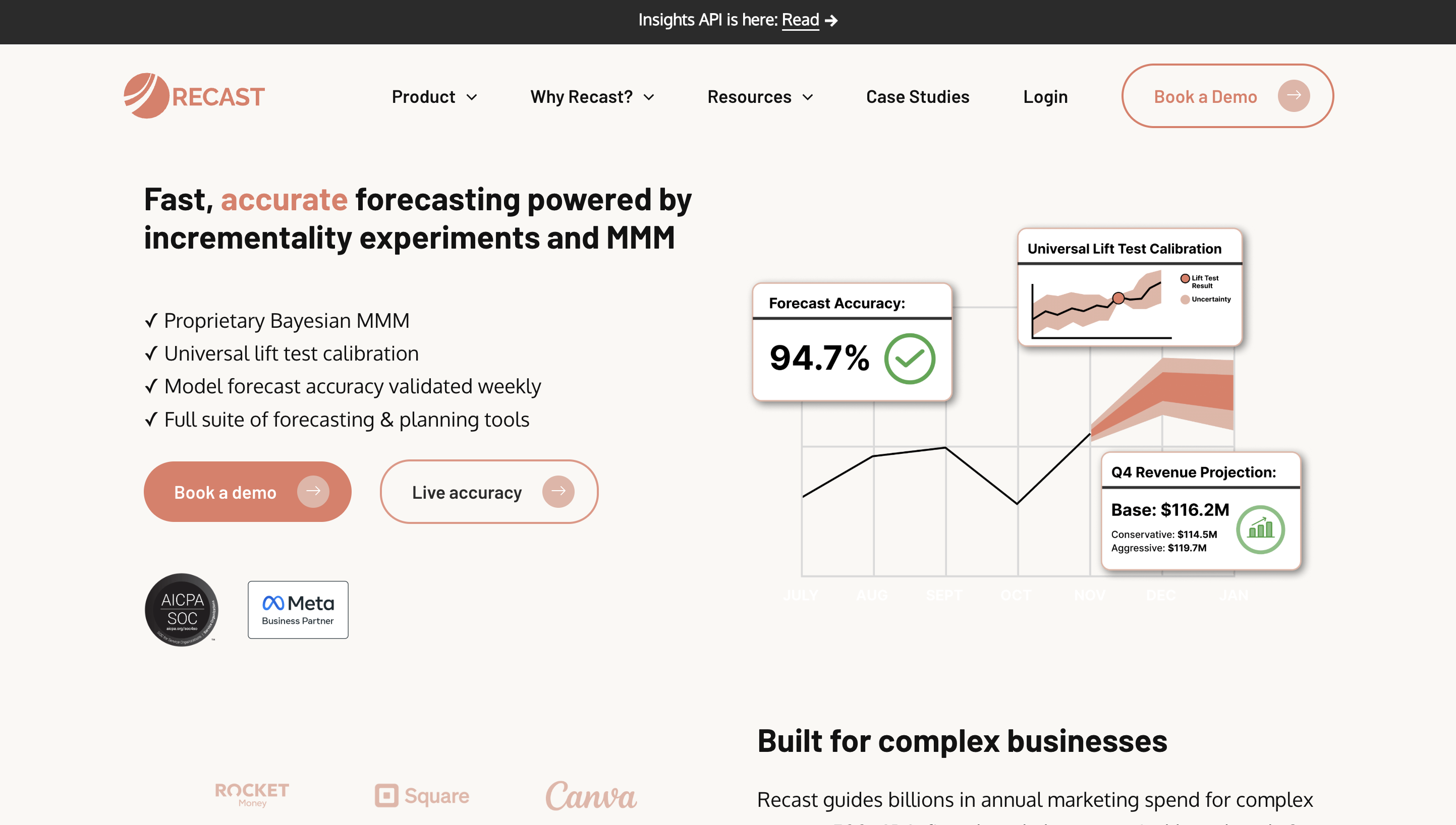
Recast is a marketing measurement company focused on Bayesian Marketing Mix Modeling, with a separate geo-based incrementality testing module called GeoLift by Recast.
Recast is fundamentally an MMM platform that has added geo testing to its offering to support MMM calibration, rather than a dedicated incrementality testing platform. Recast offers a free trial for its geo testing tool, and provides technical documentation that made this evaluation more straightforward than some other vendors. The platform does not offer a public demo.
About Sellforte

Sellforte is a SaaS platform that unifies Marketing Mix Modeling, Incrementality Testing, and Attribution into a single operating system for retail and ecommerce.
Unlike most other measurement vendors, Sellforte measures incremental ROAS at the campaign and ad set level, providing spend and bidding recommendations for tactical budget steering. Incrementality testing is one major component of the Sellforte platform, alongside Marketing Mix Modeling and incrementality-corrected attribution. Sellforte is used by enterprise retailers and ecommerce brands including bonprix, Lidl, C&A, Douglas, and Tchibo.
Side-by-Side Scorecard
| Category | Recast | Sellforte |
|---|---|---|
| 1. Geo Test Analysis | 4 / 6 | 4 / 6 |
| 2. A/B Test Analysis | 0 / 4 | 4 / 4 |
| 3. Conversion Lift Test Analysis | 0 / 5 | 5 / 5 |
| 4. Experiment Recs & Insights | 3 / 5 | 3 / 5 |
| 5. Unified Experiment Library | 1.5 / 3 | 3 / 3 |
| 6. MMM Integration | 1 / 3 | 3 / 3 |
| 7. Enterprise-Grade Platform | 1.5 / 5 | 5 / 5 |
| Total score out of 31 | 11 | 27 |
Category-by-Category Breakdown
1. Geo Test Analysis (Recast: 4/6, Sellforte: 4/6)
| Criterion | Recast | Sellforte |
|---|---|---|
| 1.1 Analyzes geo tests with synthetic control method, providing iROAS and confidence interval | 1 | 1 |
| 1.2 Self-serve UI for analyzing and reviewing geo test results | 1 | 1 |
| 1.3 Estimates media counterfactual for lost/incremental spend | 1 | 1 |
| 1.4 Configurable default post-test treatment / measurement window | 1 | 1 |
| 1.5 Executes geo experiments on ad platform | 0 | 0 |
| 1.6 Automatically detects geo tests from media and sales data | 0 | 0 |
| Category total | 4 / 6 | 4 / 6 |
Geo testing is one of Recast's core capabilities, and the one category where it matches Sellforte exactly. Both platforms score 4 out of 6. Both analyze geo tests using the synthetic control method, produce iROAS and confidence intervals, estimate the media counterfactual for lost or incremental spend, and offer a self-serve UI for reviewing results.
Neither platform executes geo experiments directly on ad platforms via API, and neither automatically detects geo tests from media and sales data. For Sellforte, ad platform execution has not been prioritized because enterprise clients typically rely on dedicated ad platform support for test execution. The shared limitations in this category mean that both platforms require geo tests to be configured on the ad platform side, with analysis handled in the tool.
2. A/B Test Analysis for Owned Media (Recast: 0/4, Sellforte: 4/4)
| Criterion | Recast | Sellforte |
|---|---|---|
| 2.1 Analyzes own media A/B tests with synthetic control method, providing iROAS and confidence interval | 0 | 1 |
| 2.2 Self-serve UI for analyzing and reviewing own media A/B test results | 0 | 1 |
| 2.3 Estimates media counterfactual for A/B tests | 0 | 1 |
| 2.4 Configurable default post-test treatment / measurement window for A/B tests | 0 | 1 |
| Category total | 0 / 4 | 4 / 4 |
This is one of the clearest gaps in the comparison. Recast scores 0 out of 4 on A/B test analysis for owned media; the platform does not support audience-level A/B test analysis at all. Sellforte scores a perfect 4 out of 4, covering synthetic control analysis, a self-serve UI, media counterfactual estimation, and configurable measurement windows.
For advertisers running catalog holdouts, email tests, loyalty program trials, or other owned media experiments, Recast does not provide a path to analyzing those tests within the platform. A separate solution would be required.
3. Conversion Lift Test Analysis (Recast: 0/5, Sellforte: 5/5)
| Criterion | Recast | Sellforte |
|---|---|---|
| 3.1 Ingests Conversion Lift test results, providing iROAS and confidence interval | 0 | 1 |
| 3.2 Self-serve UI for analyzing Conversion Lift test results | 0 | 1 |
| 3.3 API connectors for automated conversion lift test ingestion | 0 | 1 |
| 3.4 Results comparable to ad platform data on campaign and ad set level | 0 | 1 |
| 3.5 Daily snapshot of conversion lift test progress, including iROAS and confidence interval | 0 | 1 |
| Category total | 0 / 5 | 5 / 5 |
Recast scores 0 across all five criteria in this category, whereas Sellforte fully supports conversion lift test analysis, scoring 5 out of 5.
Conversion lift tests are run inside ad platforms (Meta, Google, TikTok) and form part of most enterprise advertisers' measurement programs. Sellforte ingests them via API connectors, normalizes results to the campaign and ad set level, provides a self-serve UI for analysis, and offers daily in-flight snapshots so teams can monitor tests as they run rather than waiting for completion. Recast does not ingest, analyze, or display conversion lift test results. For advertisers who run Meta or Google conversion lift tests alongside geo tests, Recast leaves a significant portion of their incrementality evidence entirely outside the platform.
4. Experiment Recommendations and Insights (Recast: 3/5, Sellforte: 3/5)
| Criterion | Recast | Sellforte |
|---|---|---|
| 4.1 Platform recommends which channels to test | 1 | 1 |
| 4.2 Platform recommends control and test groups | 1 | 0 |
| 4.3 Platform recommends test design (type, methodology) and predicts test success | 1 | 0 |
| 4.4 AI-generated plain-language readouts / executive summaries | 0 | 1 |
| 4.5 Conversational AI for discussing experiments | 0 | 1 |
| Category total | 3 / 5 | 3 / 5 |
Both platforms score 3 out of 5 here, but earn their points in different areas.
Recast scores on experiment design: it recommends which channels to test, helps configure control and test groups, and recommends test type and methodology while predicting expected test precision. These are practical features that help teams plan tests before launching them. Where Recast falls short is on AI-powered interpretation: it does not generate AI plain-language readouts or executive summaries, and does not offer a conversational AI interface for discussing experiments.
Sellforte is the mirror image. It recommends which channels to test and provides AI-generated summaries and a conversational AI interface for discussing experiments. Where it falls short is in automated recommendations for control and test group design and in predicting test success probability before a test runs. Sellforte has not prioritized these features partly because enterprise clients typically rely on open-source design packages or dedicated data science support for this step.
Teams that want the platform to guide test design end-to-end will favor Recast in this category. Teams that want AI to help interpret and communicate results will favor Sellforte.
5. Unified Experiment Library (Recast: 1.5/3, Sellforte: 3/3)
| Criterion | Recast | Sellforte |
|---|---|---|
| 5.1 Central library covers all experiments regardless of type | 0.5 | 1 |
| 5.2 Filterable by country, channel, brand, campaign, team, date | 1 | 1 |
| 5.3 Role-based access and governance for the experiment library | 0 | 1 |
| Category total | 1.5 / 3 | 3 / 3 |
Sellforte offers a complete unified experiment library: all test types (geo, A/B, conversion lift) in a single searchable and filterable repository, with role-based access controls and governance. Recast scores 1.5 out of 3. Its library covers geo tests with filterable views by country, channel, and similar dimensions, but does not include A/B tests or conversion lift tests, reflecting the broader gaps in those categories. Recast also does not offer role-based access controls for the experiment library.
For large organizations running many tests per year across teams and regions, a library that covers only geo tests means that learnings from A/B tests and conversion lift tests remain siloed in separate interfaces. There is no single source of truth for what has been tested, when, and what was learned. The absence of role-based governance is also a recurring procurement requirement that Recast does not currently meet.
6. MMM Integration (Recast: 1/3, Sellforte: 3/3)
| Criterion | Recast | Sellforte |
|---|---|---|
| 6.1 Bayesian MMM that can be calibrated by the user | 1 | 1 |
| 6.2 UI to connect experiment results to MMM | 0 | 1 |
| 6.3 Experiment-based priors comparable to attribution-based priors | 0 | 1 |
| Category total | 1 / 3 | 3 / 3 |
Both platforms include a Bayesian MMM that can be calibrated by the user. Beyond that, the gap is significant. Sellforte offers a UI-based workflow for connecting experiment results to the MMM as calibration inputs and supports side-by-side comparison of experiment-based priors against attribution-based priors. Recast scores 0 on both of these criteria.
The practical implication is notable given that MMM calibration is Recast's stated primary use case for geo testing. Recast's calibration workflow operates through a Google Sheet shared between the client and Recast, outside the product UI. This means there is no native in-platform workflow for connecting experiment results to the model, and no way to compare experiment-based and attribution-based priors side by side within the tool. For a platform whose geo testing module exists primarily to serve MMM calibration, this is a meaningful product gap relative to Sellforte's integrated approach.
7. Enterprise-Grade Platform (Recast: 1.5/5, Sellforte: 5/5)
| Criterion | Recast | Sellforte |
|---|---|---|
| 7.1 At least 10 public reference customers from $1B+ revenue brands | 0.5 | 1 |
| 7.2 SOC 2, ISO 27001, or audited IT security by a third-party auditor | 1 | 1 |
| 7.3 Data residency: US and EU options | 0 | 1 |
| 7.4 Multi-cloud option between AWS, GCP, and Azure | 0 | 1 |
| 7.5 Single sign-on (SSO) for enterprises | 0 | 1 |
| Category total | 1.5 / 5 | 5 / 5 |
Sellforte scores a perfect 5 out of 5 across all enterprise criteria: it has at least 10 publicly named reference customers from brands with more than $1B in revenue, holds SOC 2 and ISO 27001 certification, offers data residency options in both the US and EU, supports multi-cloud deployment across AWS, GCP, and Azure, and supports single sign-on (SSO) for enterprise authentication.
Recast scores 1.5 out of 5. It holds SOC 2 certification, but has only partial public reference customers among $1B+ revenue brands. It does not offer US/EU data residency options, multi-cloud deployment, or SSO. These are not niche requirements: they appear regularly in enterprise RFPs, and their absence creates procurement blockers for multi-region or heavily regulated organizations. Advertisers with operations in both the US and EU should in particular verify whether the absence of a European data residency option is a blocker under their data governance requirements.
Where Recast Wins
Recast's strongest area is geo test design. On geo test analysis, it ties with Sellforte at 4 out of 6. This helps teams size tests appropriately and set realistic expectations before committing ad spend to an experiment. On experiment recommendations, Recast earns points that Sellforte does not by recommending control and test groups and predicting test success probability.
Recast also offers a free trial for its geo testing module, which is a practical advantage for teams that want to evaluate the product before committing. For existing Recast MMM users, the GeoLift module provides a natural and low-friction path to adding geo testing within a platform they already use.
Where Sellforte Wins
Sellforte's advantage is breadth and depth of integration. Sellforte has complete coverage of all three incrementality test types across geo tests, A/B tests and conversion lift tests. Its unified experiment library consolidates all tests into a single repository for easy access and analysis. It's MMM is deeply integrated with incrementality tests, with UI-based calibration and prior comparison. Sellforte is enterprise-grade covering all evaluated enterprise requirements. Sellforte also adds AI-powered readouts and a conversational AI interface for experiments, which Recast does not currently offer.
The gap is particularly sharp in the categories where Recast scores 0: A/B test analysis for owned media (0/4), conversion lift test analysis (0/5), and the productized UI for MMM calibration (0/1). For organizations that need all of these capabilities in a single platform, Sellforte is clearly the stronger choice.
Which Should You Choose?
Choose Recast if: you are already a Recast MMM customer and want to add a lightweight geo testing module to calibrate your model, your incrementality program consists of geo tests only, A/B test analysis and conversion lift test ingestion are not priorities, and multi-region data residency, multi-cloud deployment, or SSO are not requirements.
Choose Sellforte if: you run more than one type of incrementality test and want all results in a single platform, you need A/B test analysis for owned media such as catalog or email experiments, you need conversion lift test ingestion from Meta or Google, you want experiments to feed directly into an integrated MMM through a UI-based calibration workflow, or your organization requires EU data residency, multi-cloud deployment, or SSO. Sellforte is also the stronger fit for retail and ecommerce organizations with large enterprise IT requirements or multi-country operations.
Frequently Asked Questions
What is Recast used for?
Recast is a Bayesian Marketing Mix Modeling platform that also includes a geo-based incrementality testing module called GeoLift by Recast. Its primary use case is MMM, with geo testing added to support model calibration. Recast does not cover A/B test analysis for owned media or conversion lift test analysis from ad platforms.
Does Recast support conversion lift test analysis?
No. Based on our evaluation of publicly available documentation, Recast does not ingest, analyze, or display conversion lift test results from ad platforms such as Meta, Google, or TikTok. Sellforte fully supports conversion lift test analysis.
Does Recast support A/B test analysis for owned media?
No. Recast scores 0 out of 4 on A/B test analysis for owned media. Advertisers running owned-media experiments such as catalog holdouts or email tests will need a separate solution. Sellforte has this capability.
What are the best Recast alternatives?
The closest alternatives to Recast depend on your priorities. Sellforte covers a broader set of test types, a unified experiment library, and deeper MMM integration. Measured is strong in geo tests and A/B tests. Haus is a dedicated geo experimentation platform with strong experiment design features. For teams committed to open-source approaches, Google's Meridian GeoX is a no-cost option but requires significant in-house engineering to operationalize.
Is Recast good for enterprise?
Recast holds SOC 2 certification and has some enterprise customer references, but it scores 1.5 out of 5 on our enterprise platform criteria, the lowest of the four commercial vendors in our comparison. It does not currently offer US/EU data residency options, multi-cloud deployment across AWS, GCP, and Azure, or SSO. These requirements are common in enterprise procurement processes. Organizations with strict IT or data governance requirements should verify whether these gaps are a blocker before committing to Recast.
How does Recast compare to Sellforte on geo testing specifically?
Both platforms score 4 out of 6 on geo test analysis, meaning they are evenly matched in this category. Both use the synthetic control method, produce iROAS with confidence intervals, and offer self-serve analysis. Neither executes geo tests directly on ad platforms via API.
How does Recast integrate geo test results into its MMM?
Based on publicly available information, Recast's calibration workflow operates through a Google Sheet shared between the client and Recast, rather than through a native product UI. This means there is no in-platform workflow for connecting experiment results to the model, and no way to compare experiment-based and attribution-based priors side by side within the tool. Sellforte offers a UI-based calibration workflow with side-by-side prior comparison built into the platform.
Further Reading
How to Choose an Incrementality Testing Tool: 31 Evaluation Criteria
Best Incrementality Testing Tools: In-depth Vendor Comparison
Commentary
Snapshot in time. Vendor capabilities evolve quickly. This comparison reflects publicly available information at the time of publication.
Corrections welcome. We will revise this comparison as new information becomes available. If a vendor believes a score is inaccurate, we welcome corrections with supporting documentation. Please email sales@sellforte.com.
Recommendation for buyers. Use this comparison as a structured starting point for your own evaluation, not as a final answer. We recommend conducting evaluation calls or demos with the vendors to verify fit against your organization's specific requirements.
Authors

Lauri Potka is the Chief Operating Officer at Sellforte, with over 15 years of experience in Marketing Mix Modeling, marketing measurement, and media spend optimization. Before joining Sellforte, he worked as a management consultant at the Boston Consulting Group, advising some of the world's largest advertisers on data-driven marketing optimization. Follow Lauri in LinkedIn, where he is one of the leading voices in MMM and marketing measurement.

Kacper Solarski is a Lead Data Scientist at Sellforte, focused on developing Sellforte's Experiments product. Kacper is one of the most senior data scientists and developers at Sellforte, where he has implemented Marketing Mix Models and incrementality testing solutions to Sellforte customers, while at the same time developing Sellforte's platform. Follow Kacper in LinkedIn.
.png?width=701&height=132&name=Juha%20Nuutinen%20(701%20x%20132%20px).png)
Juha Nuutinen is the Chief Executive Officer and co-founder at Sellforte, with over 15 years of experience in optimizing marketing spend and promotional activity for the largest advertisers in the world. Before co-founding Sellforte, he worked as a management consultant at the Boston Consulting Group, specializing in promotion optimization. Follow Juha in LinkedIn, where he is actively sharing his views on marketing measurement.