


When we launched Sellforte AI Visualizations in January, we moved Marketing Mix Modeling beyond static dashboards and into a conversational interface. Ecommerce, DTC, and retail marketing teams could ask questions and instantly see model-backed visual answers without digging through reports.
But seeing the past is only part of the story.
For ecommerce, DTC, and retail brands operating in increasingly competitive and privacy-constrained environments, the real challenge is not understanding what happened. It is deciding what to do next.
Today, we’re launching the next chapter of Sellforte AI.
Dynamic Scenarios lets you simulate budget decisions and instantly see their expected impact on sales before you commit a single dollar.
Move Beyond Historical Analysis
Most marketing analytics tools are built to answer one question: what happened?
Even platforms that position themselves as "AI-powered" often wrap summaries around historical data. They help interpret past performance, but when it comes to planning future investments, marketers are still left building spreadsheets, exporting data, and making assumptions.
Dynamic Scenarios moves MMM beyond historical analysis and into forward-looking planning.
Instead of stopping at analysis, you can now move directly into planning and ask:
- How should I allocate my media budget next week/month/quarter?
- What happens if I increase total marketing spend by 5%?
- What if I reduce Google Ads by 20% and reallocate to Meta?
- How would these changes affect total and incremental sales?
And Sellforte AI will simulate the outcome instantly, grounded in your MMM model.
This is the shift from explanation to prediction to planning.
A New Way to Plan Media
Dynamic Scenarios is fully integrated into the Sellforte AI experience. Within the same conversation where you explore performance, you can adjust your total budget in absolute terms or by percentage, scale individual channels up or down, and shift investment between platforms.
Each time, Sellforte AI recalculates the optimized allocation, estimates the incremental sales impact, total sales (including sales driven by promotions, holidays, and seasonality), and projects how ROI changes compared to business as usual.
The result is a clear baseline vs. scenario comparison, supported by both numerical summaries and visual outputs.
No exports. No spreadsheets. No manual modeling.
Just instant scenario simulation, all before a single dollar is spent.
Dynamic Scenarios in Action
One of the most powerful applications of Dynamic Scenarios is a practical planning workflow.
Let’s take a simple example.
You are the Director of Customer Acquisition at a large ecommerce apparel brand. Q2 planning is underway and you want to ensure your media budget is allocated to maximize incremental sales.
You ask Sellforte AI:
“Plan my media for Q2.”
Within seconds, Sellforte AI analyzes your current allocation and presents a full Q2 media plan comparison, showing Business as Usual versus the Sellforte-optimized scenario.
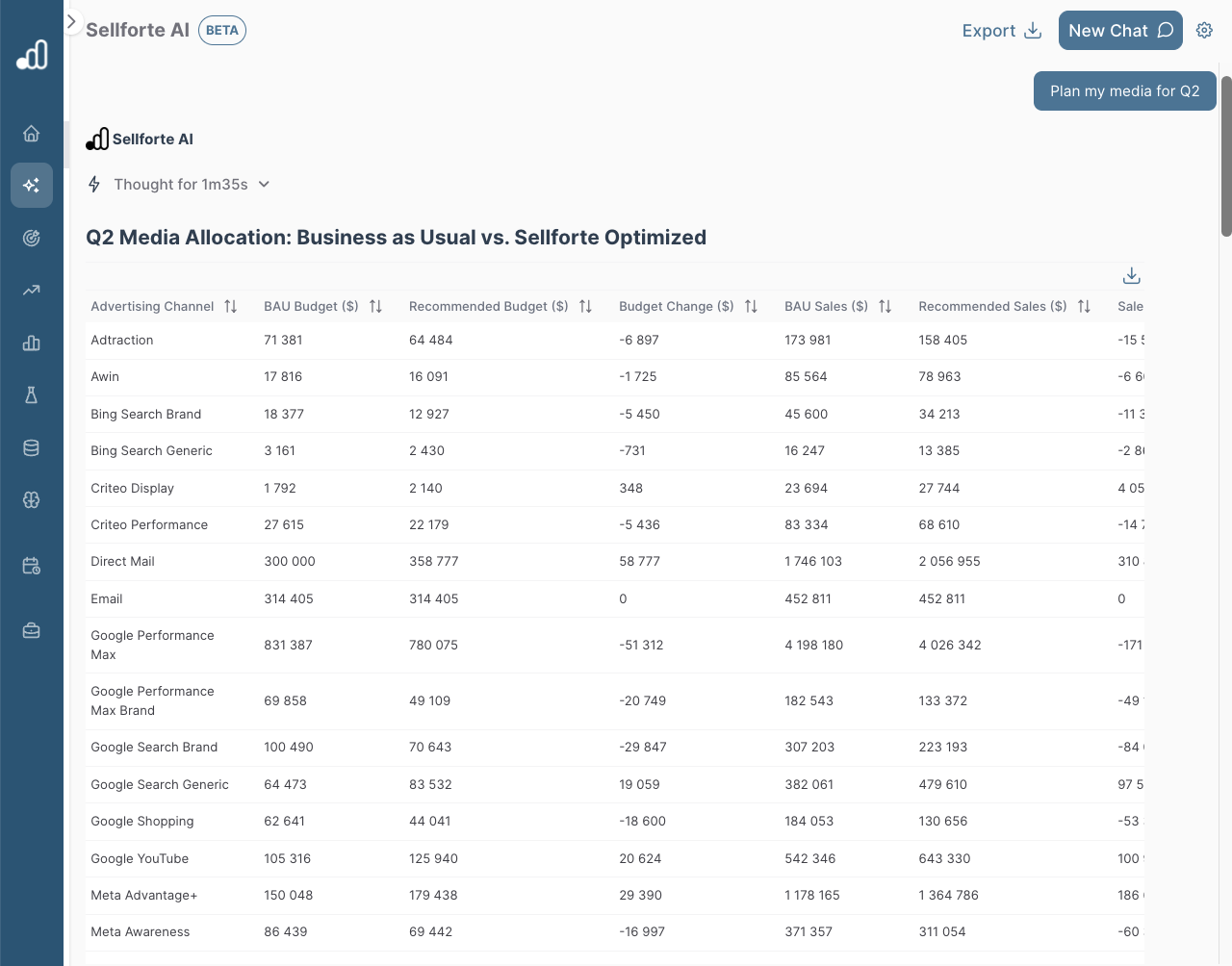
You can clearly see recommended increases and decreases by channel along with projected changes in incremental sales. Sellforte AI highlights where budget should shift to improve overall ROI while keeping total spend constant.
Next, it visualizes those reallocations.
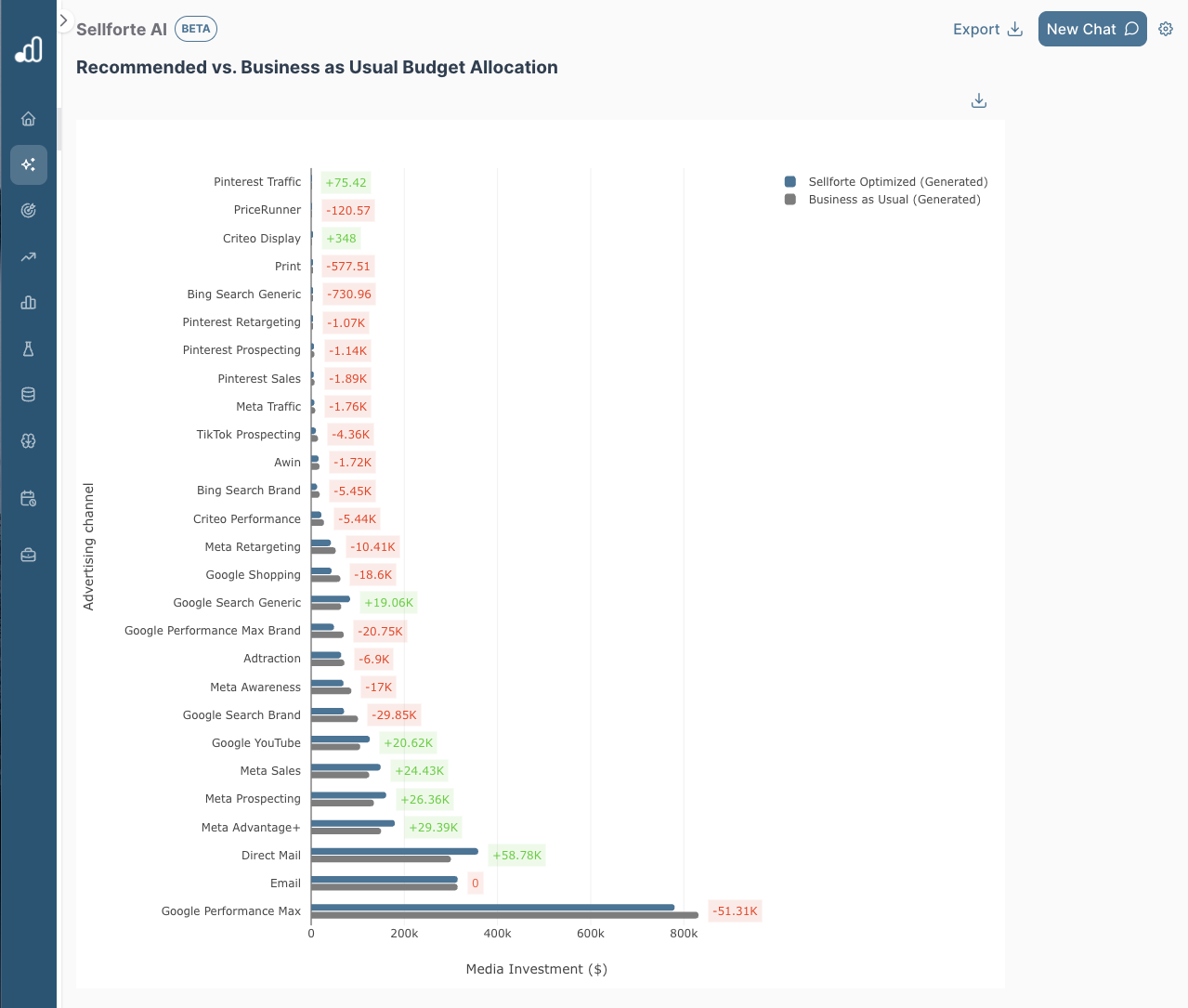
The chart makes the changes intuitive. You immediately see which channels absorb additional investment and which are reduced, all grounded in modeled performance and diminishing returns.
Finally, Sellforte AI summarizes the impact.
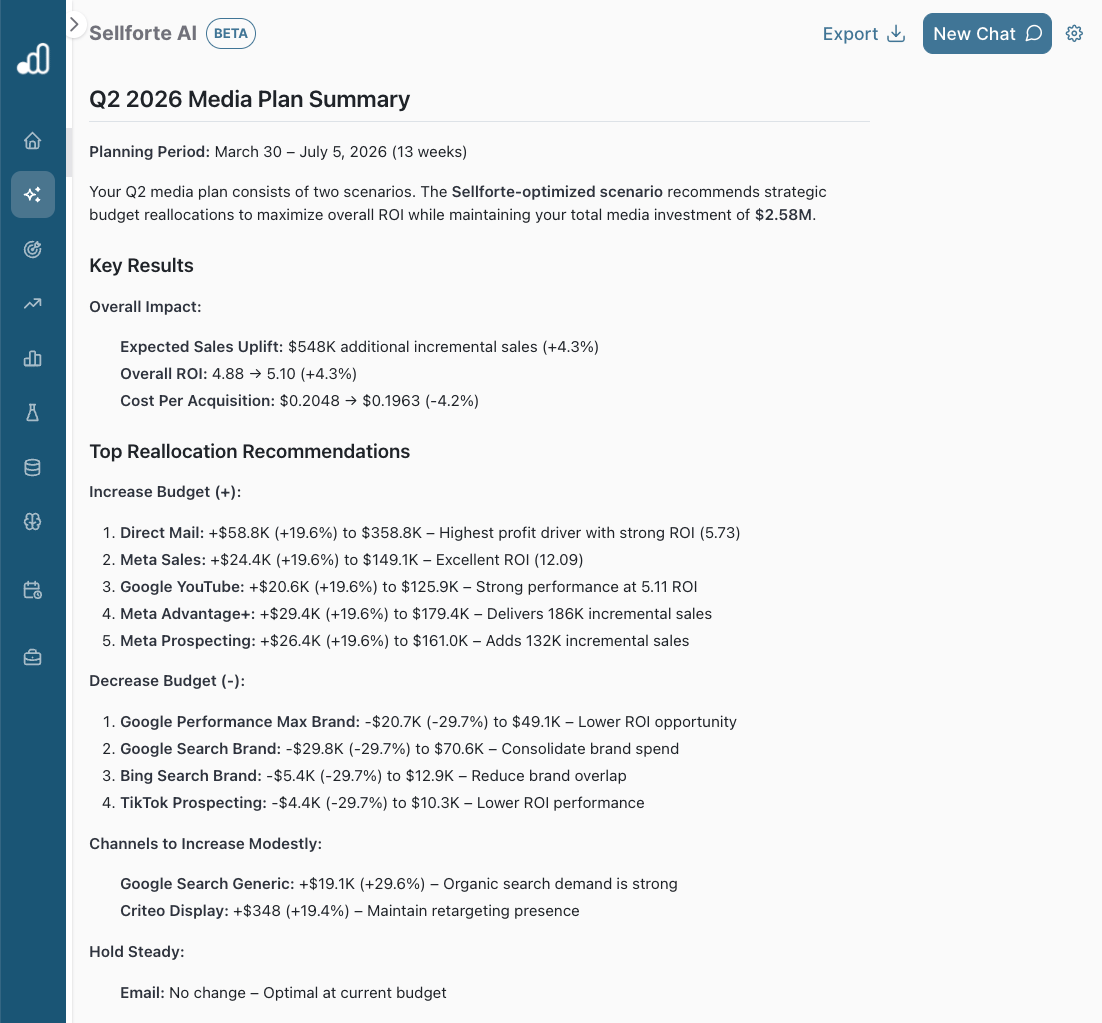
You get a concise overview of expected incremental sales uplift, ROI improvements, and cost per acquisition changes. Instead of manually consolidating reports, the entire Q2 plan is generated and explained in one conversation.
You can also ask for other visualizations, such as total sales forecast split by base sales, promotion-driven sales, and media-driven sales.
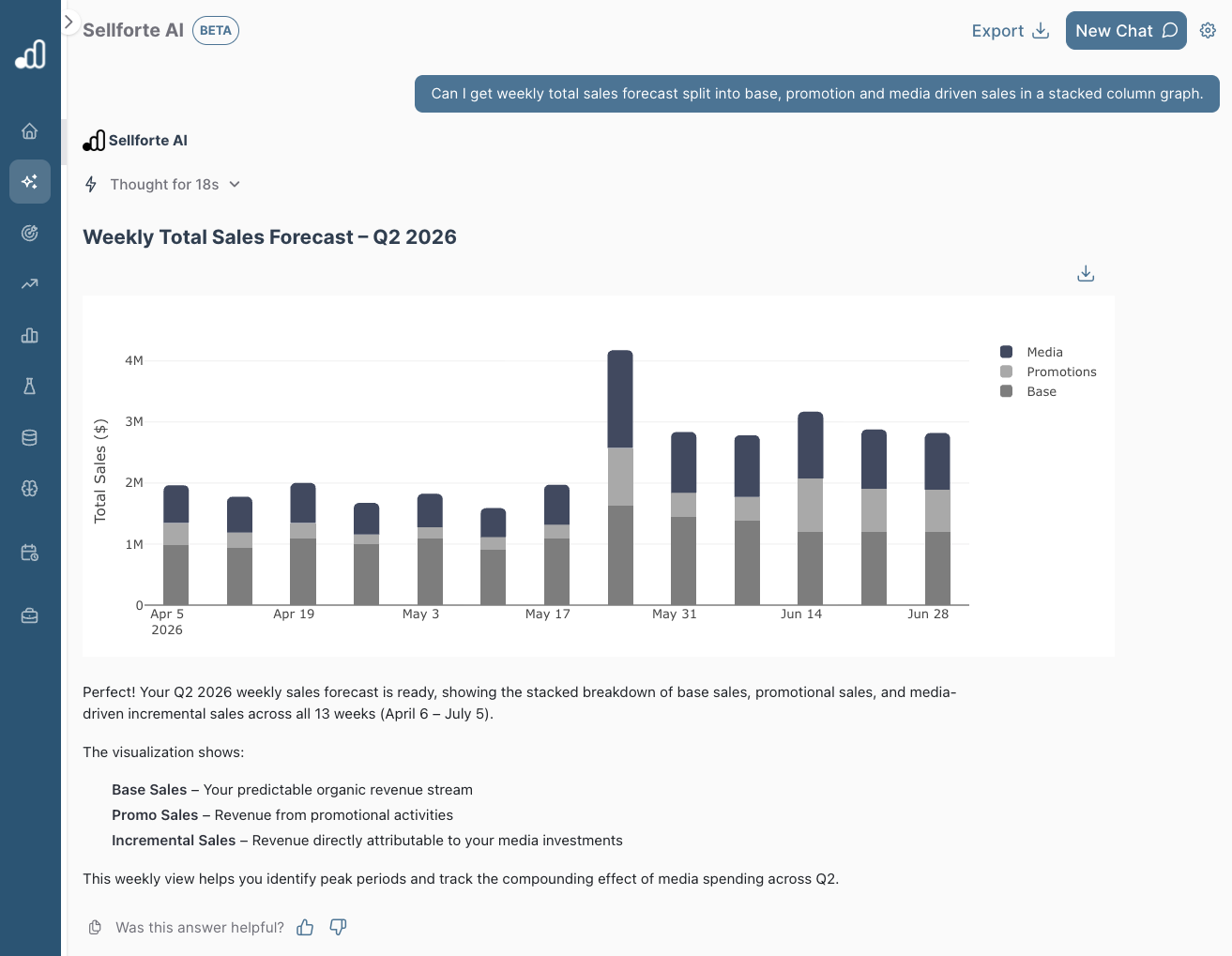
And that’s your baseline.
Now let’s explore what happens when business conditions change.
Example 1: A 20% Budget Increase
Imagine your CFO approves a 20% increase in Q2 media budget. Your goal is simple: deploy the additional investment in a way that maximizes incremental sales.
You ask:
“What effect would a 20% increase in media budget have on top-level sales?”
Sellforte AI immediately simulates the scenario.
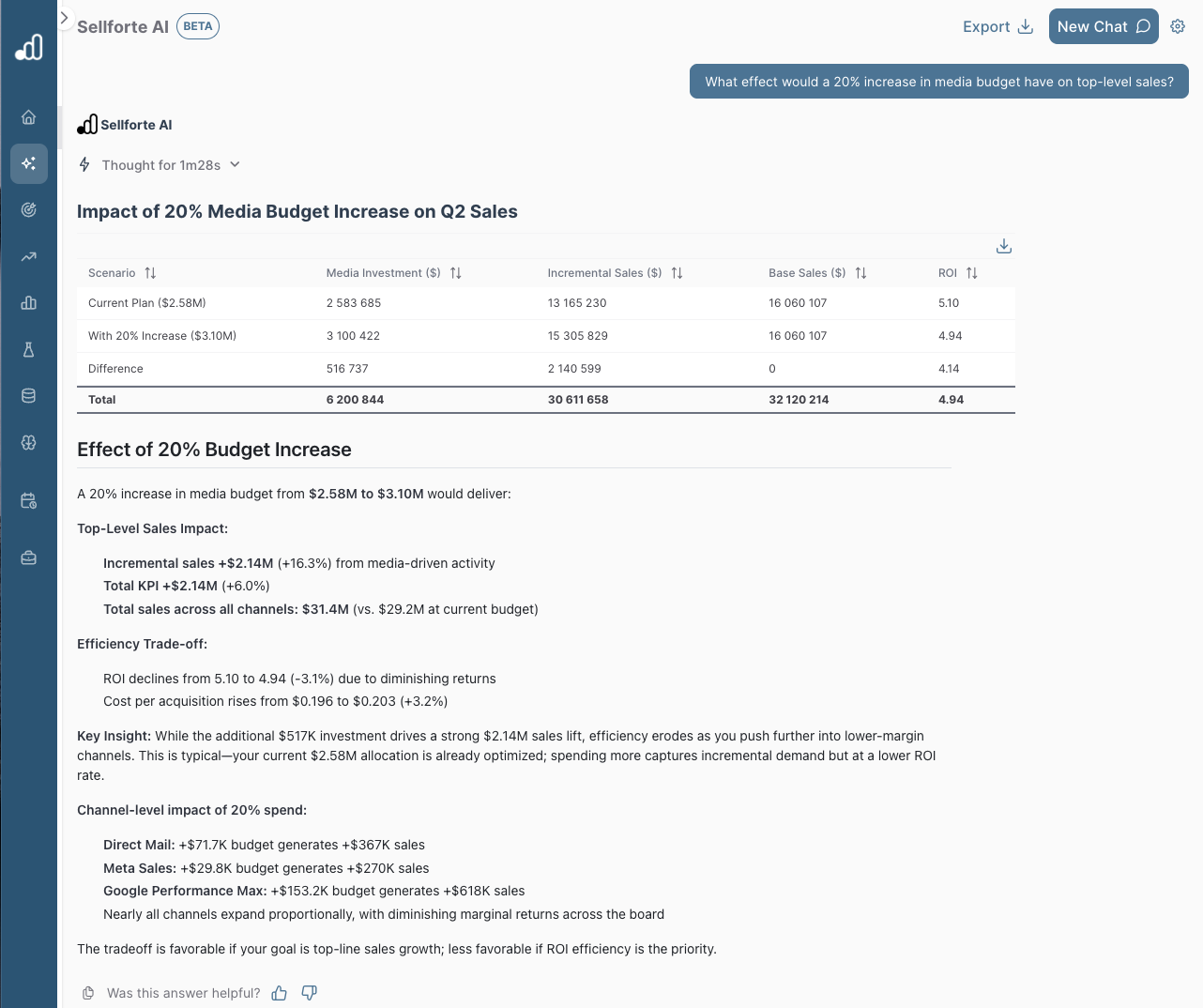
In this example, increasing the Q2 media budget from $2.58M to $3.10M generates an additional $2.14M in incremental sales, representing a 16.3% lift in media-driven revenue.
But the model also surfaces the trade-off.
While total sales increase, ROI declines from 5.10 to 4.94 due to diminishing returns. CPA rises slightly as spend pushes further into lower-efficiency inventory.
This is the nuance leadership teams need. The upside is clear. The efficiency cost is quantified. The decision becomes strategic rather than speculative.
Instead of building a spreadsheet, you now have a model-backed growth scenario in seconds.
Example 2: A 25% Budget Decrease
Now imagine the opposite scenario.
There is a disruption in your supply chain and it reduces available inventory. As a result, you now need to cut media spend by 25% but want to preserve as much revenue as possible.
You ask:
“What effect would a 25% decrease in media budget have on top-level sales?”
Sellforte AI recalculates the allocation and quantifies the impact.
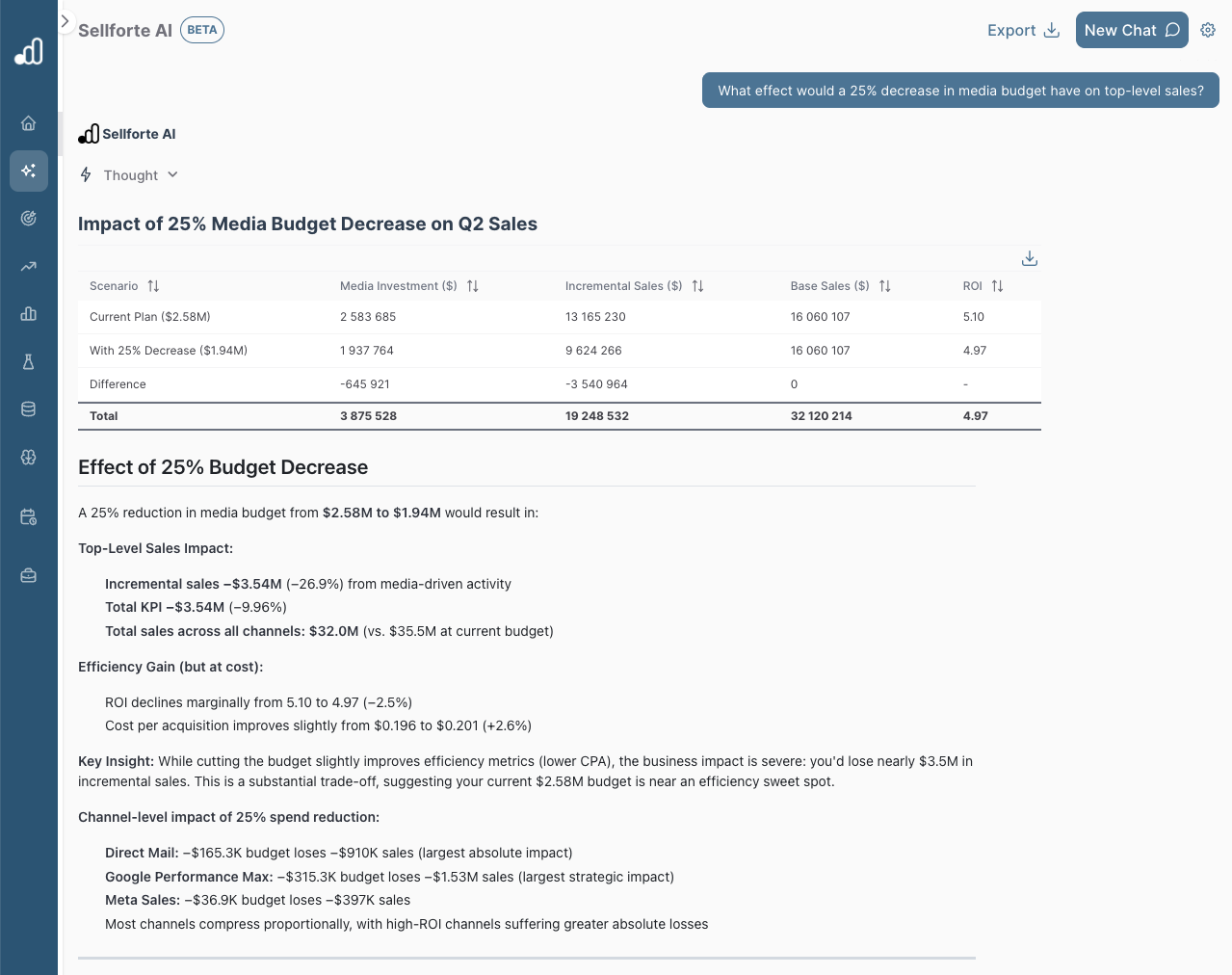
Reducing the budget from $2.58M to $1.94M results in a $3.54M decline in incremental sales, a 26.9% drop in media-driven revenue.
Interestingly, ROI only declines marginally, from 5.10 to 4.97. This reveals something important: your current allocation is already near an efficiency sweet spot. Cutting budget removes high-performing incremental demand quickly.
Sellforte AI also highlights which channels experience the largest absolute revenue losses, allowing you to reduce spend in the least damaging way possible.
This transforms a reactive cost-cutting exercise into a strategic downside optimization.
Comparing Scenarios
The real power emerges when you compare scenarios side by side.
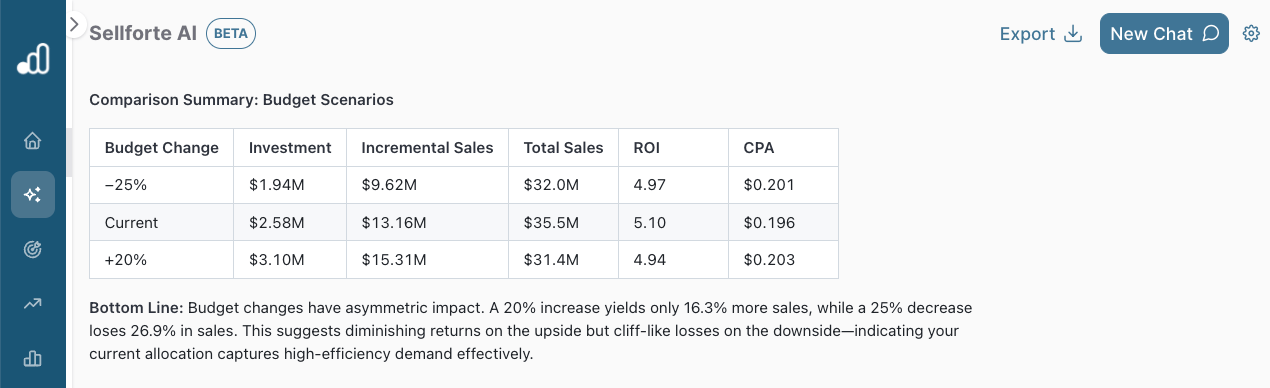
You can view the current plan, a +20% growth scenario, and a –25% contraction scenario in one structured comparison. Incremental sales, total sales, ROI, and CPA are all quantified across cases.
The asymmetry becomes clear. Increasing budget yields incremental growth but at lower marginal efficiency. Cutting budget produces steep revenue losses relative to spend reduction.
This gives leadership teams a grounded view of risk and reward.
You can also ask Sellforte AI how it built the media plan using Dynamic Scenarios so you can understand its assumptions and overall train of thought — it will even share what it didn't take into account as well.
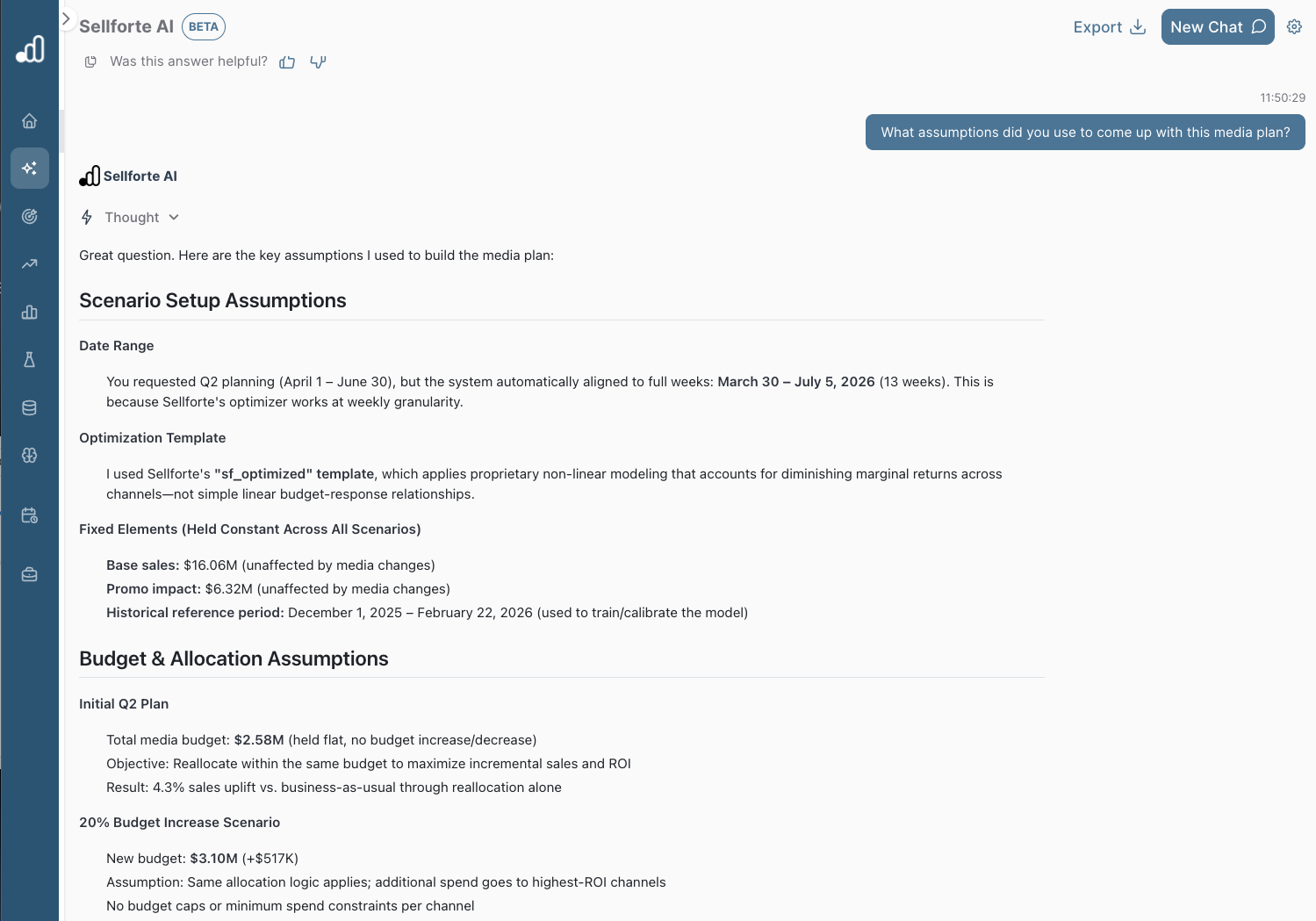
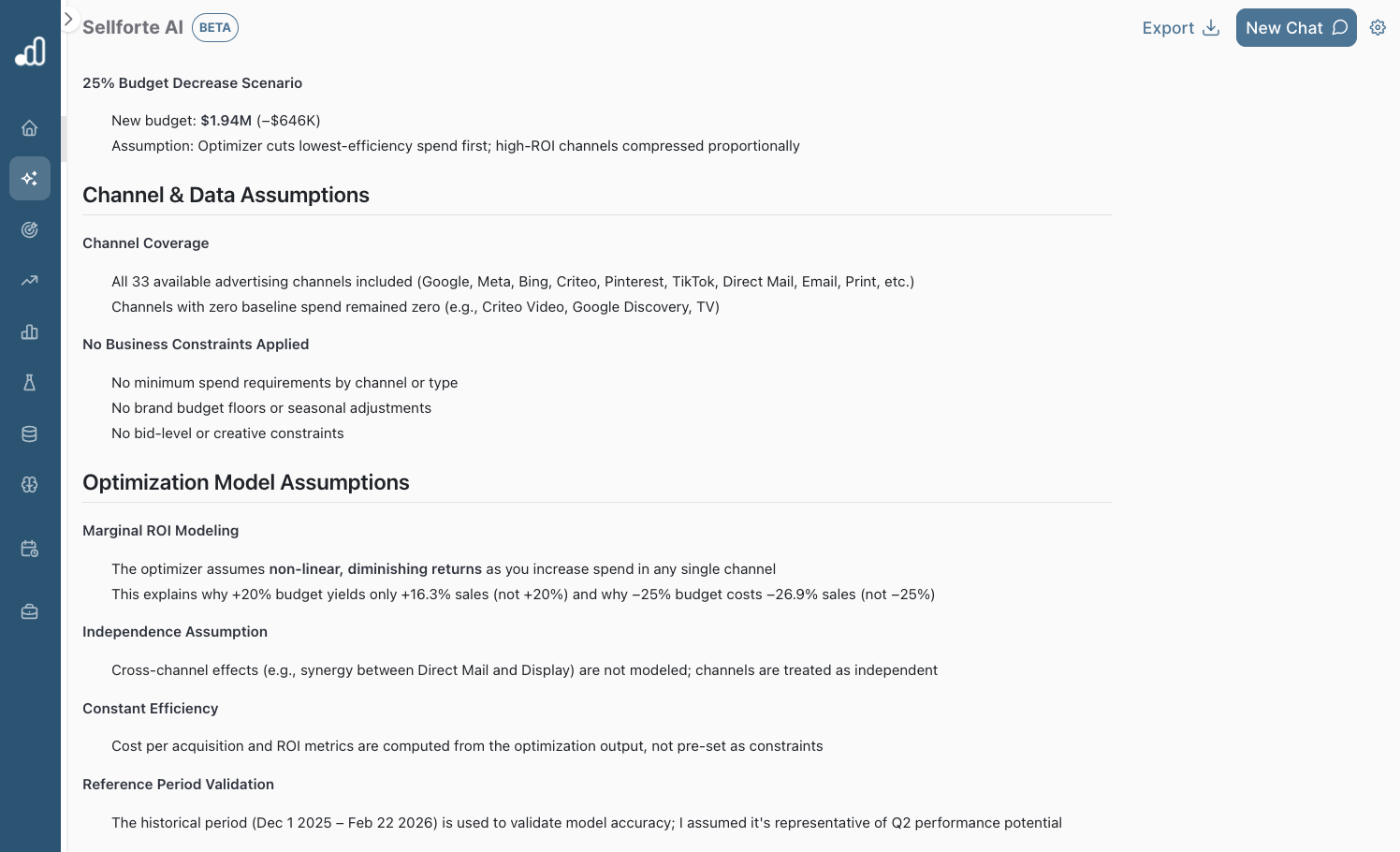
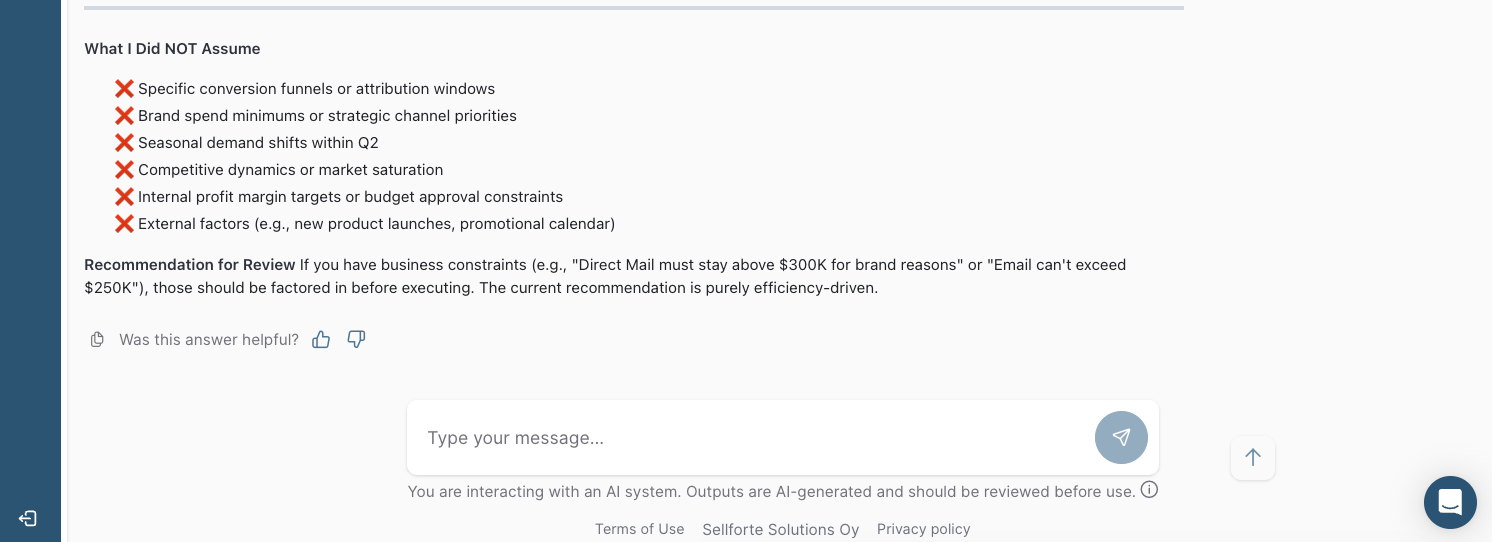
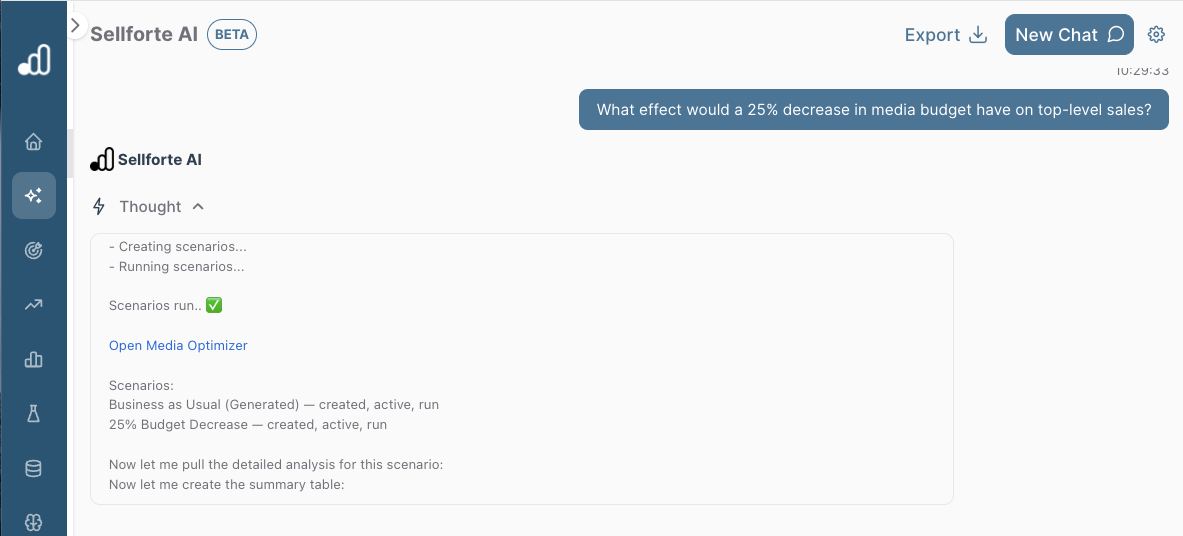
You also have the ability to open the dynamic scenarios Sellforte AI creates in Sellforte Media Optimizer so you can dive deeper into each scenario.
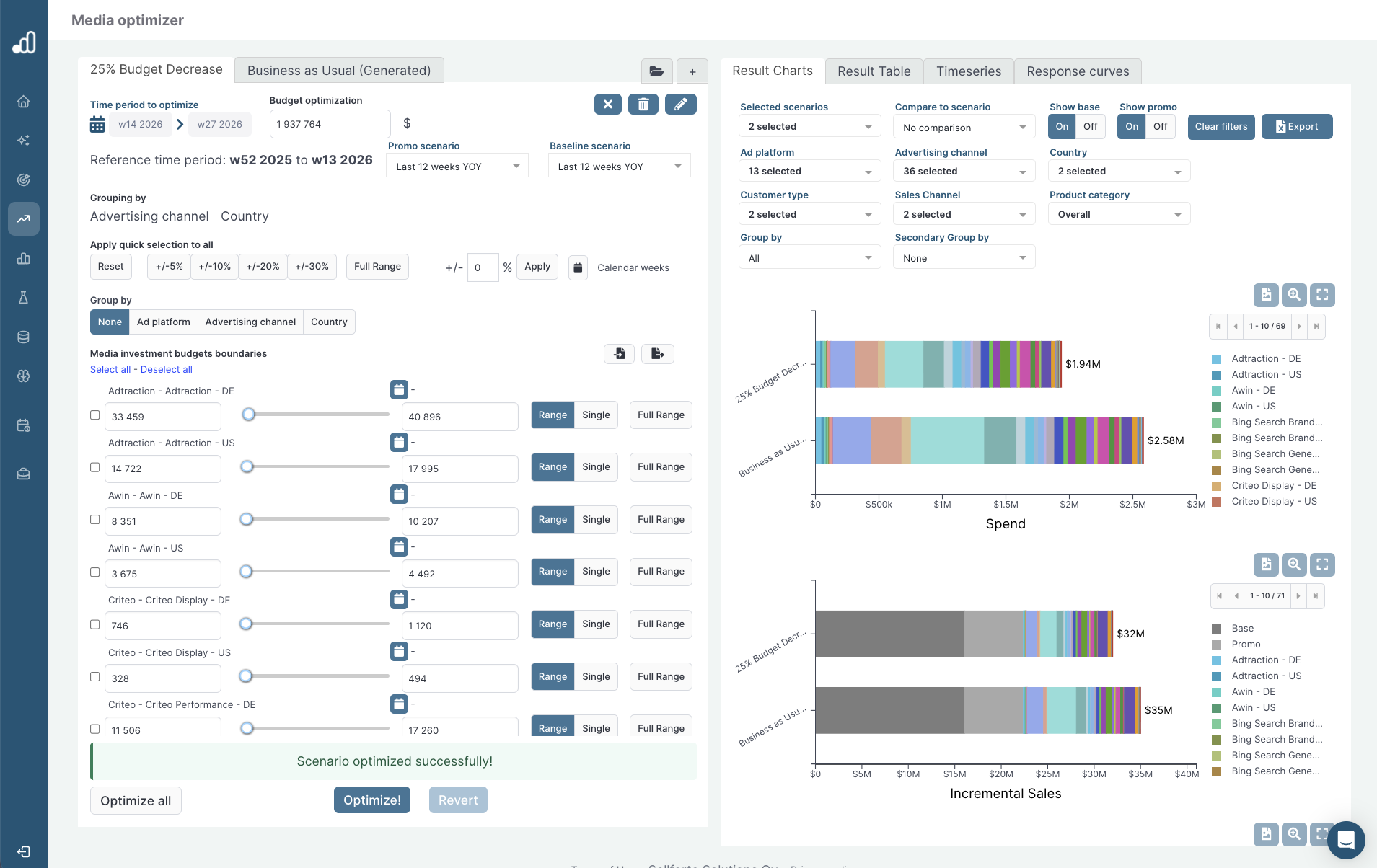
What previously required days of modeling, cross-team alignment, and assumption debates now happens in minutes of interactive planning.
This is dynamic marketing planning powered by causal MMM.
Want a 30-minute demo to see Dynamic Scenarios in action?
Enterprise-Grade by Design
Dynamic Scenarios is not a generic forecasting tool. It is built on Sellforte’s causal Marketing Mix Modeling framework, ensuring projections reflect true incremental impact rather than simple trend extrapolation.
Diminishing returns, channel interactions, and real-world marketing dynamics are all incorporated into the simulations. In a world where attribution is weakening and privacy changes are reshaping measurement, forward-looking decisions must be grounded in causality, not surface-level correlations.
But enterprise planning requires more than accurate models. It also requires consistency and transparency.
Many AI-based planning tools produce different answers depending on how a question is phrased or when a new chat is started. That variability makes them difficult to trust in high-stakes environments.
Dynamic Scenarios is designed to be robust and traceable.
Robustness means that asking the same question in different ways produces the same underlying recommendation. Allocations are grounded in deterministic MMM optimization, not conversational variability.
Traceability means you can understand exactly how the plan was constructed. You can inspect the assumptions behind each scenario, including marginal incremental ROAS, budget constraints, channel flighting, and seasonal effects.
For enterprise teams managing millions in quarterly media spend, this matters.
It turns Dynamic Scenarios from an AI assistant into a trustworthy planning engine that can stand up in executive and board-level discussions.
The Strategic Foundation for Autonomous Media Optimization
Dynamic Scenarios operates at the strategic level, optimizing allocation across channels and platforms. It enables marketing leaders to test investment decisions, understand trade-offs, and quantify the projected impact on top-line sales before budgets are deployed.
But this is more than a planning tool.
Dynamic Scenarios establishes the optimization engine that will power the next generation of Sellforte AI capabilities. By combining causal MMM with real-time scenario simulation, it creates the decision layer required for deeper automation.
Today, that optimization happens at the channel level.
Next, it extends into campaign- and ad set-level recommendations.
And from there, it becomes the backbone of fully autonomous media optimization agents, systems that do not just simulate decisions, but continuously recommend and execute them based on modeled incremental impact.
Dynamic Scenarios is the next step toward that future, where media planning, optimization, and execution are powered by causal AI.
See Dynamic Scenarios in Action
Dynamic Scenarios is now live in Sellforte AI and will begin rolling out to Sellforte customers starting today.
If you'd like to experience how it works, there are three ways to explore it.
1. You can join our upcoming live masterclass on March 26 to meet the first end-to-end agentic MMM workflow that measures, plans, and executes media decisions in real time. In this session, we’ll show how Sellforte AI connects measurement, scenario planning, and media optimization into a single workflow powered by causal MMM. Save you spot here!
2. If you'd prefer to explore it yourself, you can try Dynamic Scenarios in our open Agentic MMM Demo. Adjust total budgets, reallocate channels, compare baseline versus optimized scenarios, and visualize expected sales impact directly inside the AI interface.
3. And if you'd like a deeper look tailored to your business, you can book a demo and we’ll walk you through how to simulate your own budget decisions, test growth and downside scenarios, and build model-backed media plans before committing spend.
The Future of MMM Is Dynamic
Marketing analytics is evolving from dashboards to conversational insight to forward-looking decision engines.
Dynamic Scenarios marks the shift from retrospective reporting to proactive planning.
Simulate before you spend.
Plan with confidence.
Decide with causal AI.
Welcome to the next chapter of Sellforte AI.
👉 Save your spot at our live Agentic MMM Masterclass
👉 Book a demo to see it action
👉 Try it in our open Agentic MMM Demo
Author

Edward Ford is Marketing Director at Sellforte. He has over 15 years of marketing experience in B2B SaaS and Tech with specialization in marketing measurement and intelligence. Before joining Sellforte, Edward spent over 6 years at Supermetrics where he joined as an early-stage employee.
.png)
Introducing Sellforte Activate for Meta: Push MMM Recommendations into Daily Campaign Execution

Product Update: Improved User Experience for Marketing Dashboard