Each adjustment is a decision.
But here's the thing, almost no one measures what those changes actually did in incremental terms.



Today, we’re launching Change Intelligence.
It's one of the most important milestone's in Sellforte's evolution and will transform the way media teams operate.
Change Intelligence is built for Paid Search and Paid Social specialists at B2C ecommerce, DTC, and retail brands, where paid media decisions directly influence revenue and growth at every stage.
Your work happens inside the ad platforms. You adjust target ROAS values, refine bids, rebalance efficiency thresholds, and decide when to push for scale or protect profitability.
Week by week, those target ROAS values move.
5 → 5.5
5.5 → 8
8 → 6
Each adjustment is a decision.
But here's the thing, almost no one measures what those changes actually did in incremental terms.
Did that tighter ROAS target protect efficiency or suppress profitable growth?
Did that looser target unlock incremental revenue or dilute returns?
Where is the true marginal return?
Until now, those operational changes were just… changes.
With Change Intelligence, they become experiments.
Modern marketing teams already rely on powerful measurement tools.
MMM provides structural incrementality. Geo experiments deliver clean causal validation.
But performance marketing doesn't happen at the annual planning level.
You don't rewrite the marketing budget every day. You operate within it.
The real decisions happen inside the ad platform.
That is where the operational gap exists.
Traditional MMM shows strategic value. Experiments require setup and sometimes campaign pauses. Neither captures the impact of the tactical adjustments happening every day in Google Ads, Meta, and TikTok. Things like:
Each of these actions contains causal signals.
Change Intelligence captures them.
Let’s explain this in the simplest possible way.
Marketing teams adjust target ROAS all the time.
What most teams do today is a basic pre–post comparison:
But as Alex Schultz explains in Click Here, pre–post alone is misleading. Sales fluctuate naturally, seasonality changes, and competitors react.
Just because something moved after a change does not mean the change caused it; correlation is easy but incrementality is hard.
That’s why Change Intelligence upgrades pre–post analysis into causal measurement.
Here's how it works in five steps:
You change target ROAS from 5 to 7.
That change becomes a measurement event.
Before the change:
After the change:
Note, these are incrementality-corrected sales, not plain attributed sales.
We are measuring real causal sales impact, not platform-reported numbers.
Instead of assuming the drop in sales was caused by the change, we ask:
What would have happened if target ROAS had stayed at 5?
That is the counterfactual.
We estimate what post-spend and post-incremental sales would have been without the change.
This is what turns simple pre–post into causal estimation.
Now we calculate the marginal incremental ROAS of the change.
The delta in incremental sales:
100 – 84 = 16
The delta in spend:
20 – 12 = 8
Marginal incremental ROAS (miROAS):
miROAS = 16 / 8 = 2.0
This means the last dollar removed from spend was returning 2.0 in incremental sales.
Let’s say your business has set a marginal incremental ROAS requirement of 2.5.
Your observed miROAS is 2.0.
Because 2.0 is below your target of 2.5, the reduction in spend was justified.
You moved closer to your optimal equilibrium.
Next logical step?
Test target ROAS 7.5 or 8.0.
This is no longer guesswork.
It is structured marginal learning.
Let's take at two concrete examples of Change Intelligence in action; one where a Target ROAS change has a positive impact and one where it has a negative impact.
Imagine a campaign running with a target ROAS of 8.5. The efficiency requirement is strict, and as a result, the campaign barely spends. Media investment is close to zero, impressions are limited, and incremental sales remain minimal.
In practice, this is almost the same as not running the campaign at all.
A target ROAS that is set too high can become a lost opportunity. There may be profitable demand available, but the algorithm is too constrained to capture it.
So the team lowers target ROAS from 8.5 to 7.
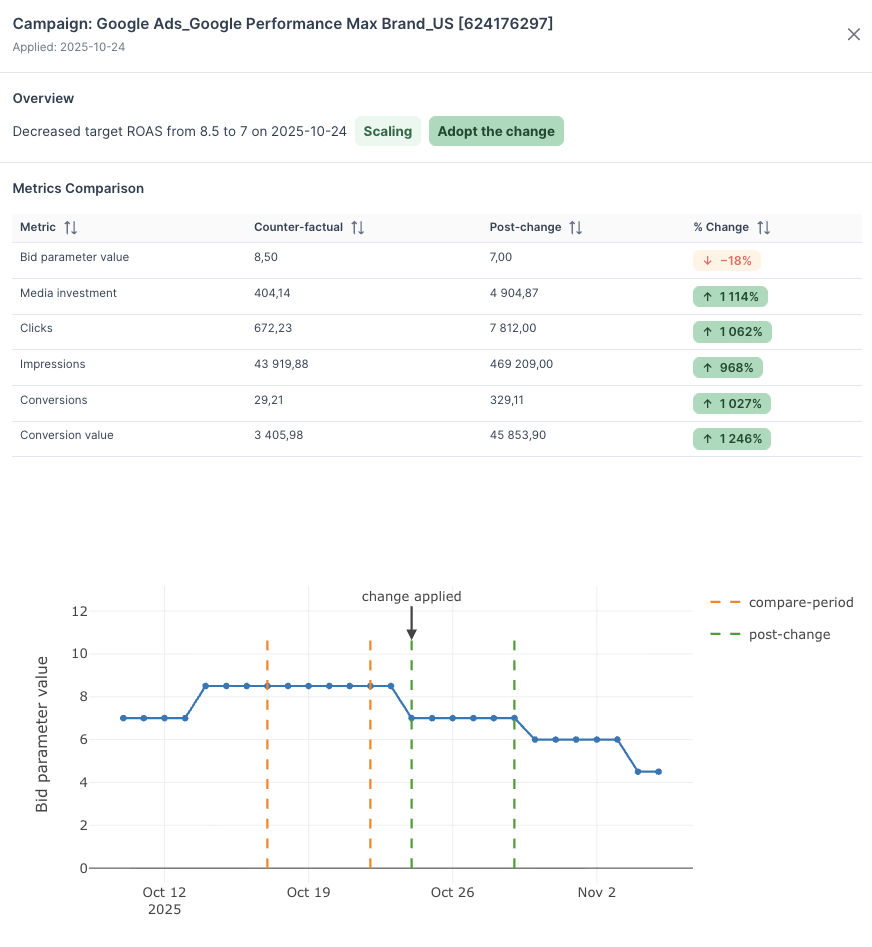
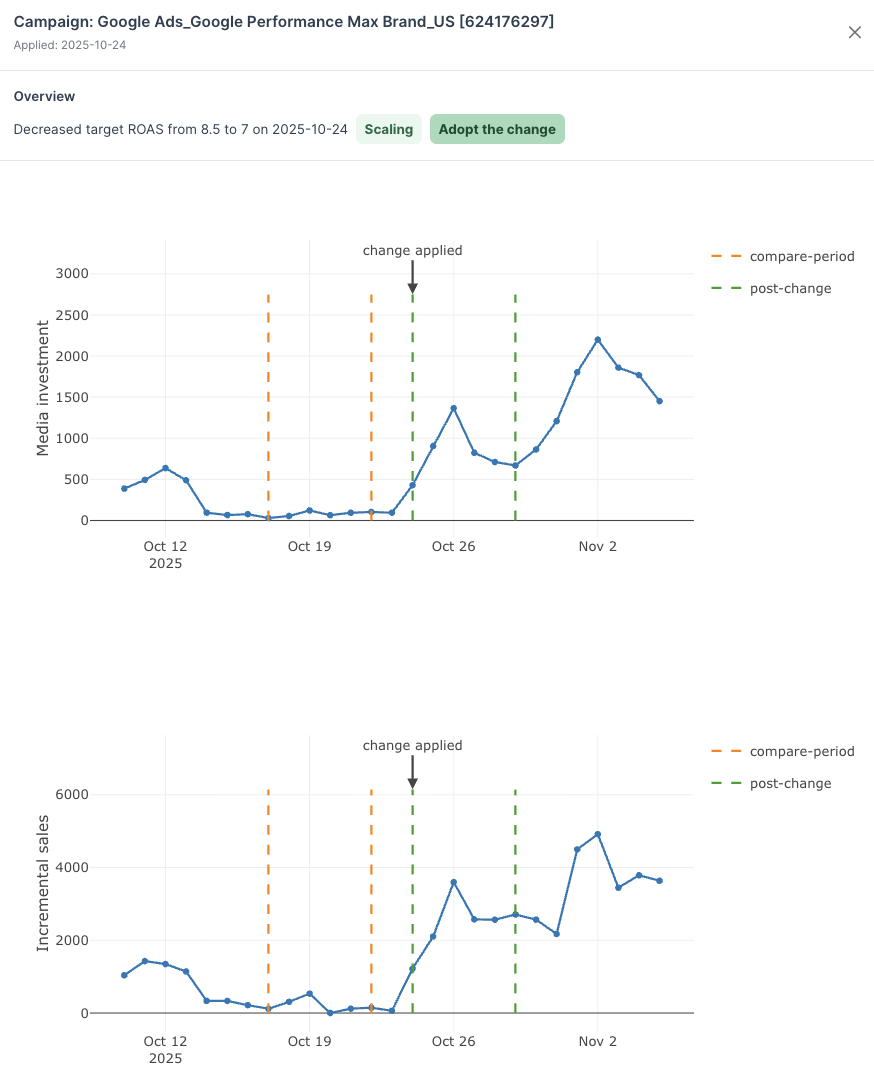
After the change, spend increases meaningfully. Media investment rises from roughly $404 to nearly $4,905, conversions increase from about 29 to 329, and incremental sales from $3,406 to $45,854.
This is not just growth. It's scalable growth.
Change Intelligence evaluates the counterfactual and calculates the marginal incremental ROAS of the additional spend. In this case, the return on the extra investment meets or exceeds the business’ required threshold.
The campaign was previously constrained but the adjustment unlocked profitable scale.
That is why the recommendation from Sellforte is clear: adopt the change.
Instead of leaving revenue on the table, Sellforte moved the campaign toward its optimal bidding range.
This is the difference between protecting efficiency too aggressively and scaling intelligently.
The same logic applies in the opposite direction.
Say you decrease target ROAS from 11 to 5. The algorithm is allowed to spend more aggressively, media investment increases sharply, clicks rise, and conversions grow.
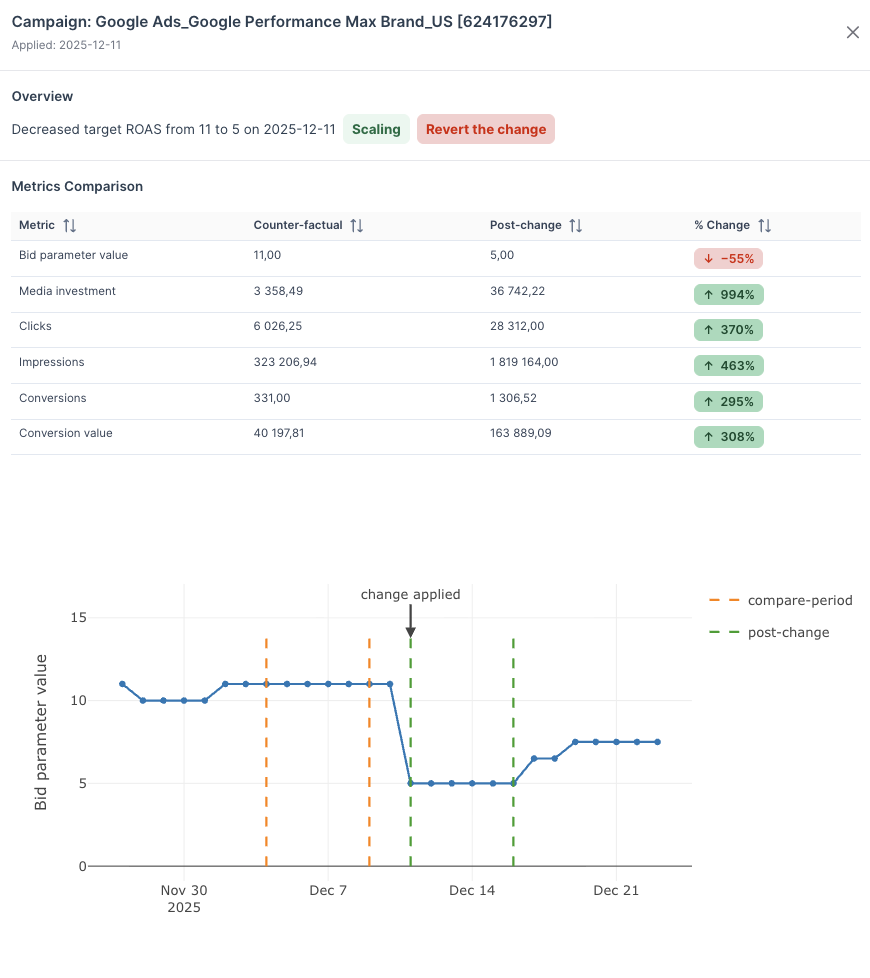
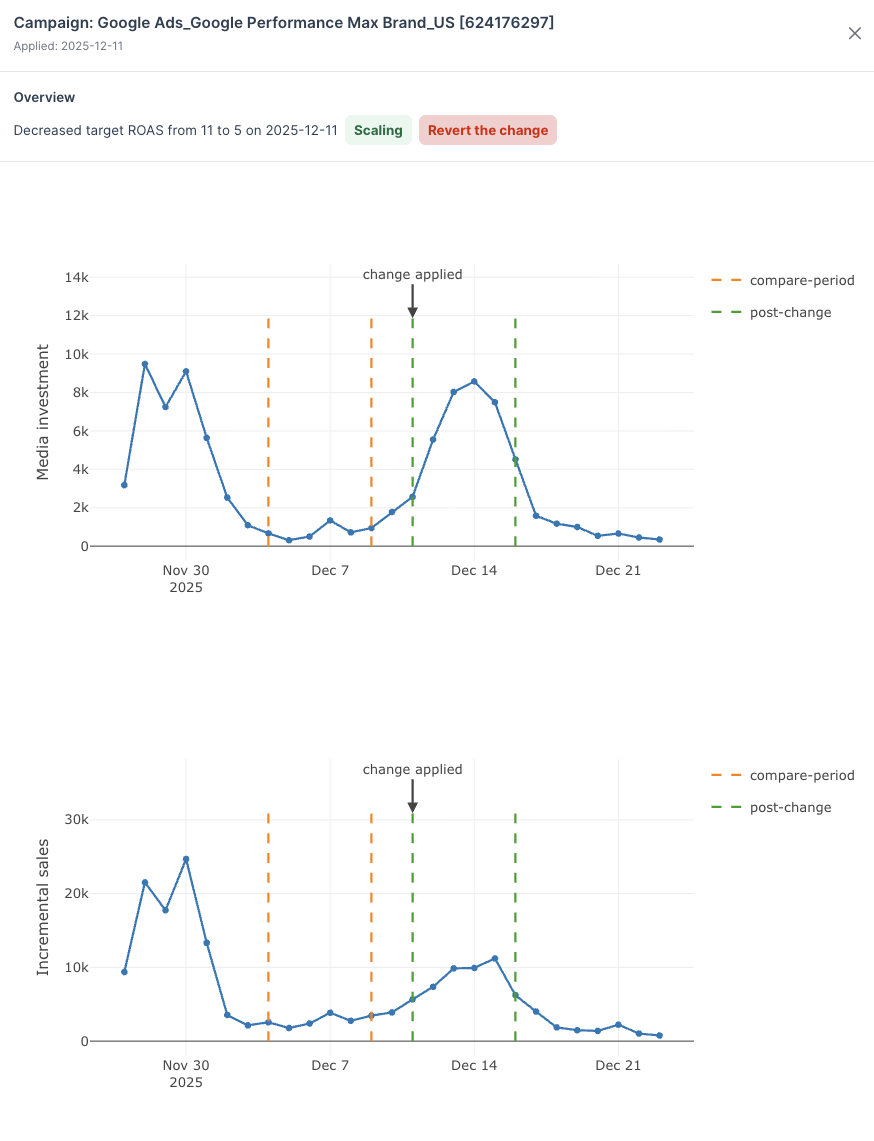
At first glance, this looks like a clear scaling success.
But Change Intelligence looks beyond surface-level growth. Instead of just comparing before and after performance, it evaluates what would have happened if target ROAS had remained at 11.
This counterfactual allows us to isolate the true incremental impact of the change.
In this case, incremental sales did increase, but spend increased even more.
When we calculate the marginal incremental ROAS of the additional investment, the return on the extra dollars falls below the business’ required threshold. In other words, revenue went up, but not enough relative to the extra investment.
Without this analysis, many teams would stop at “sales increased” and assume the change was successful.
Change Intelligence shows whether the last dollar spent was actually worth it.
That is the difference between scaling intelligently and overspending.
Want to see Change Intelligence in action?
Change Intelligence does not just analyze.
It operationalizes.
This is the real breakthrough, since now it's:
Pre → Post → Counterfactual → Delta → Marginal Return → Recommendation
And it's automated.
Every target ROAS change becomes a quasi-experiment.
Every experiment feeds back into optimal bid range recommendations.
Change Intelligence does not rely on naive before-after comparisons. It estimates the counterfactual, i.e. what would have happened without the change, and measures the true incremental impact.
And this is the operational breakthrough.
This approach unlocks three things performance marketers have been missing.
You are not measuring attributed conversions.
You are measuring incrementality-corrected sales.
No manual test setup.
No spreadsheets.
No geo splits.
This is the key.
The system does not just analyze.
It feeds learning back into:
That is the closed loop.
Today, many bid decisions are based on:
Change Intelligence replaces that.
The manual bid adjustments you make today (often based on incomplete or biased data) become validated, automated, and optimized.
Instead of reacting to noise, you steer toward marginal equilibrium.
And over time, the system learns.
Change Intelligence represents more than a new product.
It signals a shift in how performance marketing is measured, validated, and optimized on a daily basis.
As Juha Nuutinen, CEO of Sellforte, puts it, “Every marketing team already makes bid adjustments. The breakthrough is not running more experiments, it’s turning the changes you are already making into continuous, incrementality-corrected learning. That is how tactical steering becomes measurable and optimizable.”
This launch represents a clear shift:
MMM gives you structural incrementality.
Experiments give you intentional validation.
Change Intelligence gives you continuous operational learning.
Now the loop becomes:
Measure → Adjust → Validate → Learn → Recommend → Adjust again
Over time, performance marketing becomes self-improving.
Change Intelligence is the first step toward that vision.
Change Intelligence is now live and has already stated rolling out to Sellforte customers.
If you want:
We’d love to show you how it works:
Performance marketing shouldn’t rely on instinct.
It should learn from every target ROAS change.
Now it does.

Edward Ford is Marketing Director at Sellforte. He has over 15 years of marketing experience in B2B SaaS and Tech with specialization in marketing measurement and intelligence. Before joining Sellforte, Edward spent over 6 years at Supermetrics where he joined as an early-stage employee.