


Quick Answer: The Best Marketing Mix Modeling Tools in 2026
The best MMM tools depend on your needs:
Mid-sized to Large Retail and Ecommerce brands: Sellforte is a specialized Marketing Mix Modeling platform designed for Retail, Ecommerce and Direct-To-Consumer brands, providing campaign & ad set level measurement, enterprise-grade platform, and AI Agents that help marketers optimize their spend allocation.
Open-source MMM: Consider Google Meridian, Meta Robyn, or PyMC Marketing for building a Marketing Mix Modeling platform from the ground up in-house yourself.
Consultancy MMM: Consider Analytic Partners, Kantar, Circana, Nielsen, Ekimetrics, if you want a consultancy service for MMM (and not an MMM platform or tool).
Traditional MMM SaaS: Consider traditional MMM vendors, such as Recast, Liftlab, Keen Decision Systems, Rockerbox, Mutinex, Paramark if you don't need a solution that delivers campaign & ad set level recommendations,
SMB MMM Tools: Evaluate Prescient AI, Triple Whale, Northbeam, Fospha, Cassandra, WorkMagic, Seeda If you are a small company and looking for a simpler and lighter MMM with less optimization capabilities.
Each category serves different use cases depending on data maturity, team size, and optimization needs.
Introduction: 30 Marketing Mix Modeling Tools for Accelerating Growth in 2026
Marketing Mix Modeling (MMM) has become a vital tool for businesses looking to measure and optimize their media spend. In a world where last-click attribution is still broadly used in cross-channel measurement, MMM provides an alternative for measuring media ROI based on true incremental sales impact of each channel, campaign and ad set.
Modern MMM tools and software are more accessible and powerful than ever. But how should one choose which tool to adopt? In this article, we'll discuss the evaluation criteria for choosing an MMM tool, as well as evaluate top MMM solutions and MMM companies.
Quick Comparison: Best MMM Tools and Software in 2026
| # | Tool / Software | Type | Focus | ROI Granularity | Bidding recom-mendations for campaigns | AI Agents for optimization |
| 1 | Sellforte | Next-Gen MMM | Large to mid-sized Retail & Ecommerce | Campaign & ad set | Yes | Media Buyer Agent, Media Planner Agent |
| 2 | Google Meridian | Open-source MMM library | Enterprise Data Science teams | Channel / tactic level | No | No |
| 3 | Meta Robyn | Open-source MMM library | Enterprise Data Science teams | Channel / tactic level | No | No |
| 4 | PyMC Marketing | Open-source MMM library | Enterprise Data Science teams | Channel / tactic level | No | No |
| 5 | Uber Orbit | Open-source MMM library | Enterprise Data Science teams | Channel / tactic level | No | No |
| 6 | Analytic Partners | Consultancy MMM | Enterprises | Channel / tactic level | No | No |
| 7 | Nielsen | Consultancy MMM | Enterprises, esp. CPG | Channel / tactic level | No | No |
| 8 | Circana | Consultancy MMM | Enterprises | Channel / tactic level | No | No |
| 9 | Ekimetrics | Consultancy MMM | Enterprises | Channel / tactic level | No | No |
| 10 | Kantar | Consultancy MMM | Enterprises | Channel / tactic level | No | No |
| 11 | Ipsos MMA | Consultancy MMM | Enterprises | Channel / tactic level | No | No |
| 12 | Nepa | Consultancy MMM | Enterprises | Channel / tactic level | No | No |
| 13 | Lifesight | MMM SaaS | CPG, Consumer services, Apps, Retail, Ecom | Campaign & ad set | No | No |
| 14 | Incrmntal | MMM SaaS | Gaming | Campaign & ad set | No | No |
| 15 | Recast | MMM SaaS | Small to mid-sized advertisers | Channel / tactic level | No | No |
| 16 | Cassandra | MMM SaaS | B2B, Universities, Charity,+ others | Channel / tactic level | No | No |
| 17 | Keen Decision Systems | MMM SaaS | CPG, travel, B2B, retail, QSR | Channel / tactic level | No | No |
| 18 | Measured | MMM SaaS | Tech, CPG, Financial, Hospitality, + others | Campaign & ad set | No | No |
| 19 | LiftLab | MMM SaaS | Small to mid-sized advertisers | Channel / tactic level | No | No (Miles Agent for historical analysis) |
| 20 | Paramark | MMM SaaS | Small to mid-sized advertisers | Channel / tactic level | No | No |
| 21 | Mutinex | MMM SaaS | Enteprises | Channel / tactic level | No | MAITE Agent |
| 22 | DoubleVerify / Rockerbox | MMM SaaS | Small to mid-sized advertisers | Campaign & ad set | No | No |
| 23 | Seeda | MMM SaaS | SMBs | Channel / tactic level | No | No |
| 24 | WorkMagic | MMM SaaS | SMBs | Channel / tactic level | No | No |
| 25 | Aryma Labs | MMM SaaS | Broad | Channel / tactic level | No | Aryma Nebula |
| 26 | Prescient AI | MMM SaaS | SMBs | Campaign & ad set | No | No |
| 27 | Fospha | MTA + Light MMM | SMBs | Campaign & ad set | No | No (Spark ROAS Agent in Beta for historical analysis) |
| 28 | Triple Whale | MTA+ Light MMM | SMBs | Campaign & ad set | No | Moby Agents |
| 29 | Northbeam | MTA + Light MMM | SMBs | Campaign & ad set | No | No |
| 30 | Objective Platform | Consultancy + SaaS | Auto, FMCG, Insurance, Utilities, Energy, Telco +others | Channel / tactic level | No | No |
What is Marketing Mix Modeling (MMM)?
Marketing Mix Modeling (MMM) is a statistical analysis technique to measure how investments in marketing are driving revenue. By analyzing historical data, MMM is able to explain how different channels, such as Google Performance Max and Meta Advantage+, contribute to sales.
MMM quantifies the return on investment (ROI) for media spend, enabling data-driven media spend optimization decisions. Below is an illustration of how MMMs work:
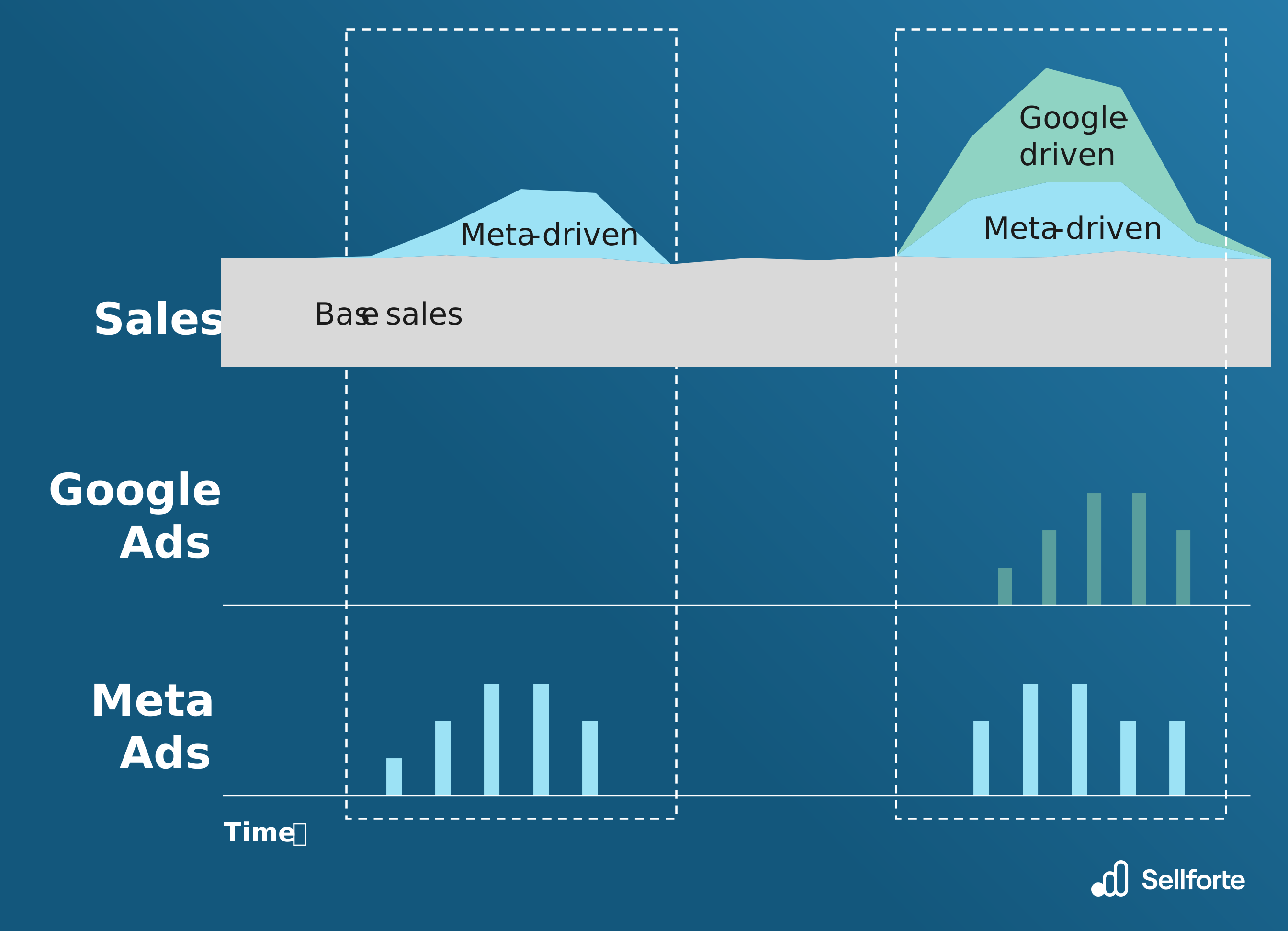
While MMMs traditionally have operated purely on time-series data illustrated above, Next-Gen MMM solutions have evolved to integrate even more data into the analysis: they also leverage incrementality tests and attribution data to uncover the true ROI of each channel, campaign and ad set.
What are Marketing Mix Modeling (MMM) Tools and Platforms?
MMM tools measure the ROI of different marketing activities and provide recommendations on optimal spend allocation to each channel, campaign and ad set.
To achieve this, MMM tools use Marketing Mix Modeling that ingests data on sales, marketing, promotions and external factors, and estimates marketing ROI from the data using various modeling techniques, such as Bayesian inference and model calibration.
MMM tools typically have following capabilities
-
Measure ROI and incremental sales contribution of each channel / tactic (e.g., Google Performance Max), campaign and ad set
-
Measure Marginal Incremental ROAS (miROAS), which is the return for the next dollar spent on the channel, campaign or ad set. miROAS enables spend optimization.
-
Provide optimal budget allocation across channels, campaigns and ad sets
-
Provide bidding recommendations for each campaign and ad set
-
Automate measurement and optimization workflows with AI Agents
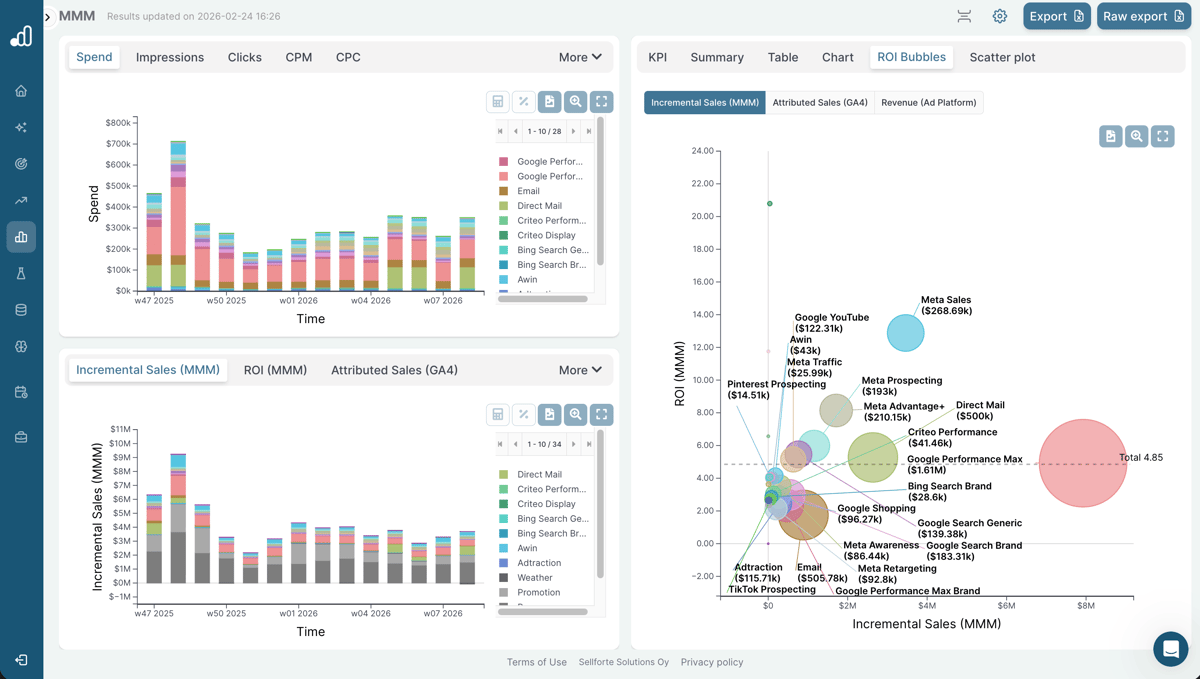
The image below shows a typical example of an analysis dashboard in an MMM tool.
The 5 Categories of MMM Tools and Software
The MMM tool market in 2026 can be divided into five distinct categories based on how granular the insights are, how the models are built, how frequently insights are updated, and how actionable the outputs are for marketers. Some solutions are frameworks that require heavy internal work, while others are fully automated systems designed for daily decision-making.
| # | Solution type | Typical user | Examples | Update frequency | Measurement Granularity | Bidding recom-mendations for campaigns |
| 1 | Next-Gen MMM | Large and mid-sized Retailers and Ecommerce brands | Sellforte | Daily | Campaign & ad set | Yes |
| 2 | In-house solution built with an open-source MMM library | Enterprises with own data science teams and large amount of funding | Google Meridian, Meta Robyn, PyMC | Quarterly, monthly or weekly | Channel / tactic level | Not available |
| 3 | Traditional MMM with a Consultancy model | Enterprises requiring consulting support | Analytic Partners, Circana, Nielsen | Annual, quarterly or monthly | Channel / tactic level | Not available |
| 4 | Traditional MMM with a SaaS model | Mid-sized businesses who don't require campaign-level measurement | Recast, Liftlab, Keen Decision system | Monthly or weekly | Channel / tactic level | Not available |
| 5 | Light MMM for small businesses | Small ecommerce businesses who don't need advanced optimization tools | Triple Whale, Northbeam, Fospha | Daily or Weekly | Campaign & ad set | Not available |
1. Next-Gen MMM: Campaign-Level Measurement and Recommendations, AI Agents
Examples: Sellforte
Typical user: Large and mid-sized Retail and Ecommerce brands
Update frequency: Daily
Measurement Granularity: Campaign & Ad set
Bidding Recommendations for campaigns: Yes
Next-Gen MMMs are the most advanced MMM solutions in the market, delivering campaign & ad set level measurement, daily updates, bidding recommendations and built-in AI agents for optimization.
These platforms work well for large- to mid-sized marketing teams in retail and ecommerce teams, because they are
- Granular: They measure Marginal Incremental ROAS and response curves at the Campaign and Ad Set level
- Optimization-focused: They have advanced optimization features, such as bidding recommendations, scenario planning tools
- Agentic: They AI Agent automating marketers workflows, such as Media Planner Agent, Media Buyer Agent, Experiments Agent
This approach is designed for ecommerce brands that want MMM to guide daily marketing decisions rather than periodic reporting.
2. Building own MMM with an Open-Source MMM Library
Examples: Google Meridian, Meta Robyn, PyMC Marketing
Typical user: Enterprises with own data science teams
Update frequency: Quarterly, Monthly or weekly
Measurement Granularity: Channel / Tactic level
Bidding Recommendations for campaigns: No
Open-source MMM libraries are statistical frameworks that allow data science teams to build their own in-house marketing mix modeling platform from the ground up.
They offer modeling methods but they don’t function as full software solutions. Organizations need to develop their own data pipelines, automate models, and create dashboards and optimization systems on top of them. How frequently updates happen is fully determined by the company’s internal setup. Some teams refresh their models weekly, others monthly. Updating them on a daily basis isn’t possible.
3. Traditional MMM with a Consultancy model
Examples: Analytic Partners, Circana, Nielsen
Typical user: Enterprises requiring consulting support
Update frequency: Annual, Quarterly, or Monthly
Measurement Granularity: Channel / Tactic level
Bidding Recommendations for campaigns: No
If you want a consultancy service for MMM (and not an MMM platform or tool), consider Analytic Partners, Kantar, Circana, Nielsen, Ekimetrics, Nepa, Objective Platform, Aryma Labs, Proof Analytics.
4. Traditional MMM with a SaaS model
Examples: Recast, Liftlab, Keen Decision Systems
Typical user: Mid-sized businesses who don't require campaign-level measurement
Update frequency: Monthly or weekly
Measurement Granularity: Channel / Tactic level
Bidding Recommendations for campaigns: No
Traditional MMM with a SaaS model are platforms that automate model building and provide a user interface for marketing teams. Most of them update models on a monthly or weekly or monthly cadence. With some exceptions, these tools typically measure marketing impact at the channel, making them less useful in some segments such as Retail and Ecommerce.
Because these tools can't provide campaign & ad set level measurement, Ecommerce and retail teams need to have a different tools for more granular optimization, such as Multi-Touch Attribution (MTA). MMM+MTA combination makes optimization challenging because the tools give conflicting direction. MMM might guide marketer to reduce branded search spend, but if MTA consistently shows high ROAS for branded search campaigns, the team will not act on it.
5. Light MMM for small businesses
Examples: Fospha, Triple Whale, Northbeam
Typical user: Small ecommerce businesses who don't need advanced optimization tools
Update frequency: Weekly or Daily
Measurement Granularity: Campaign & Ad set
Bidding Recommendations for campaigns: No
Some multi-touch attribution (MTA) tools have introduced basic MMM features to enhance their MTA-based measurement. By combining attribution data with MMM, these platforms can deliver updates on a daily basis.
However, while this setup enables fast insights, it typically falls short in terms of causal validation and statistical robustness compared to more comprehensive MMM solutions. Their optimization features are also more limited. Because of this, they’re commonly adopted by smaller ecommerce companies and then replaced with more advanced, enterprise-grade MMM solutions as the business scales.
How to Choose a Marketing Mix Modeling Tool?
Before we dive into the specific MMM tools, let's discuss how to choose an MMM tool. Here's three recommendations questions I would look at when choosing a modern MMM tool today:
- Optimization use-cases: Choose an MMM tool that has optimization capabilities that help your drive most sales
- Agentic MMM: Choose an MMM tool with AI Agents that automate your planning and optimization workflows
-
Trust: Choose an MMM tool that produces high quality modeling results
1. Optimization Use-cases: Choose an MMM Tool That Covers Use-Cases that Helps You Drive Most Sales
Your primary goal is to ensure that the Marketing Mix Modeling solution you choose includes optimization capabilities that help you drive sales growth and improve marketing ROI. In our research Unlock 6.5% More Sales with Marketing Mix Modeling, we found out that there's three large levers for driving sales growth. These are illustrated in the picture below:
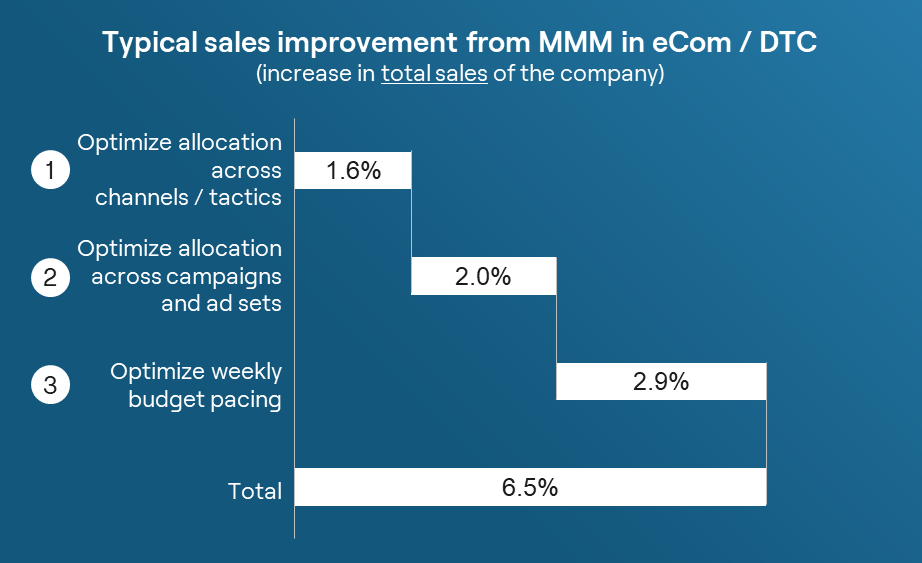
Let's walk through each of these growth levers.
1. Optimize spend allocation across channels/tactics (+1.6% more sales). In this lever, MMM recommends optimal spend allocation for each channel/tactic, such as Google Performance Max, Meta Advantage+, Meta prospecting. Being able to provide channel/tactic-level spend optimization requires measuring miROAS (Marginal Incremental ROAS) for each channel /tactic. miROAS tells the return for the next spent dollar on the channel.
Below is an example for cross-channel spend optimization from public Sellforte demo.
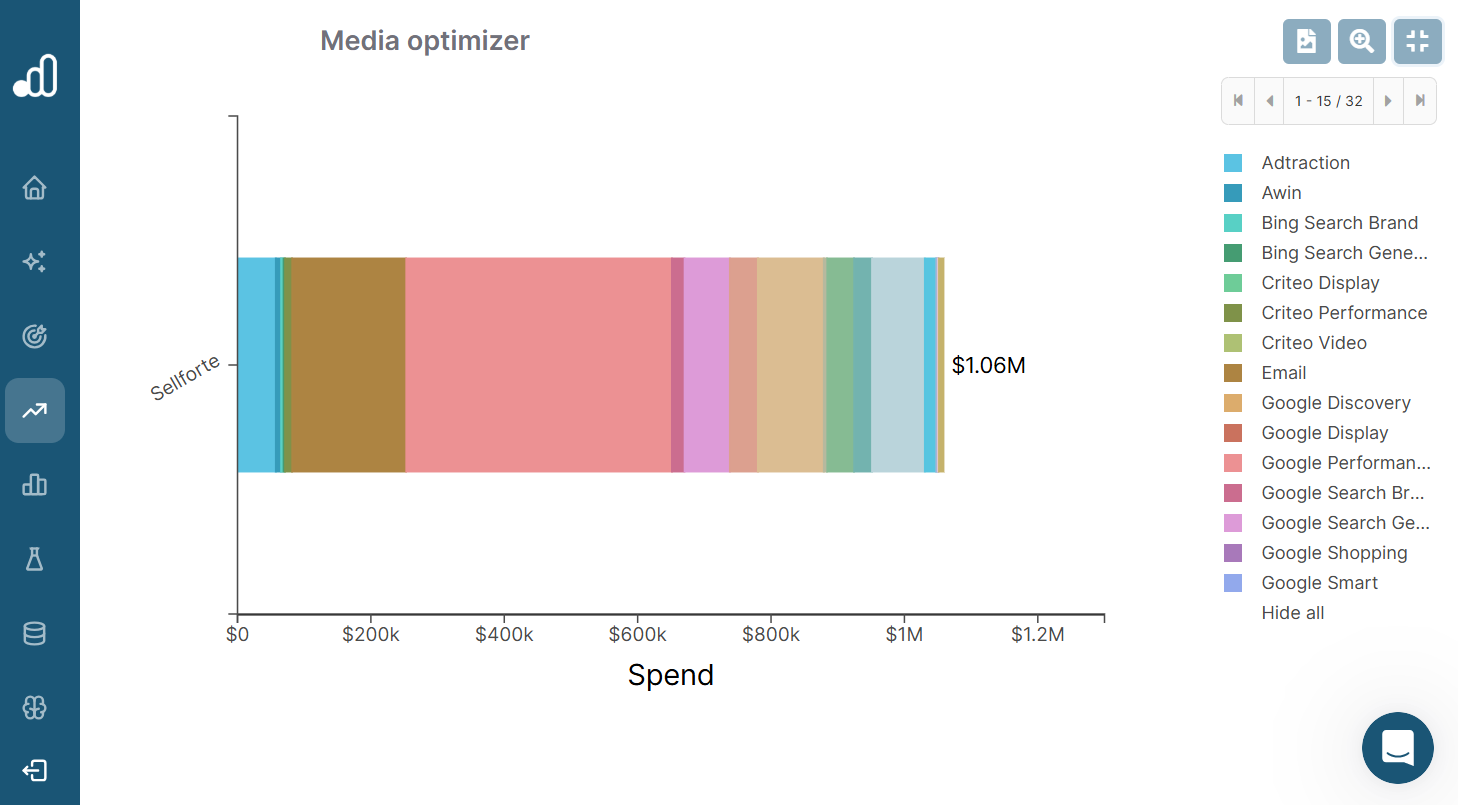
💡Channel-level of optimization is a basic MMM feature. If your MMM doesn't cover this, you look for other alternatives.
2. Optimize budget pacing (+2.0% more sales). Budget pacing ensures that your advertising spend is distributed optimally across weeks, preventing for example overinvestment when demand is naturally low and underinvestment when there’s high level of natural demand. Budget pacing requires that the MMM can produce realistic week-level spend recommendations for each channel/tactic, which are based on understanding business-specific demand seasonality and promotional dynamics.
Below is an example of budget pacing recommendation for the next 5 weeks from the public Sellforte demo.
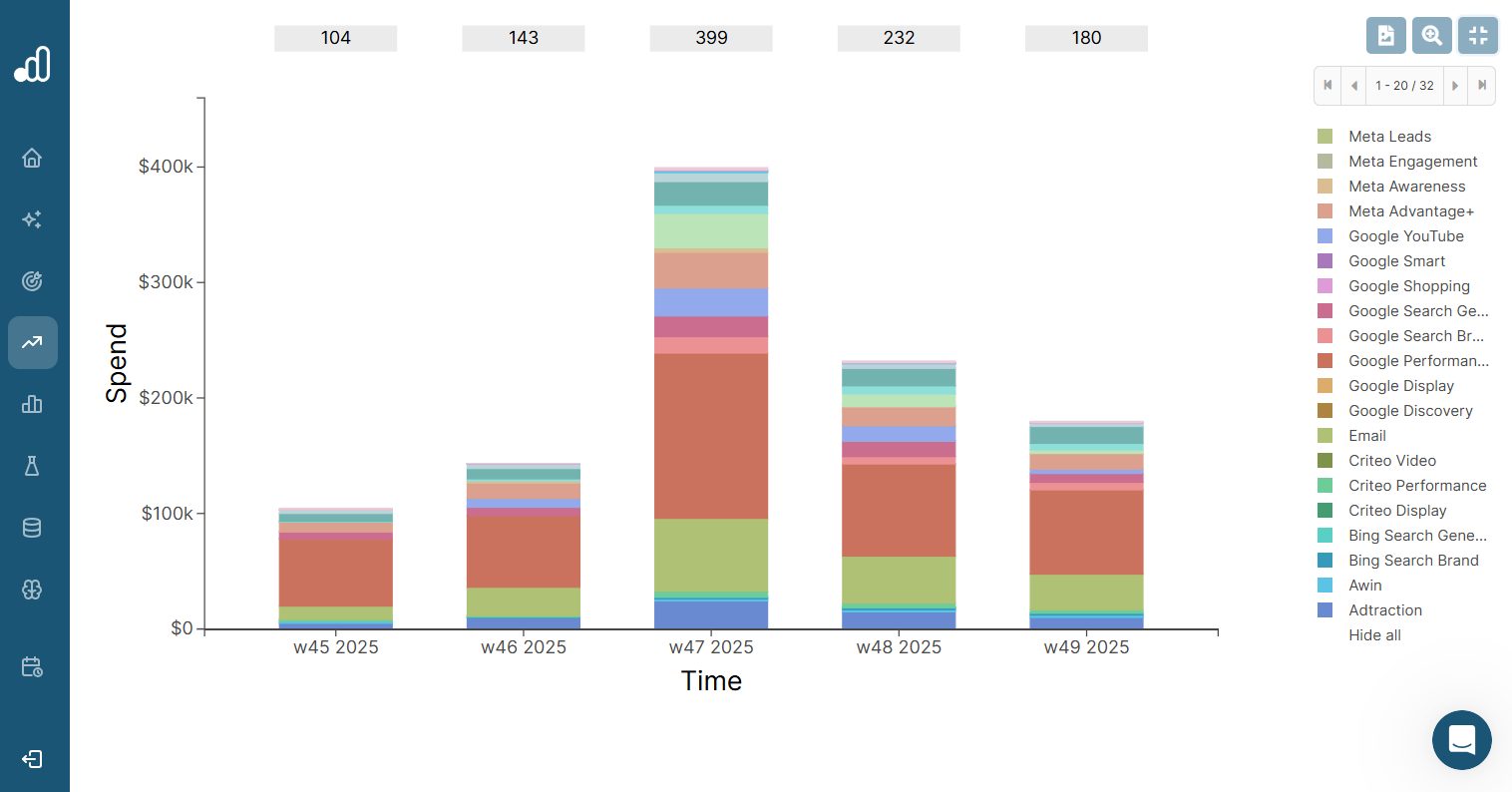
💡 Optimizing budget pacing is a Next-Gen MMM feature. It doubles MMM's value when compared to channel-level spend optimization
3. Optimize spend allocation across campaigns and ad sets (+2.9% more sales). Best Marketing Mix Models today provide optimal spend allocation for each campaign and ad set. Being able to do this requires extreme sophistication from MMM: It needs to be able to estimate response curves and miROAS for each campaign and ad set. The most advanced MMMs, like Sellforte, go even beyond this: they translate recommended spend changes to optimal bid values.
Below is an example of a dashboard providing optimal bid values for each campaign and ad set, based on the public Sellforte demo.
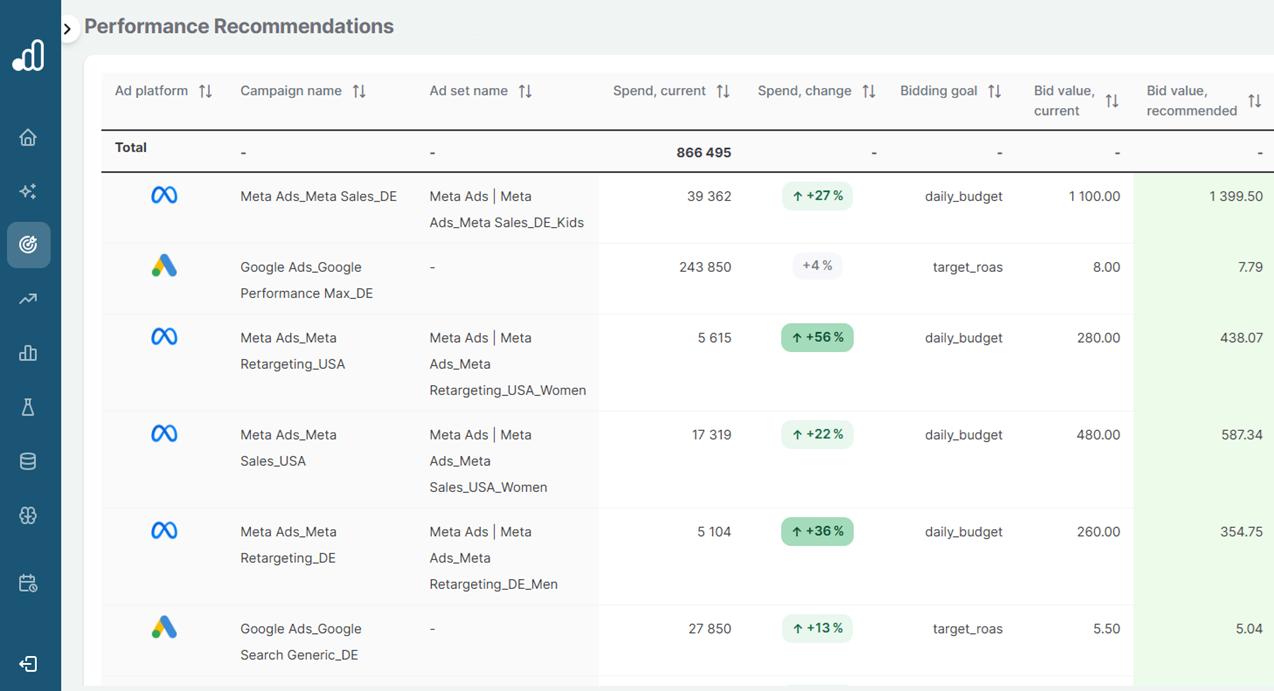
💡 Optimizing spend for each campaign and ad set is a Next-Gen MMM feature. It is the most impactful optimization use-case for MMM.
2. Agentic MMM: Choose an MMM tool with AI Agents that Automate Your Workflows
Once you've checked that the MMM tool you're evaluating has the optimization capabilities you need, it's time to look at its AI capabilities.
Why is this relevant? We are entering the era of Agentic MMM, where MMM tools have AI Agents that help you find optimal media spend allocations and even execute media buying. They can save your marketing team and agency countless of hours that are typically spent in budget planning or tinkering with bid levels in ad platform tools. Agentic Marketing Mix Modeling (MMM) combines two technologies:
- MMM's superpower to understand how media affects revenue
- AI Agents' superpower to help marketers in specific tasks, such as media planning, revenue forecasting or media buying.
For clarity, Agentic MMM is not about changing how the MMM analysis itself is done: we don't have AIs yet that can do the modeling part with the same rigor and quality than we can. Instead, AI Agents are using the MMM results and tools connected to them to help marketers get answers to their questions faster. This ensures that the agentic optimization workflow has the same rigor and quality that a non-agentic workflow would have.
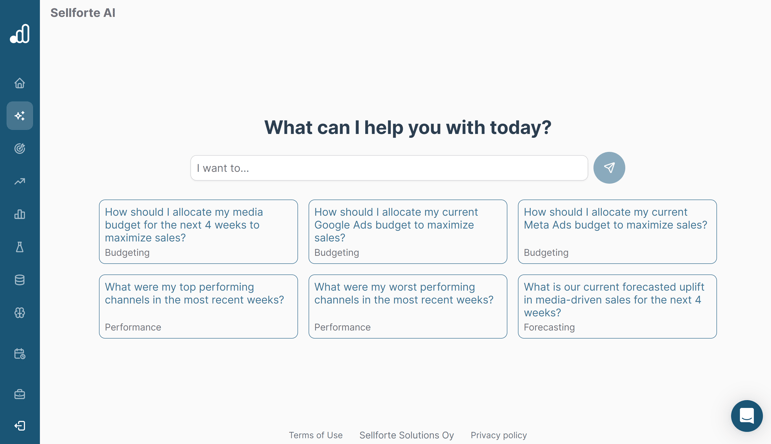
Agents are accessed from a ChatGPT-like conversional interface. Below is an example from the public Sellforte demo.
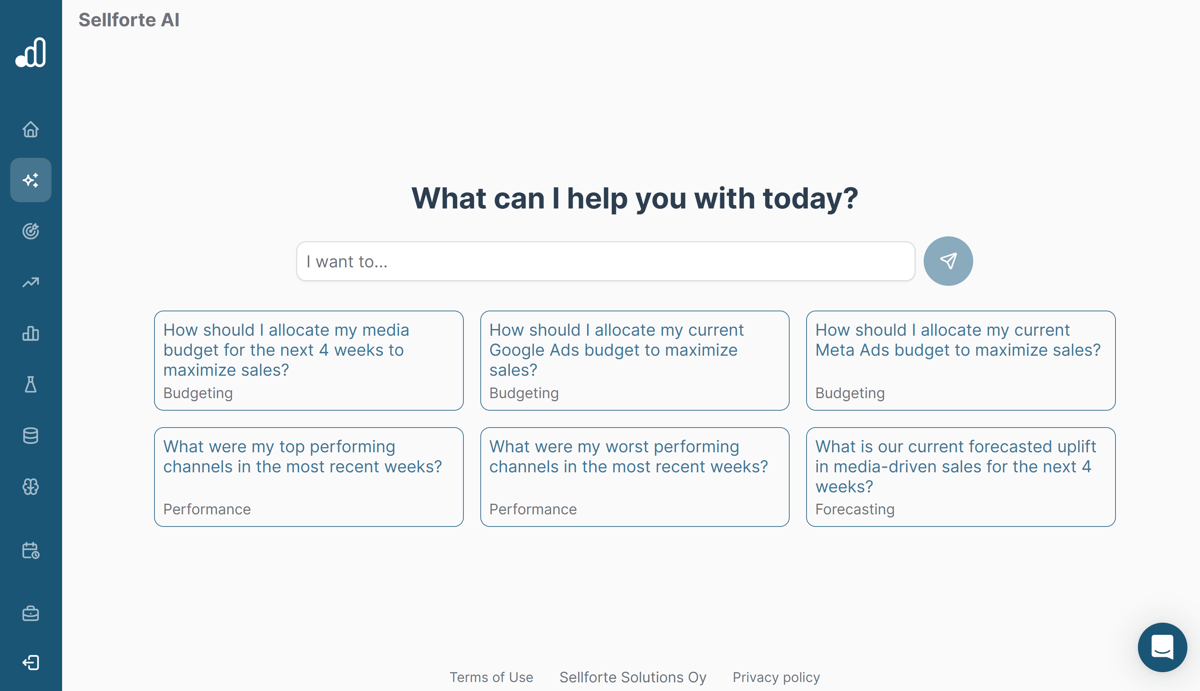
Marketers can ask the AI any questions related to marketing performance or optimization, such as
- How should I allocate my media budget for the next 4 weeks to maximize sales?
- How should I allocate my current Google Ads budget to maximize sales?
- What were my top performing channels in the most recent weeks?
Underneath the conversational interface, AI agents are doing their work. As an example, Sellforte AI has three agents:

👩💻 Media Planner Agent answers all the optimization, planning and forecasting-related questions. Under the hood, it is using Sellforte's optimization tools to answers marketers' questions.
👨💼 Media Buyer Agent execute the plans you are building with Media Planner Agent, byl pushing bid value changes directly Google, Meta etc. You can define how the Media Buyer Agent operates. It can operate in full self-drive mode, automating your media buying against certain objectives, or in an assisted-drive mode, where you are approving the actions it wants to take
🧑🔬 Experiments Agent recommends, designs and analyses incrementality tests for you. It also tries to uncover the hidden experiments you have accidentally done in the history, trying to minimize the need for new tests.
💡Next-Gen MMMs have built-in AI Agents. They will answer your measurement & optimization questions fast and save you countless of hours spent you would have otherwise spent finding the answers
3 Trust: Choose an MMM Tool That Produces High Quality Results
Once you've checked that the MMM tool has the required optimization capabilities that help you drive more sales, and AI Agents that help you use those optimization capabilities, you need to determine whether you can trust the MMM results sufficiently to act on the recommendations.
Here’s the reality: many Marketing Mix Models on the market produce low-quality, unreliable results. Why? While generating MMM results has become easier than ever with free-to-use modeling libraries, the real challenge remains: MMM datasets are often noisy and plagued by multicollinearity. This makes building stable, high-quality models that generate accurate results challenging.
Fortunately, there are indicators that can help you assess whether an MMM vendor delivers high-quality results. Here’s a checklist:
Basic features:- Basic statistical model validation
- Bayesian approach
- MMM is calibrated with informative priors, based on a robust calibration framework covering geo lift experiments, conversion lift studies, and attribution data
- In-built tools for analyzing Experiments, including Geo Lift tests and Conversion Lift Tests
- Promotions are included in measurement in Retail and eCom/DTC
- Advanced model validation based on model outputs
💡Best practice: Check the Model Calibration Framework
When taking a demo from an MMM vendor, ask for their model calibration framework. It is the one of the most influential elements for the quality of modeling results. As an example, here's Sellforte's approach: Calibrating Marketing Mix Models with Experiments and Attribution data.
4. Bonus: Additional features for evaluation
Here's a list of additional features you can evaluate, depending on your needs for the MMM solution.
| Topic | Best practice |
| Onboarding time |
|
| Data integrations |
|
| Modeling capabilities |
|
| Support |
|
| Public resources supporting your buying process |
|
How This Comparison Article Was Created
To create this article, we assessed 30 marketing mix modeling tools, platforms and vendors. We evaluated following criteria: approach, industry focus, update frequency, measurement granularity, optimization capabilities, and ability to deploy AI Agents to help marketers automate spend optimization workflows. As data sources, we evaluated review sites (such as G2), solution pages, technical product documentation, demos, customer references, case studies, and webinar recordings.
1. Sellforte: Next-gen MMM
Summary
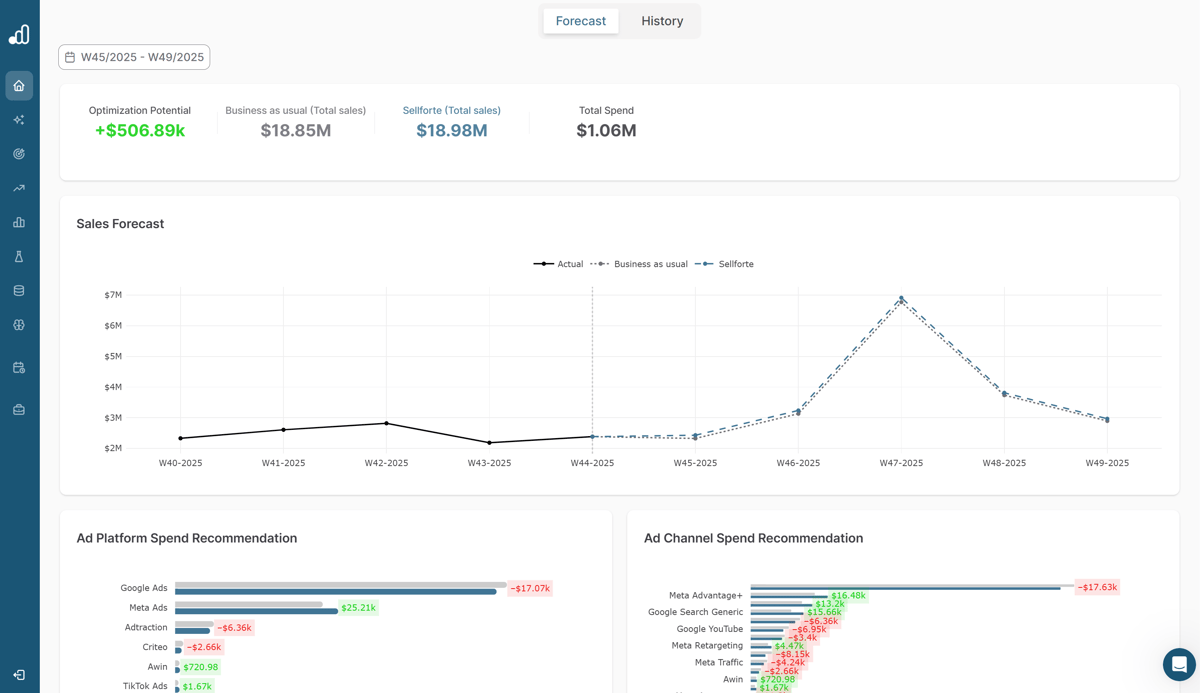
Summary: Sellforte is a next-gen MMM platform designed for Ecommerce, Retail and DTC brands that helps marketers measure and optimize performance across channels, campaign and ad sets.
Unlike traditional MMM approaches that focus on channel-level analysis, Sellforte provides insights at the campaign and ad set level. Sellforte results are updated daily for digital channels. Sellforte is a leader in Agentic MMM, which enables marketers automate their measurement and optimization workflows.
Update frequency: Daily
Measurement granularity: Campaign & Ad set level
Bidding recommendations for campaigns ad sets: Yes, available
AI Agents for optimization: Media Planner Agent, Media Buyer Agent, Experiments Agent
Target Segment: Mid-sized and Large ecommerce, DTC and Retail brands
Approach: Bayesian MMM and Experiments combined with attribution data
Why Sellforte Is the Top Marketing Mix Modeling Tool For Ecommerce and Retail
1. Sellforte provides bidding recommendations for each campaign and ad set, whereas other tools focus on channel-level recommendations.
2. Sellforte is an enterprise-grade MMM SaaS vendor fully specialized in Ecommerce and Retail. Tailored specifically for Retail & Ecommerce, Sellforte's modeling takes into account industry-specific characteristics such as promotions, seasonalities and product-group level dynamics. Sellforte MMM covers all sales channels from physical stores to ecommerce, and includes all media cross offline and digital channels.
3. Sellforte is the leader in Agentic MMM, making industry leading optimization accessible to a broader range of marketing team members. As a result, teams can transition from measurement to optimization significantly faster.
Key Capabilities
Enterprise-grade Marketing Mix Modeling solution: robust battle-tested MMM, built to handle all spend optimization use-cases from strategic to tactical, secure automated data integrations, enterprise-grade customer success.
Trusted by leading brands in Ecommerce: The platform is battle-tested by leading pureplay ecommerce businesses such, as bonprix , as well as major retailer operating ecommerce businesses, such as C&A and Tchibo.
Incrementality testing: MMM is calibrated and validated with Geo Hold out tests and Conversion Lift tests to maximize accuracy and robustness.
Campaign & ad set level spend and bidding recommendations: Enables performance marketing teams conduct continuous tactical optimization at the campaign and ad set level, and finally transition from MTA-reported ROAS to incrementality-based optimization.
Measures Marginal Incremental ROAS (miROAS), which shows the return for the next dollar spent in a campaign or ad set. Instead of only explaining past performance, the model estimates where additional spend will generate the highest incremental revenue.
AI Agents for optimization: Instead of navigating dashboards, users can ask questions from Sellforte AI, such as what is the optimal spend allocation for the next quarter, or which campaigns and ad sets have room to scale.
Strengths
- Battle-tested platform: Strong public references across large enterprise ecommerce businesses (such as bonprix), rapidly growing ecommerce brands (such as Represent), and major retailers (such as Lidl)
- Most advanced optimization technology: Sellforte provides optimal spend and bid value for each campaign & ad set, based on Marginal Incremental ROAS (miROAS)
- Optimization focus, supported by AI: Advanced features for spend optimization, ranging from use-case specific optimization views to AI Agents
- Enterprise-grade MMM features such as measuring offline media, modeling all sales channels (ecom, retail, Amazon,..), modeling Promotions, Experiments, Optimizer
Limitations
- Narrow industry-focus: Purely focused on Ecommerce, DTC and Retail. Might not be the right solution for B2B companies or FMCG brands without own online or retail store
- Narrow use-case focus to media measurement and optimization: Not catering to other ecommerce use-cases, such as inventory management
Best for
Sellforte is best for mid-sized and large Ecommerce and Retail businesses who want the most advanced real-time MMM solution for optimizing media spend on channel-level and campaign/ad set level.
💡 Pro Tip: Try Sellforte today and see pricing
Sellforte is one of the few MMM vendor with open public demo and public pricing.2. Google Meridian (Build-it-yourself MMM)
Meridian enables organizations to develop customized Marketing Mix Models. Like Sellforte, Meridian leverages Bayesian MMM approach. It incorporates several advancements studied by Google Research teams over the years, providing a powerful toolkit for skilled analysts and data scientists. With Meridian, users can:
- Build models using Python
- Analyze key outputs, such as Marketing ROI and diminishing return curves.
- Optimize media budget allocation by creating scenarios in Python and reviewing the results as plotted graphs.
Meridian accelerates the process of developing Bayesian Marketing Mix Models, saving data scientists the effort of manually implementing essential MMM components like adstock effects and diminishing returns.
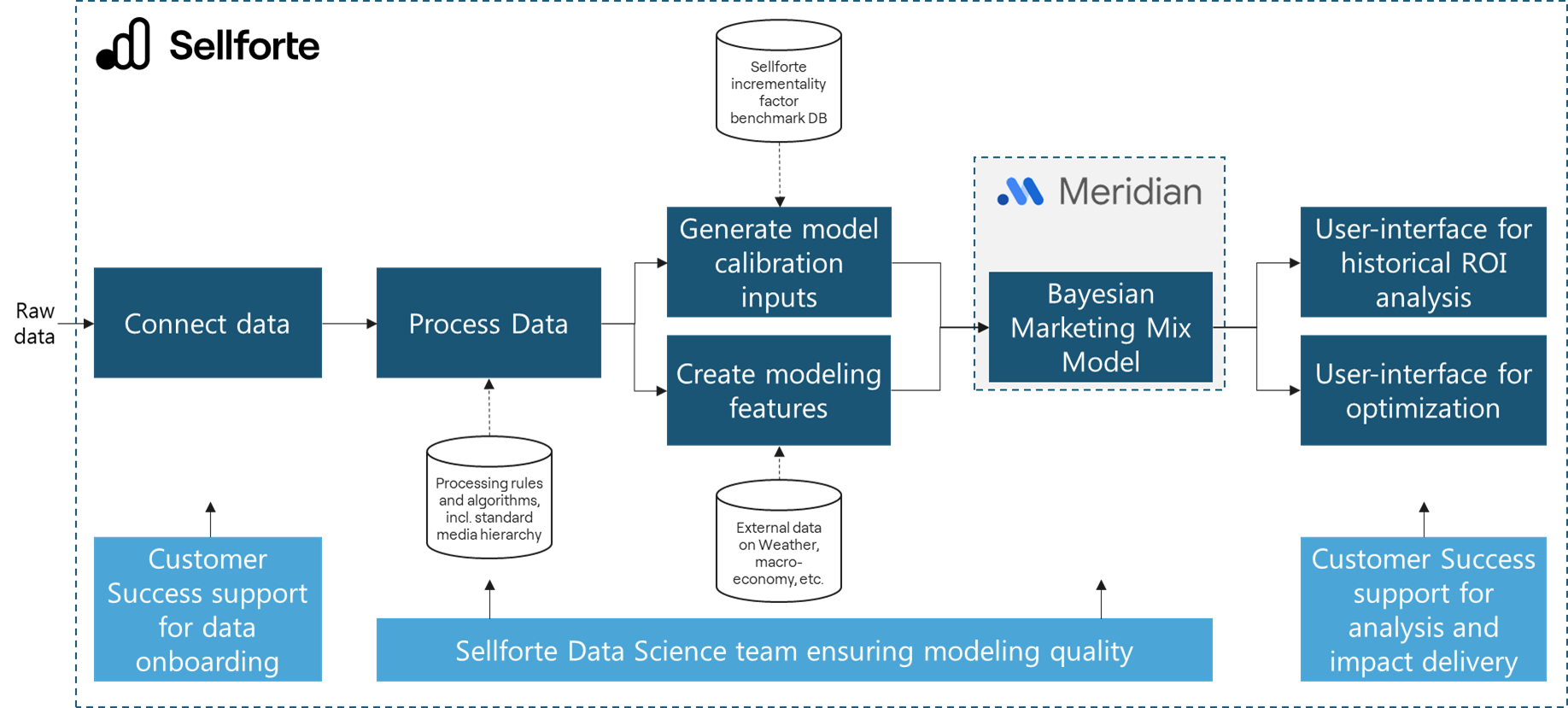
This solution is best suited for companies with experienced data science and software development teams looking to build a highly customized MMM framework almost from scratch. However, compared to a comprehensive MMM platform like Sellforte, Meridian lacks a user-friendly interface for marketers to conduct analyses and optimize media budgets. Additionally, it does not include built-in data connectors for ad platforms, automated data processing pipelines, or automated model calibration workflows. The image below summarizes the scope difference between Meridian and Sellforte.
💡Best Practice: Learn the difference between MMM SaaS and Do-It-Yourself MMM
Using an MMM SaaS and building an own solution from ground up are two very different things - make sure you understand the difference. Here's a detailed comparison between Meridian and Sellforte: Meridian vs. Sellforte MMM SaaS: The Complete Comparison for 2025.
3. Meta Robyn MMM (Build-it-yourself MMM)
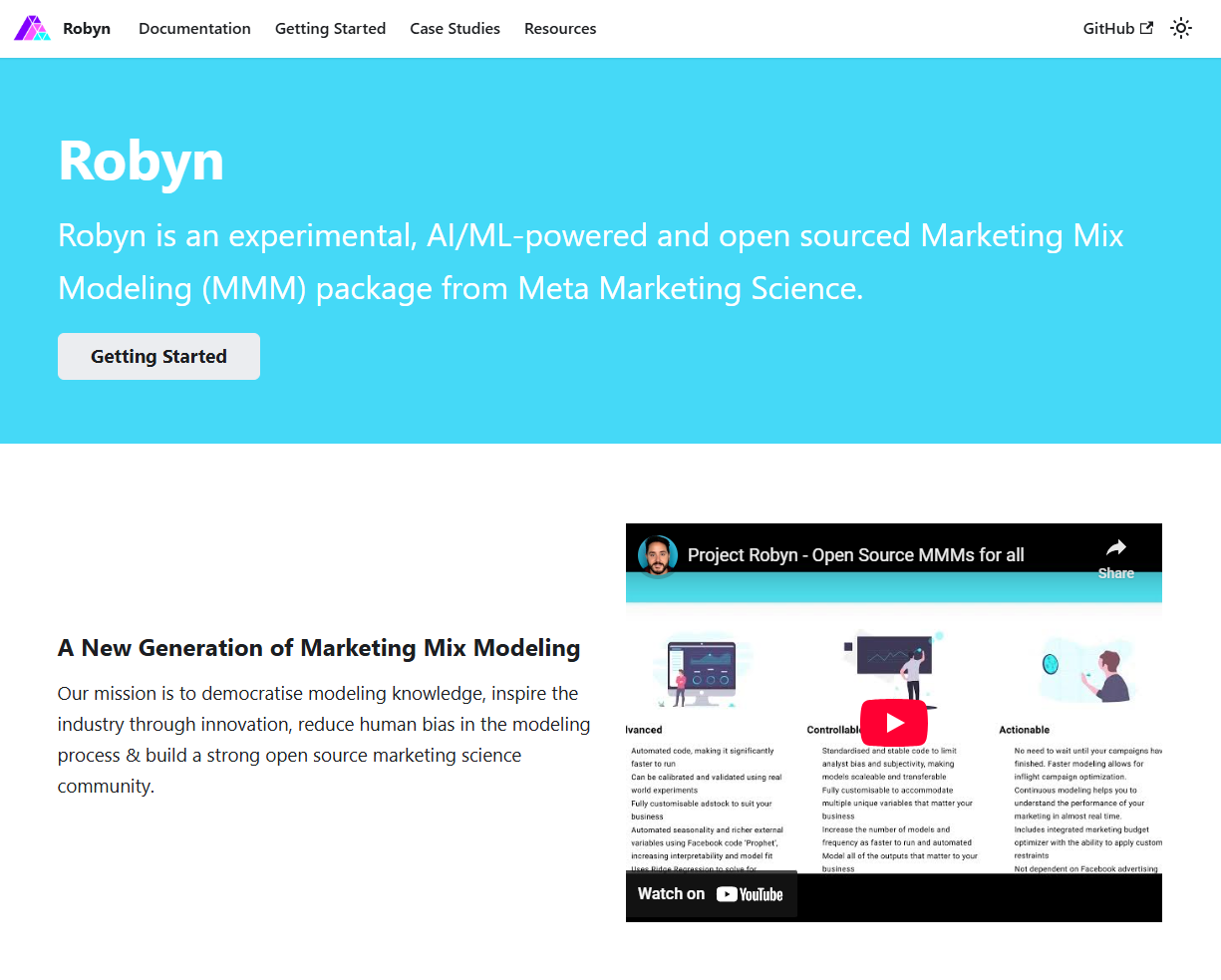
Robyn, developed by Meta, is an open-source Marketing Mix Modeling (MMM) library that allows businesses to create customized marketing mix models. It leverages Facebook’s Nevergrad optimization library along with the Prophet time-series forecasting library. Nevergrad applies advanced machine learning techniques—such as Bayesian optimization and genetic algorithms—to fine-tune model parameters. Robyn also utilizes hyperparameter optimization, running thousands of model variations with different parameter settings to identify the most accurate configuration.
Like Meridian, Robyn is best suited for companies with experienced data science and engineering teams looking to build a fully customized MMM solution from the ground up. However, compared to a complete MMM platform like Sellforte, Robyn lacks a user-friendly interface for marketers to analyze results and optimize scenarios. Additionally, it does not include built-in data connectors to ad platforms, automated data processing pipelines, or automated model calibration workflows.
Compare Robyn and Sellforte: Comparison of Robyn vs Lightweight vs Marketing Mix Modeling SaaS.
4. PyMC-Marketing (Build-it-yourself MMM)
PyMC-Marketing is an open-source library built on PyMC. Like Sellforte and Meridian, PyMC-Marketing leverages a Bayesian Marketing Mix Modeling (MMM) approach.
PyMC-Marketing is best suited for companies with experienced data science and engineering teams looking to build a fully customized MMM solution from the ground up. However, it lacks features typically found from full MMM solutions, like built-in data connectors, automated data processing pipelines, automated model calibration workflows, or a user-interface for analysis and optimization.
5. Uber Orbit (Build-it-yourself MMM)
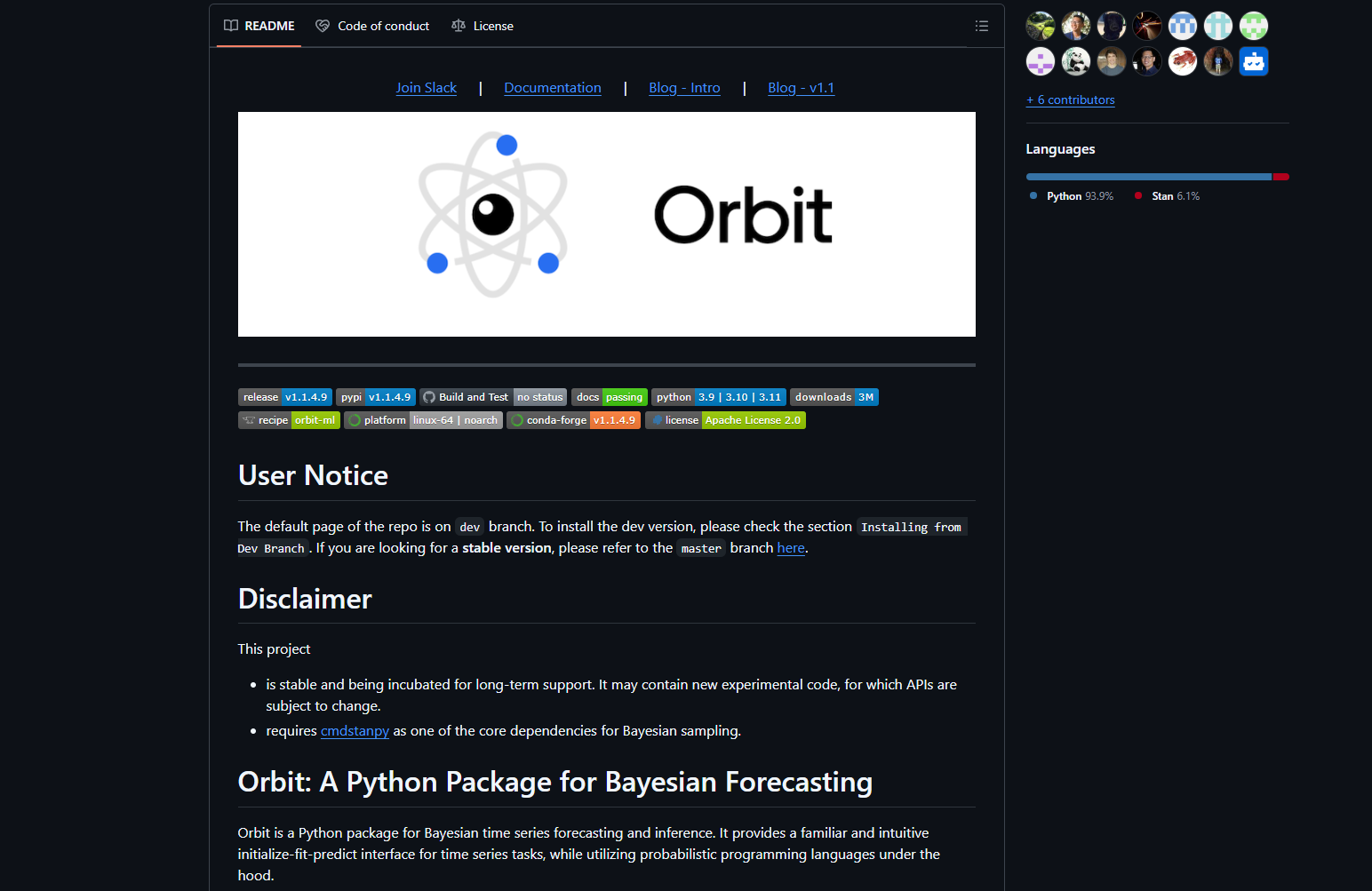
Uber’s Orbit library is a lightweight, scalable framework designed for time-series forecasting, making it useful for Marketing Mix Modeling (MMM) applications. Like Sellforte, Orbit leverage Bayesian MMM approach. Orbit's use in MMM was illustrated in Orbit's paper “Bayesian Time Varying Coefficient Model with Applications to Marketing Mix Modeling“
Since Orbit is primarily a forecasting library, it lacks some critical MMM features, such as modeling diminishing returns or adstock. It also lacks features typically found from full MMM solutions, like built-in data connectors, automated data processing pipelines, automated model calibration workflows, or a user-interface for analysis and optimization.
6. Analytic Partners (Consultancy MMM)
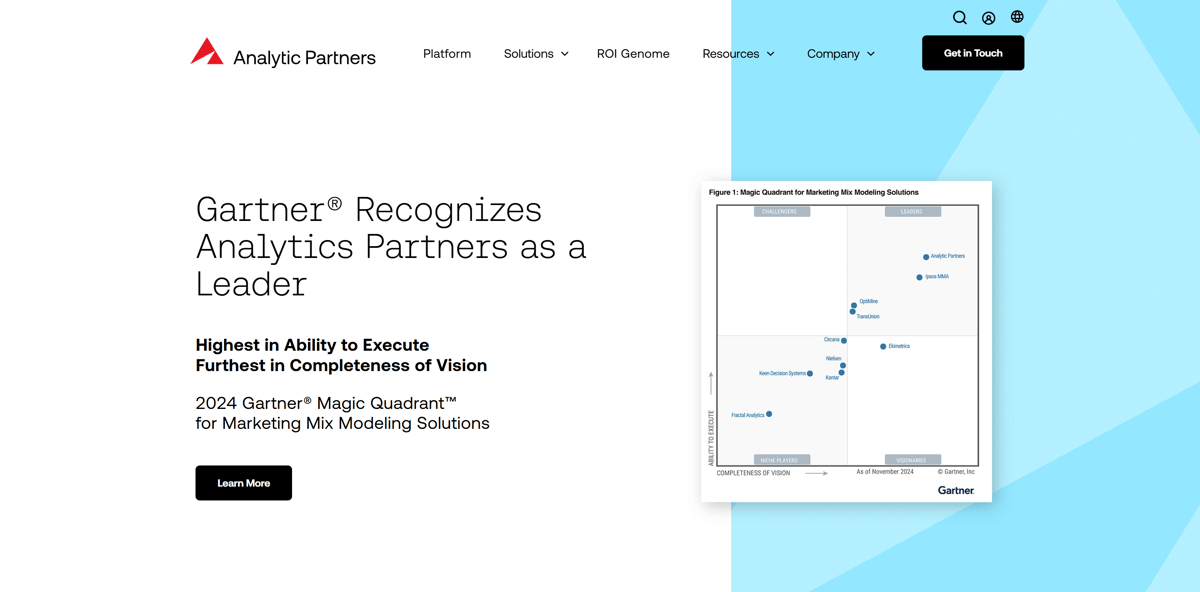
Overview: Analytic Partners, a US-based firm, is one of the most recognized consultancies in marketing measurement and is frequently invited to participate in Marketing Mix Modeling (MMM) RFPs for large ecommerce companies. Although it still ranks highly in Gartner reports, it has begun to lag behind competitors in both technology and methodological advancement.
Pros:
- Strong track record with enterprise clients
- Recognized as a leading consultancy in Gartner reports
- Extends beyond MMM into other commercial areas like customer segmentation and pricing strategy
Cons:
- Lacks campaign- or ad set–level measurement and optimization
- Does not support daily model updates
- Operates more as a consultancy than a software provider (outcomes depend on assigned team)
- Pricing model is consultancy-driven, making it many times more expensive than MMM product companies like Sellforte
Best suited for: Large enterprises looking for consultancy support and channel-level MMM to guide high-level budget allocation, rather than detailed campaign-level optimization.
7. Nielsen (Consultancy MMM)

Summary: Nielsen is a long-standing player in the marketing measurement space, known for its strength in traditional media and brand analytics.
Advantages
- Deep expertise in TV, offline media, and FMCG sectors
- Access to large-scale media and audience data
- Strong global reputation and presence
Limitations
- Emphasizes strategic insights over hands-on optimization (no campaign or ad set–level bidding guidance)
- Slower update frequency compared to modern MMM solutions
- Setups can be complex and require significant resources
Best suited for: Large retail organizations with a strong focus on TV and traditional media channels
8. Circana (Consultancy MMM)

Summary: Circana delivers analytics solutions for large enterprises, blending market data with advanced modeling techniques.
Advantages
- Deep expertise in retail and CPG industries
- Access to rich retail sales and category-level data
- Combines marketing insights with wider market intelligence
Limitations
- MMM is typically embedded within broader analytics offerings rather than a standalone solution
- Limited support for campaign and ad set optimization (no detailed spend or bidding recommendations)
- Implementations often depend heavily on consulting services
Best suited for: Large enterprises seeking high-level budget optimization and looking to leverage Circana’s proprietary data assets
9. Ekimetrics
Summary: Ekimetrics is a France-based analytics consultancy focused on advanced marketing analytics and tailored MMM solutions.
Advantages
- Strong data science expertise and advanced modeling skills
- Highly flexible and customizable MMM approaches
- Emphasis on strategic consulting
Limitations
- Limited support for performance marketing use cases, with no campaign or ad set–level spend and bidding guidance
- Operates mainly as a consultancy rather than a productized software solution
- Ongoing reliance on consulting may be required to maintain and evolve models
Best suited for: Enterprises looking for consultancy support and fully customized MMM solutions built around their specific needs.
10. Kantar (Consultancy MMM)
Summary: Kantar is a global insights and analytics firm that offers marketing effectiveness solutions, including marketing mix modeling.
Advantages
- Strong background in brand and consumer research
- Broad global presence with analytics and consulting capabilities
- Combines consumer insights with marketing performance analysis
Limitations
- Focuses more on high-level strategic insights than hands-on optimization (no campaign or ad set–level spend and bidding guidance)
- Can be costly due to its consultancy-based model
- Implementations often require extensive consulting involvement
Best suited for: Enterprises that want consultancy support and have a requirement to integrate consumer research insights with marketing effectiveness measurement
11. Ipsos MMA
Summary: Ipsos MMA (Marketing Management Analytics) delivers marketing mix modeling within the broader Ipsos research and analytics offering.
Advantages
- Strong capabilities in econometric modeling
- Solutions tailored to individual client needs
- Backed by global consulting support
Limitations
- Limited support for digital marketing teams, with no campaign or ad set–level spend and bidding recommendations
- Implementation timelines can be long
- Primarily focused on channel-level insights
Best suited for: Enterprise that value a consultancy-led approach.
12. Nepa (Consultancy MMM)
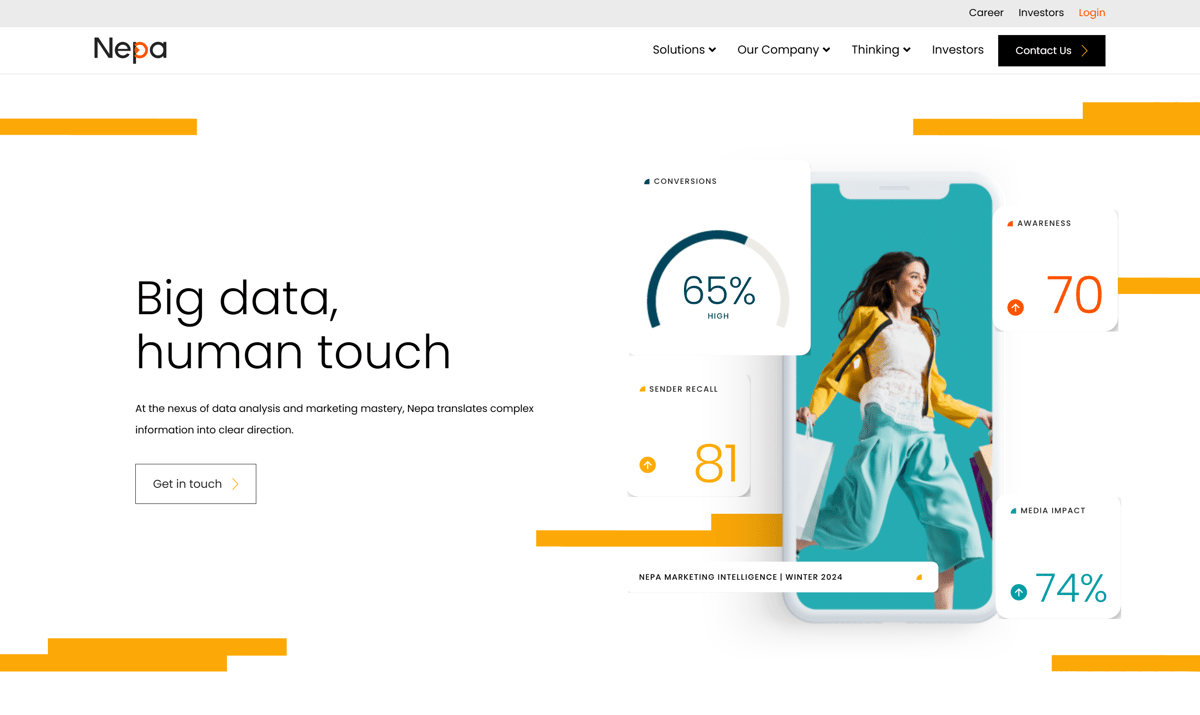
Nepa is a Sweden-based marketing analytics consultancy, also offering Marketing Mix Modeling.
Nepa headline: "Big data, human touch. At the nexus of data analysis and marketing mastery, Nepa translates complex information into clear direction."
13. Lifesight (MMM SaaS)
 Lifesight website
Lifesight is an MMM SaaS alternative, with majority of employees in India (source: LinkedIn).
Lifesight healine: "Turn wasted ad dollars into predictable growth & profit".
14. Incrmntal (MMM SaaS)
 Incrmntal website
Israeli-based Incrmntal is a 2020-founded MMM Saas startup, with several gaming companies mentioned as their reference customers, such as Sega, Supercell, Gameloft.
Incrmntal headline: "Welcome to the Future of Measurement"
15. Recast (MMM SaaS)
 Recast website
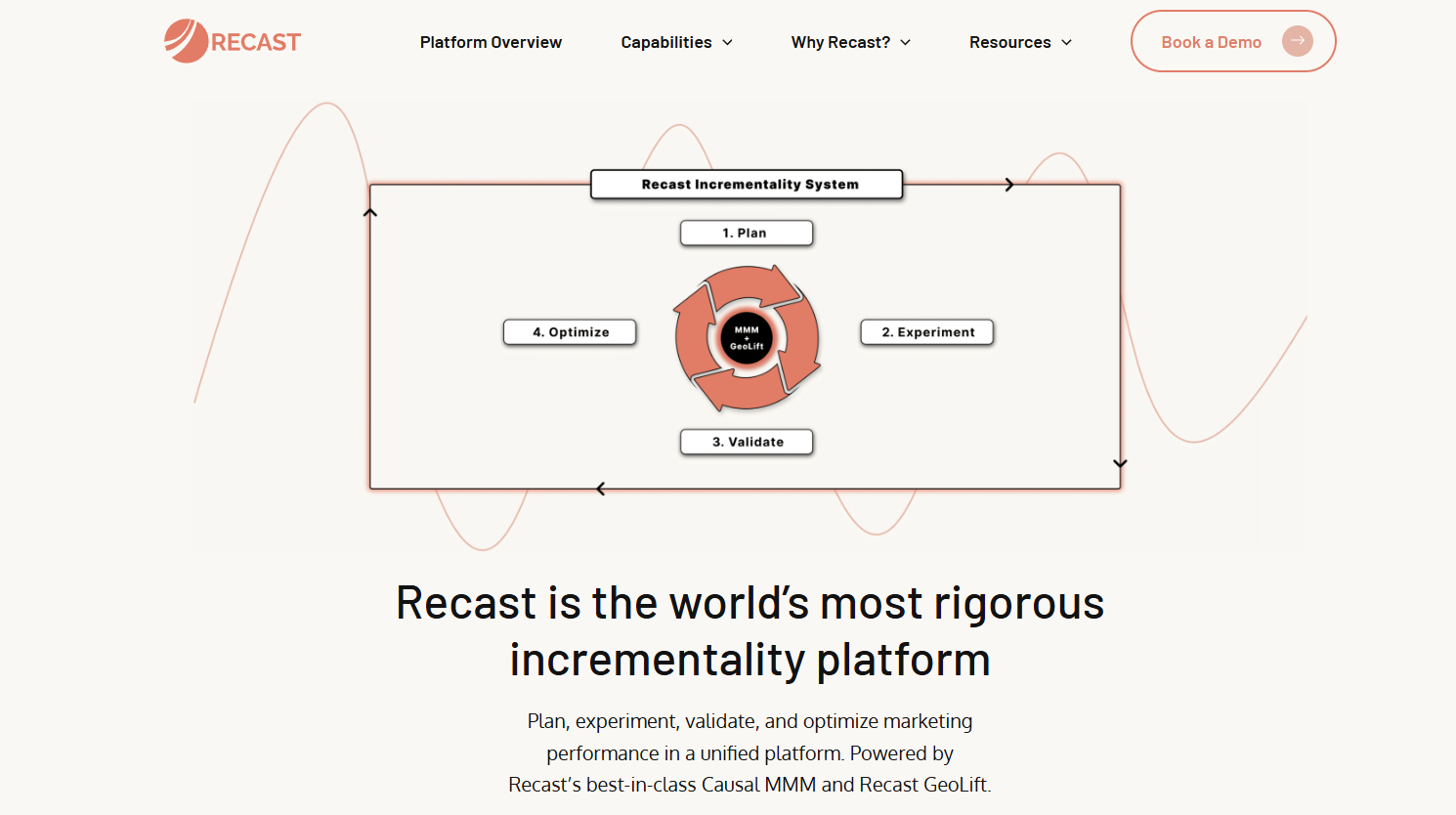
Recast is an MMM SaaS that highlights rigorous modeling and model validation as its strength.
Recast headline: "Recast is the world’s most rigorous incrementality platform"
16. Cassandra (MMM SaaS)
 Cassandra website
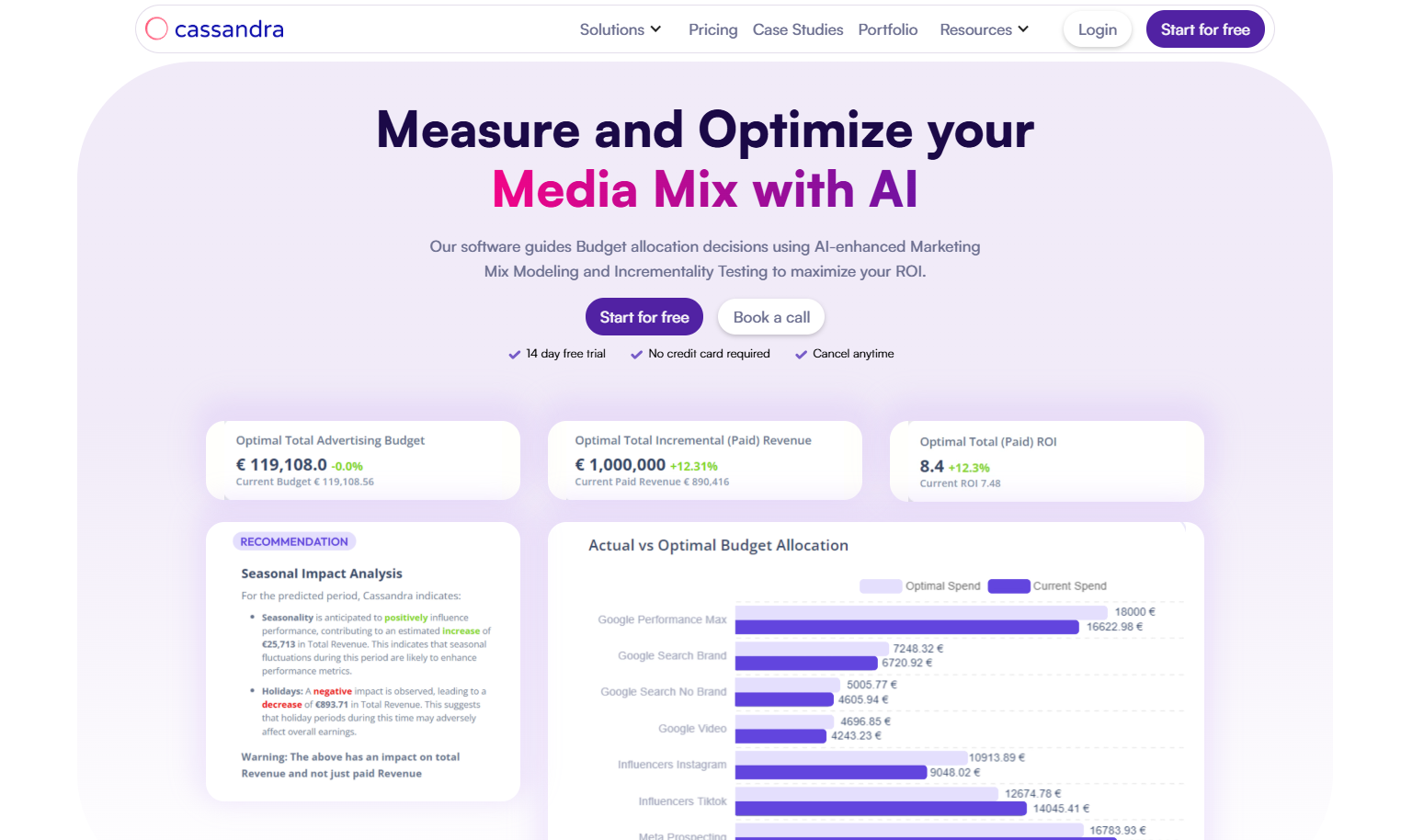
Cassandra is an Italian MMM SaaS startup, founded in 2022.
Cassandra headline: "Measure and Optimize your Media Mix with AI"
17. Keen Decision Systems (MMM SaaS)
 Keend Decision Systems website
Keen Decision Systems is an MMM SaaS alternative.
Keen Decision Systems headline: "Forecast, optimize, and analyze your marketing investment"
18. Measured (MMM SaaS)
Measured is an MMM SaaS company.
Measured headline: "If it's not growing your business, it's waste"
19. Liftlab (MMM SaaS)
LiftLab is an MMM SaaS alternative.
LiftLab headline: "Maximize Your Marketing P&L for Growth and Profitability."
20. Paramark (MMM SaaS)
Paramark is 2023-founded MMM SaaS alternative.
Paramark headline: "Invest in marketing with confidence & predictability"
21. Mutinex (MMM SaaS)
Mutinex is an Australian MMM SaaS company.
Mutinex headline: "Mutinex is your business growth co-pilot. Your best decisions start here."
22. DoubleVerify / Rockerbox (MMM SaaS)
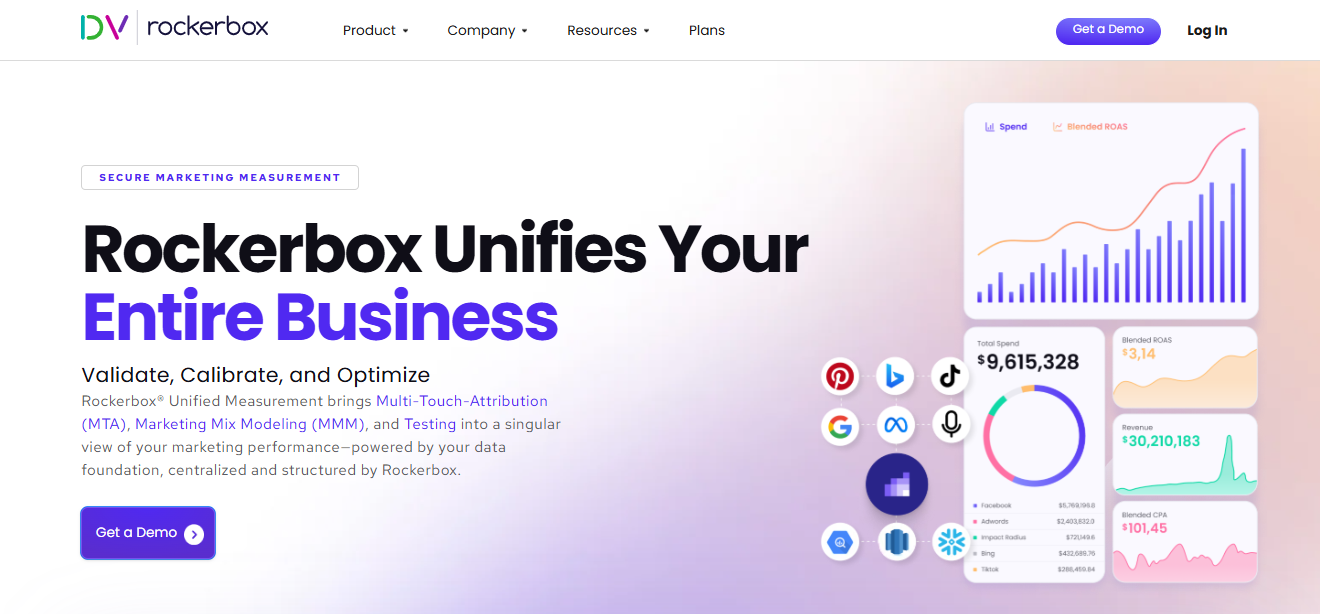
Rockerbox is originally a multi-touch-attribution company, who has later expanded to providing MMM SaaS. Rockerbox was originally an independent MMM vendor, but was acquired by DoubleVerify in 2025.
Rockerbox headline: "Rockerbox unifies your marketing measurement, marketing data, marketing decisions making, entire business"
23. Seeda (MMM SaaS)
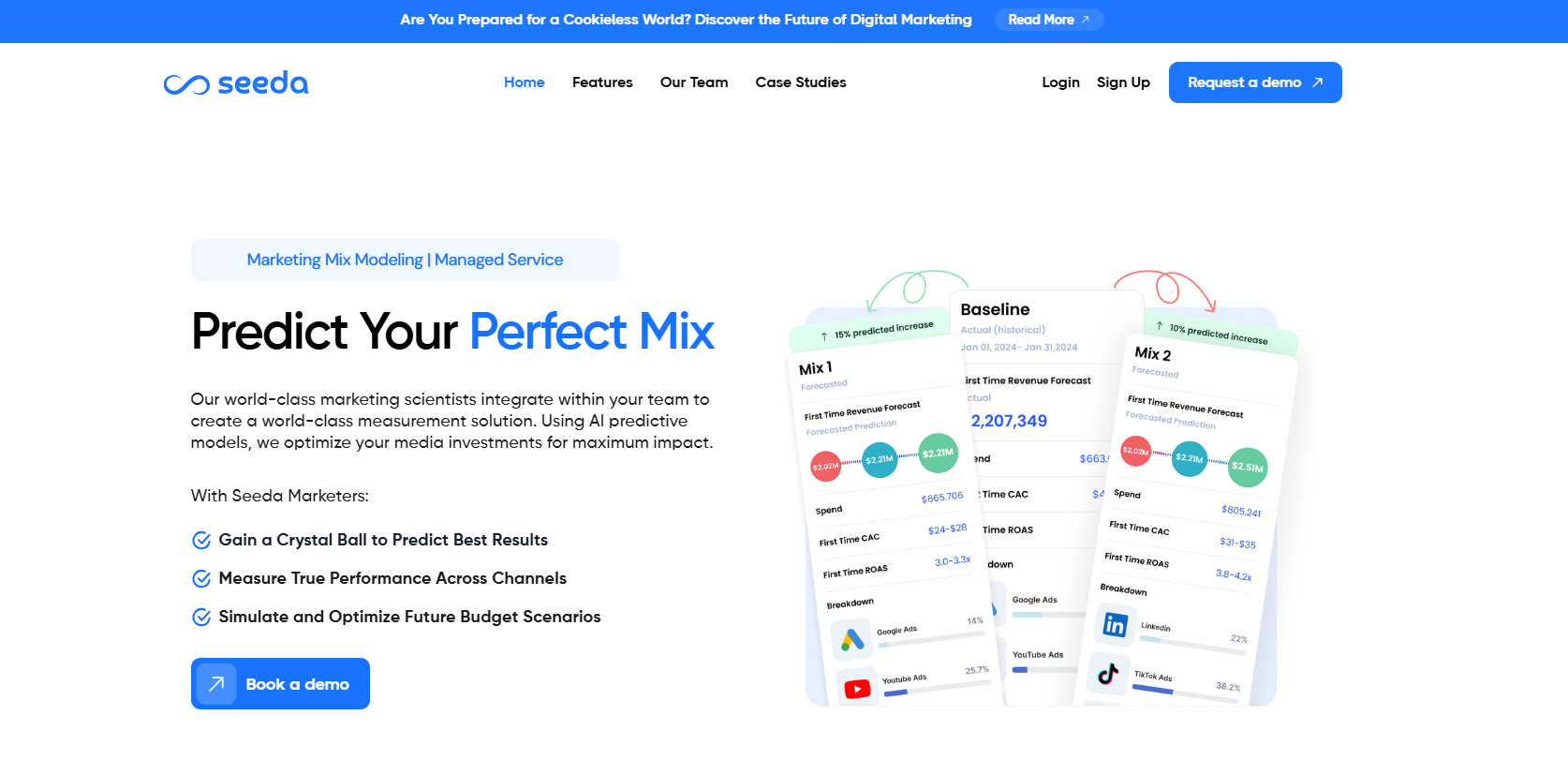
Seeda is a 10-person (Linkedin 2025 July) Australian startup with a headline "Predict Your Perfect Mix".
24. WorkMagic (MMM SaaS)
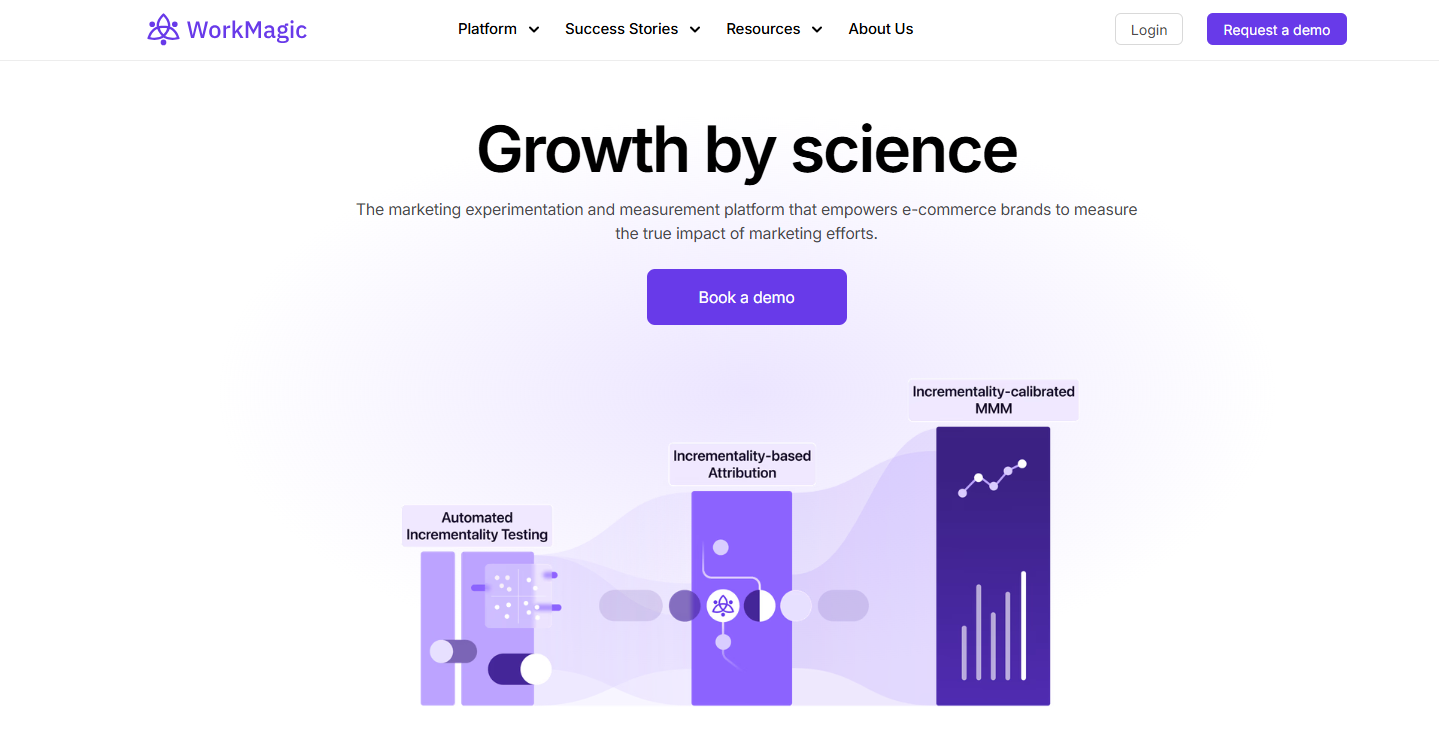
WorkMagic is an MMM startup with 25 employees (LinkedIn 2025 July) with a headline "Growth by science".
25. Aryma Labs (MMM SaaS)
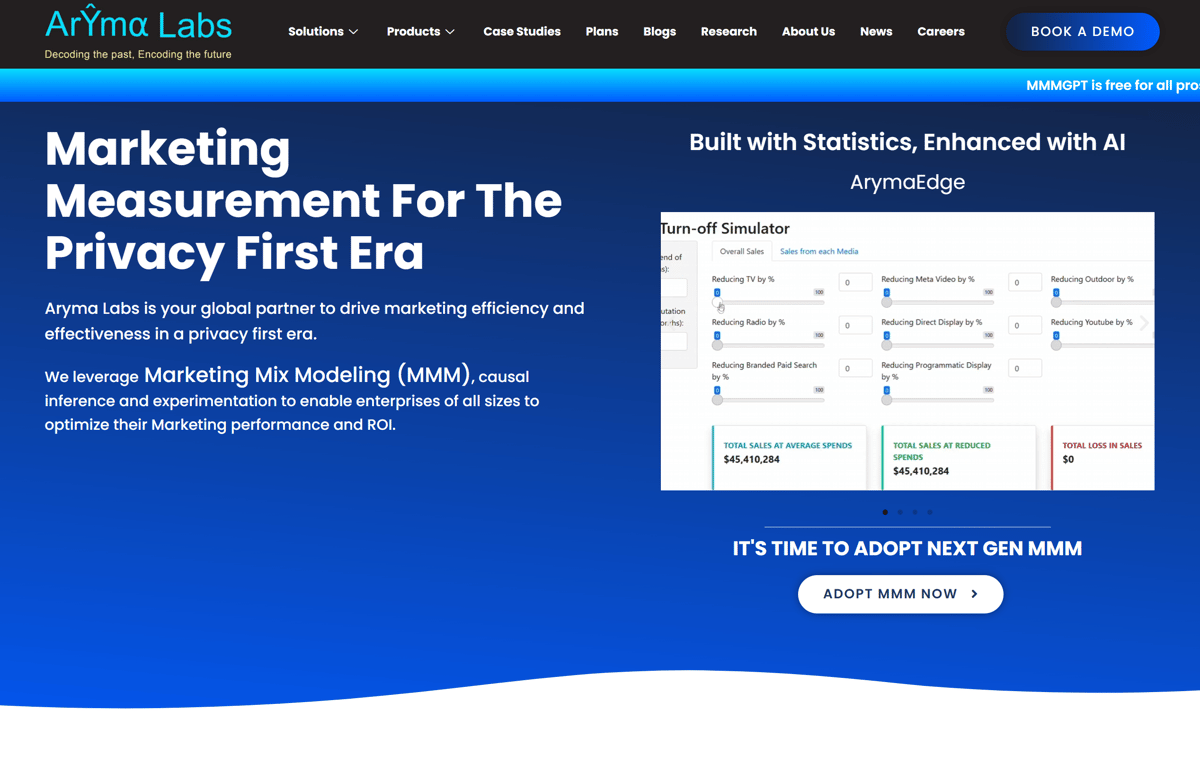 Aryma Labs website
Aryma Labs is an India-based company offering Marketing Mix Modeling projects. They are active in MMM-related publications, emphasize the frequentist MMM approach (instead of Bayesian).
Aryma Labs headline: "Marketing Measurement For The Privacy First Era."
26. Prescient AI (MMM SaaS)
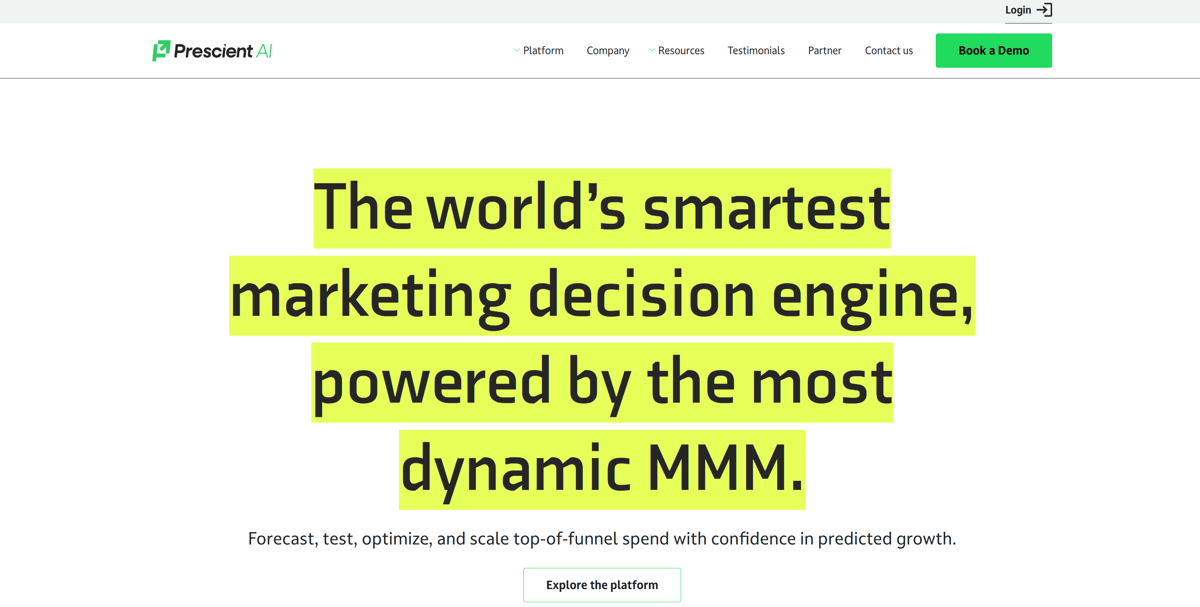 Prescient AI website
Prescient AI is an MMM SaaS alternative.
Prescient AI headline: "The world’s smartest marketing decision engine, powered by the most dynamic MMM."
27. Fospha
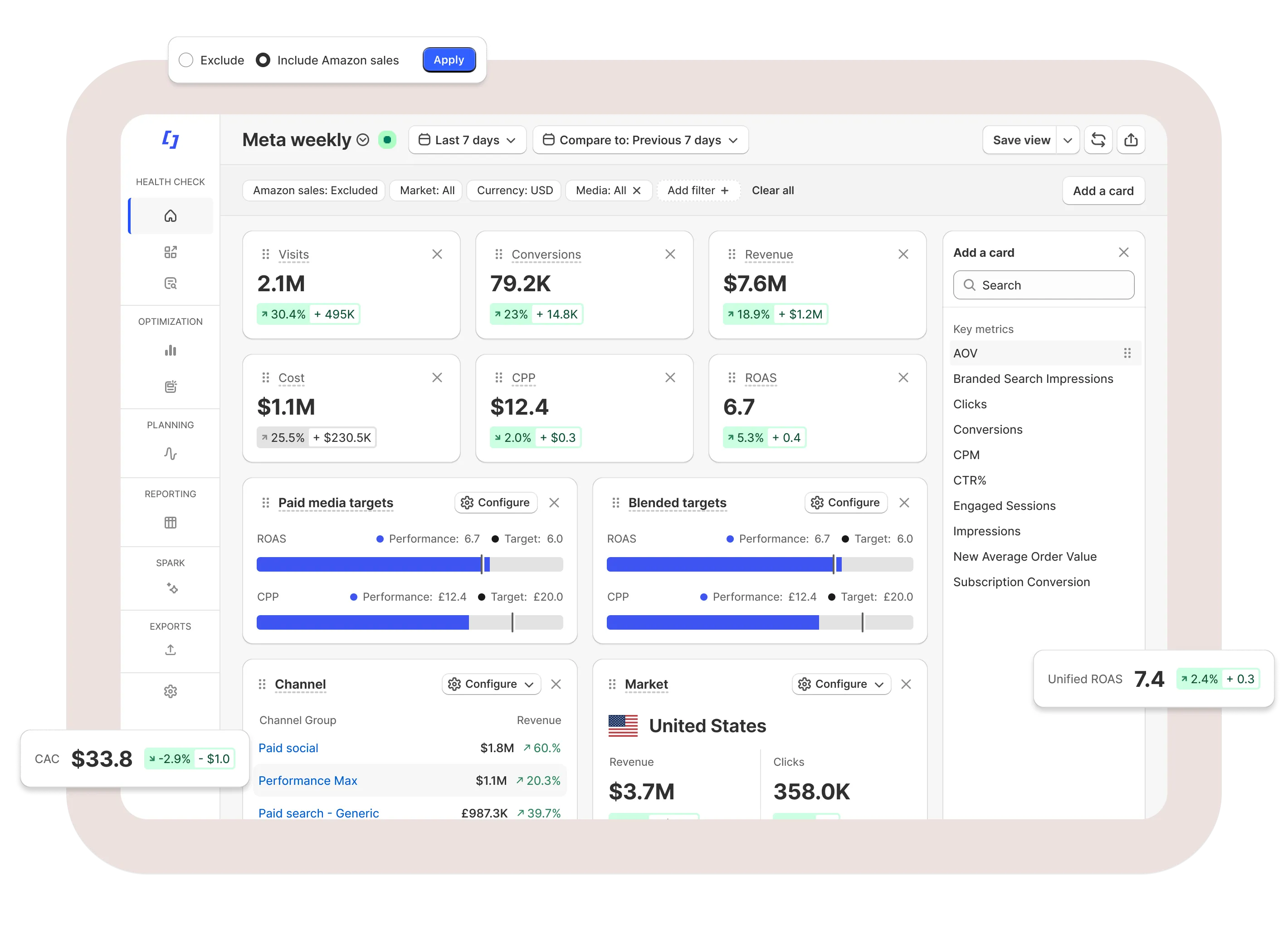
Overview: Fospha is primarily known as a multi-touch attribution platform, but it has expanded its offering to include MMM capabilities.
Pros:
- References from several smaller UK-based ecommerce companies
- Strong partnerships with platforms like TikTok and Snapchat, with case studies highlighting increased spend on these channels
- Fast onboarding enabled by existing integrations
- Supports campaign-level measurement
Cons:
- Limited optimization features (e.g., no advanced scenario planning or campaign/ad set–level recommendations based on miROAS)
- No AI capabilities built into the platform
- Limited scalability, making it less suitable for larger ecommerce businesses due to a simpler modeling approach
- Does not support analysis of marketing experiments
Best suited for: Smaller ecommerce brands, particularly in the UK, looking to explore MMM for the first time.
28. Triple Whale

Overview: Triple Whale is primarily recognized as an ecommerce analytics and multi-touch attribution platform for Shopify brands, but it has recently expanded its offering to include MMM.
Pros:
- Combines MTA and MMM within a single platform, making it easy to adopt for existing users
- Strong integrations tailored to ecommerce businesses, particularly Shopify
- Incorporating AI-driven features into the product
- Offers campaign-level measurement
Cons:
- MMM capabilities are relatively basic compared to dedicated MMM platforms (e.g., promotions are not included, which can bias results toward lower-funnel channels)
- Limited scalability, making it less suitable for larger ecommerce companies due to simpler modeling
- Lacks campaign-level Marginal Incremental ROAS (miROAS), reducing the reliability of recommendations
- Does not support analysis of marketing experiments
Best suited for: Smaller ecommerce teams looking for a simple way to get started with MMM without introducing a separate measurement tool, especially those already using Triple Whale for attribution and reporting.
29. Northbeam
.webp)
Overview: Northbeam is mainly known as a multi-touch attribution (MTA) platform, but it has introduced MMM features to align with the growing focus on incrementality.
Pros:
- Brings together MTA and MMM within a single solution
- Extensive customer base among smaller US ecommerce brands, particularly for its MTA offering
- Strong brand presence established during the rise of attribution tools
Cons:
- MMM is not its core capability, making it more limited compared to dedicated MMM platforms
- Lacks campaign-level Marginal Incremental ROAS (miROAS) and detailed spend recommendations
- Weaker in evaluating brand-building and awareness channels compared to MMM-focused providers
- No AI functionality integrated into the platform
Best suited for: Smaller ecommerce teams that still depend on attribution and want to complement it with MMM insights
30. Objective Platform (MMM Consultancy services / SaaS)

Objective Platform is a Neatherlands-based company offering MMM consultancy services and an MMM platform.
Objective Platform headline: "Elevate your marketing with data-driven insights, cross-channel optimization, holistic data overview, next gen attribution modeling, advanced budget forecasting, customizable reporting"
Is Sellforte the Marketing Mix Modeling tool you’re looking for?
Marketing Mix Modeling reveals the true ROI of all of your channels, and enables you to optimize your media spend based on true incremental impact of each media.
If you are ready to unlock the full potential of your media budget, book your demo with Sellforte today.
Further Reading & Resources on MMM
MMM Methdology
- Calibrating Marketing Mix Models with Experiments and Attribution data
- Advertising response curves: What are they and why do you need them?
- What is Causal Marketing Mix Modeling (MMM)?
- Understanding R2 in Marketing Mix Modeling: A Guide for Marketers
- MMM for Ecommerce: How Marketing Mix Modeling (MMM) Works for Online DTC Brands
- What does "Enterprise-Grade" Mean in Marketing Mix Modeling (MMM)?
- What is Incrementality Testing? Guide for Marketers
- Marginal Incremental ROAS (miROAS): What is it? And why does it matter to marketers?
- How Much Ad Spend Is Needed for Marketing Mix Modeling?
MMM, AI and Agents
- The Rise of Agentic MMM (Marketing Mix Modeling): How AI Is Transforming Media Optimization
- State of AI in MMM: Only 13% of MMM Vendors Implementing AI
- Webinar: Agentic MMM in Action: The Future of Autonomous Media Planning and Buying in Real Time
Use-cases: Using MMM to optimize media spend
- 11 Benefits of Marketing Mix Modeling (MMM) Every Marketer Should Know
- 6 Reasons eCommerce & DTC Brands Should Use Marketing Mix Modeling (MMM)
- The Shift in Marketing Mix Modeling: Why Campaign-Level Optimization is Taking Over
- The Five Requirements of Autonomous Media Buying and Optimization: M.A.G.I.C.
- Bid Optimization: How to Calculate the Optimal Bid Values for Your Campaigns Using miROAS
- ROAS, iROAS, miROAS: Choosing the Right KPI for Optimizing Media Spend
Original MMM Research by Sellforte Labs
- The 3 Danger Zones of Last-Click (And How to Avoid Them)
- How to measure Meta correctly? GA4 vs. MTA vs. MMM
- How to Measure the True Effectiveness of TikTok Ads?
- From Last-click to Marketing Mix Modeling (MMM): Unlock +6.5% more sales
- The Missing 24%: Why MMM Without Promotions Behaves Like Last-Click
Practical hands-on MMM guides
- How to Integrate Experiments Into an MMM Platform: A Practical Guide
- MMM Pilot Best Practices: 4 Steps to Plan, Run & Scale Your Marketing Mix Modeling Pilot
MMM tools, MMM software and MMM vendors
- Best Real-Time MMM Tools for Ecommerce Brands: Software That Delivers Instant Marketing Insights
- Best MMM Tools for Ecommerce Brands: Top 10 Software for 2026
- Top 5 Enterprise MMM Software for Large Ecommerce Brands ($1B+ in Sales)
- Top 5 Mid-Market MMM Software for Medium-Sized Ecommerce Brands ($50M–$1B Revenue)
- Top 5 SMB MMM Software for Small Ecommerce Brands ($0–$50M Annual Revenue)
- Best MMM Solutions for Retail Brands: Top Marketing Mix Modeling Platforms (2026)
- Meridian vs. Sellforte MMM SaaS: The Complete Comparison for 2026
Review MMM SaaS Product Features
- Visit Sellforte demo (no sign-up required): Sellforte demo
Research papers and whitepapers
- Challenges And Opportunities In Media Mix Modeling (2017, Google - Chan et al.) Link
- Bayesian Methods for Media Mix Modeling with Carryover and Shape Effects (2017, Google - Jin et al.) Link
- Geo-level Bayesian Hierarchical Media Mix Modeling (2017, Google - Sun et al.) Link
- Hierarchical Bayesian Approach to Improve Media Mix Models Using Category Data (2017, Google, Wang et. al) Link
- Bayesian Time Varying Coefficient Model with Applications to Marketing Mix Modeling (2021, Uber - Ng et al.) Link
- Hierarchical Marketing Mix Models with Sign Constraints (2020, Cheng et al.) Link
- Bayesian Hierarchical Media Mix Model Incorporating Reach and Frequency Data (2023, Google - Zhang et al.) Link
- Media Mix Model Calibration With Bayesian Priors (2024, Zhang et al.) Link
Authors

Lauri Potka is the Chief Operating Officer at Sellforte, with over 15 years of experience in Marketing Mix Modeling, marketing measurement, and media spend optimization. Before joining Sellforte, he worked as a management consultant at the Boston Consulting Group, advising some of the world’s largest advertisers on data-driven marketing optimization. Follow Lauri in LinkedIn, where he is one of the leading voices in MMM and marketing measurement.
Meridian vs. Sellforte MMM SaaS: The Complete Comparison for 2026

11 Benefits of Marketing Mix Modeling (MMM) Every Marketer Should Know