
How to read marginal incremental ROAS and use it to make better bid and budget decisions.
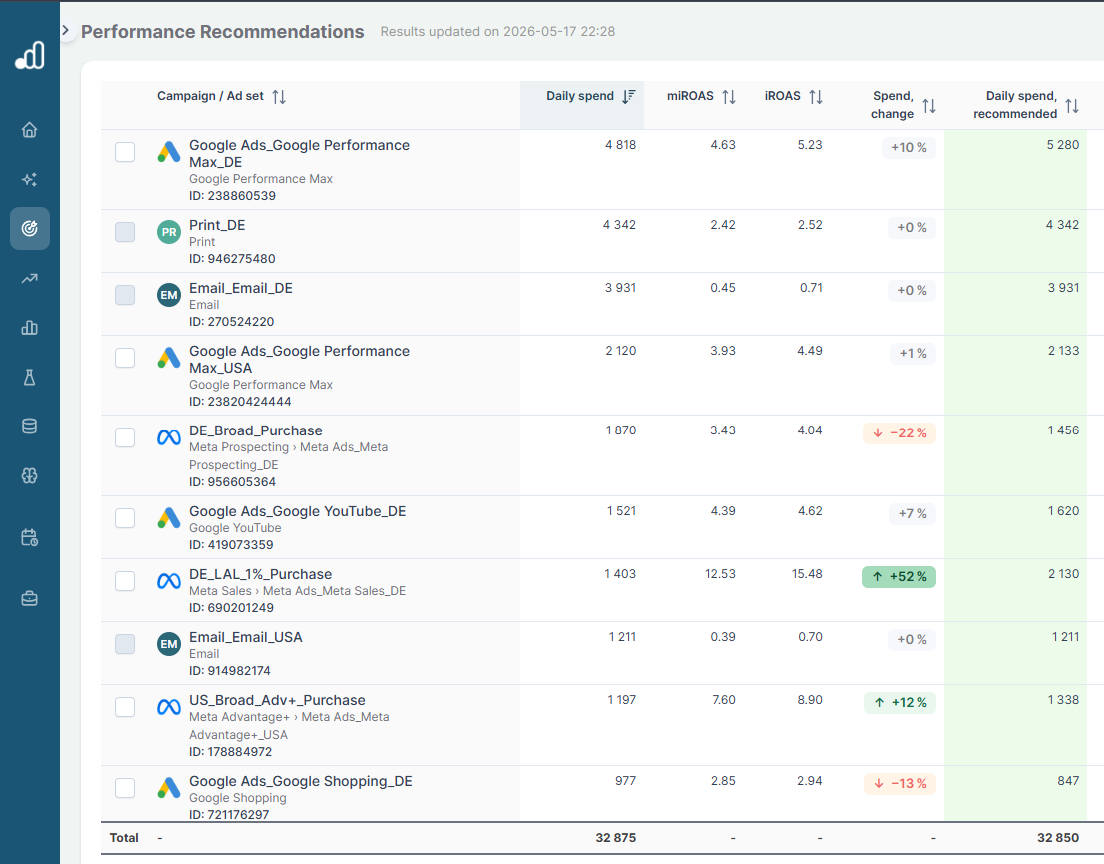
Marginal Incremental ROAS (miROAS) is the metric that drives Performance Recommendations. Every recommendation Sellforte generates — whether to scale a campaign up, pull it back, or leave it alone — comes from reading miROAS against your business's threshold. Understanding how to read miROAS is the difference between treating Performance as a black box and using it as a daily decision-making tool.
What miROAS tells you
miROAS is the projected incremental return on the next dollar of spend in a campaign, ad set, or channel. If a campaign has a miROAS of 4, the next dollar invested there is expected to return four dollars in incremental revenue. If it has a miROAS of 1.5, the next dollar is expected to return one dollar fifty.
The forward-looking framing is the important part. Platform-reported ROAS and historical iROAS both describe what already happened. miROAS describes what would happen next, given how much has already been spent and where the campaign sits on its diminishing returns curve. That is what makes it the right metric for deciding where to add budget and where to pull it back.
Reading miROAS against your threshold
A miROAS number on its own does not tell you whether to act. What matters is how it compares to your business's required miROAS threshold — the return below which additional spend is no longer profitable.
If miROAS is meaningfully above the threshold, the campaign has room to scale and the next dollar is worth investing. If miROAS sits below the threshold, the campaign is over-saturated and the additional spend is returning less than it should. If miROAS is close to the threshold, the campaign is near its optimal bidding range and most likely should be left alone.
Performance Recommendations applies this logic automatically. A recommendation to increase spend means miROAS is comfortably above the threshold. A recommendation to decrease spend means miROAS has fallen below it. A campaign without an active recommendation is usually close enough to optimal that no change is needed.
Using miROAS in Performance Recommendations
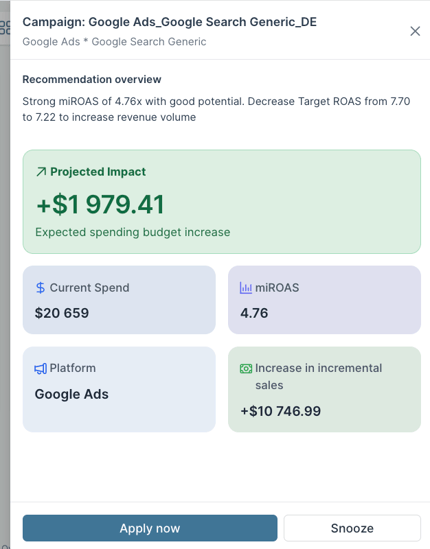
Open the Recommendations view and you will see miROAS surfaced on every card, alongside the suggested change. Use it to gut-check the recommendation before you apply. A strong miROAS with a recommended spend increase is a clear scale-up signal. A weak miROAS with a recommended pullback is a clear sign the campaign has been pushed too hard.
When you compare two recommendations and need to prioritise, miROAS is the right tiebreaker. Two campaigns suggesting a 20% spend increase are not equally valuable if one has miROAS 5 and the other miROAS 2.5. The higher-miROAS recommendation is where the next dollar earns most.
Why miROAS is the right metric for these decisions
It is worth being explicit about why miROAS sits at the centre of Performance, because the alternative metrics you see every day in your ad platforms answer different questions.
miROAS is the only metric that answers "where should the next dollar go?" Platform-reported ROAS tells you what the platform credits to itself, which is usually inflated and is not comparable across campaign types. Last-click ROAS skews toward channels closest to conversion and tells you nothing about marginal returns. Even iROAS — incremental ROAS — describes the average return on past spend rather than what would happen next. All three are useful in their own context, but none of them is the right input for a bid or budget decision.
For judging whether a past change paid off, the right metric flips. iROAS becomes the benchmark, because what you care about there is the actual incremental revenue your campaigns drove, not what each platform credited to itself. A retargeting campaign with a high platform-reported ROAS may simply be capturing conversions that would have happened anyway — iROAS strips that out.
The short version: use miROAS to decide where to put spend, and use iROAS to judge whether past changes paid off. Performance is built around that split.
Remember: miROAS moves when you act on it
One thing to keep in mind. miROAS is dynamic. As you increase spend on a campaign, you move further along its diminishing returns curve and the miROAS drops. As you pull spend back, the miROAS rises. This is why Performance Recommendations does not suggest pouring unlimited budget into the highest-miROAS campaigns. Beyond a certain point, the curve flattens and the next dollar earns less than the threshold demands.
Trust the recommended spend changes rather than extrapolating from the current miROAS in a straight line. Sellforte models the curve and accounts for the drop in miROAS that your change will cause.