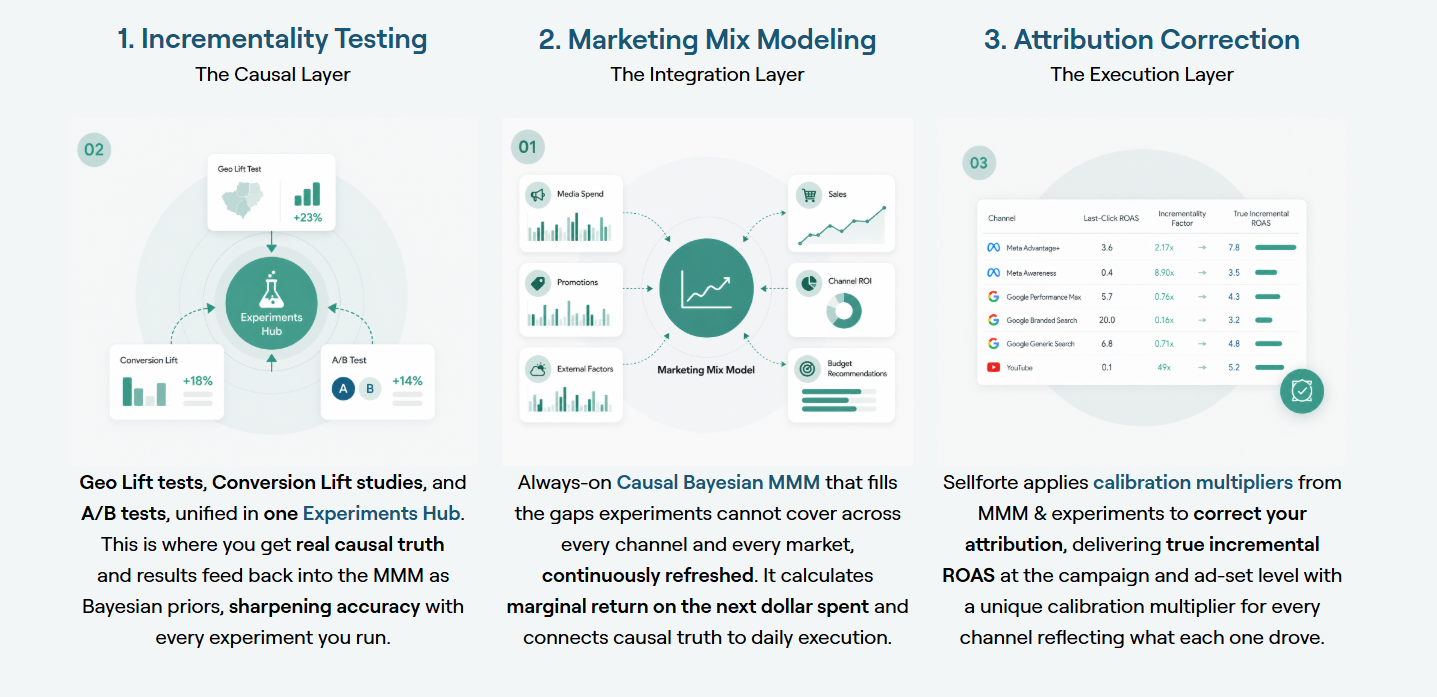
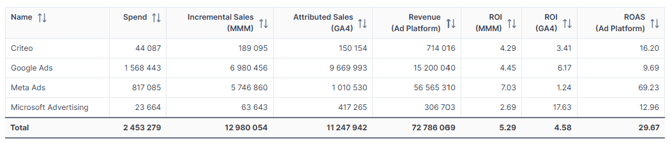
When you look at Sellforte, you'll often see a different number than what Google Ads, Meta Ads, or TikTok show for the same channel. This isn't a mistake. The two numbers are answering different questions, and once you see the difference, the gap makes sense.
How ad platforms count sales
Every ad platform — Google Ads, Meta Ads, TikTok, and the rest — reports on the sales it thinks it drove. It does this by looking at who clicked or saw its ads before buying, and taking credit for those sales. This way of measuring is called attribution.
There are two things worth keeping in mind. First, each platform only sees its own ads. Google can't see what Meta showed the same customer. Meta can't see what happened on TV or on a Google search page. So each platform assumes the customer bought because of what it can see, and doesn't know about anything else.
Second, if you add up the sales reported by all your ad platforms, the total is almost always higher than the number of sales your business actually made. The same order often shows up in several platforms at once — Google claims it, Meta claims it, TikTok claims it — even though only one order happened. On top of that, showing an ad to someone who was going to buy anyway isn't the same as causing the sale. Attribution counts both the same way.
How incrementality-based measurement works
Incrementality-based measurement asks a different question: how many extra sales did this channel actually cause? Put another way — if we hadn't run those ads, how many sales would we have lost?
Instead of tracing individual customer journeys, incrementality-based measurement looks at daily sales and spend across all channels at once, together with other things that move sales, like seasonality, pricing, and promotions. From that bigger picture, it works out how much each channel really added on top of what would have happened anyway. This is what Sellforte reports, and it's called incremental sales contribution — the extra sales driven by each channel that wouldn't have existed without it.
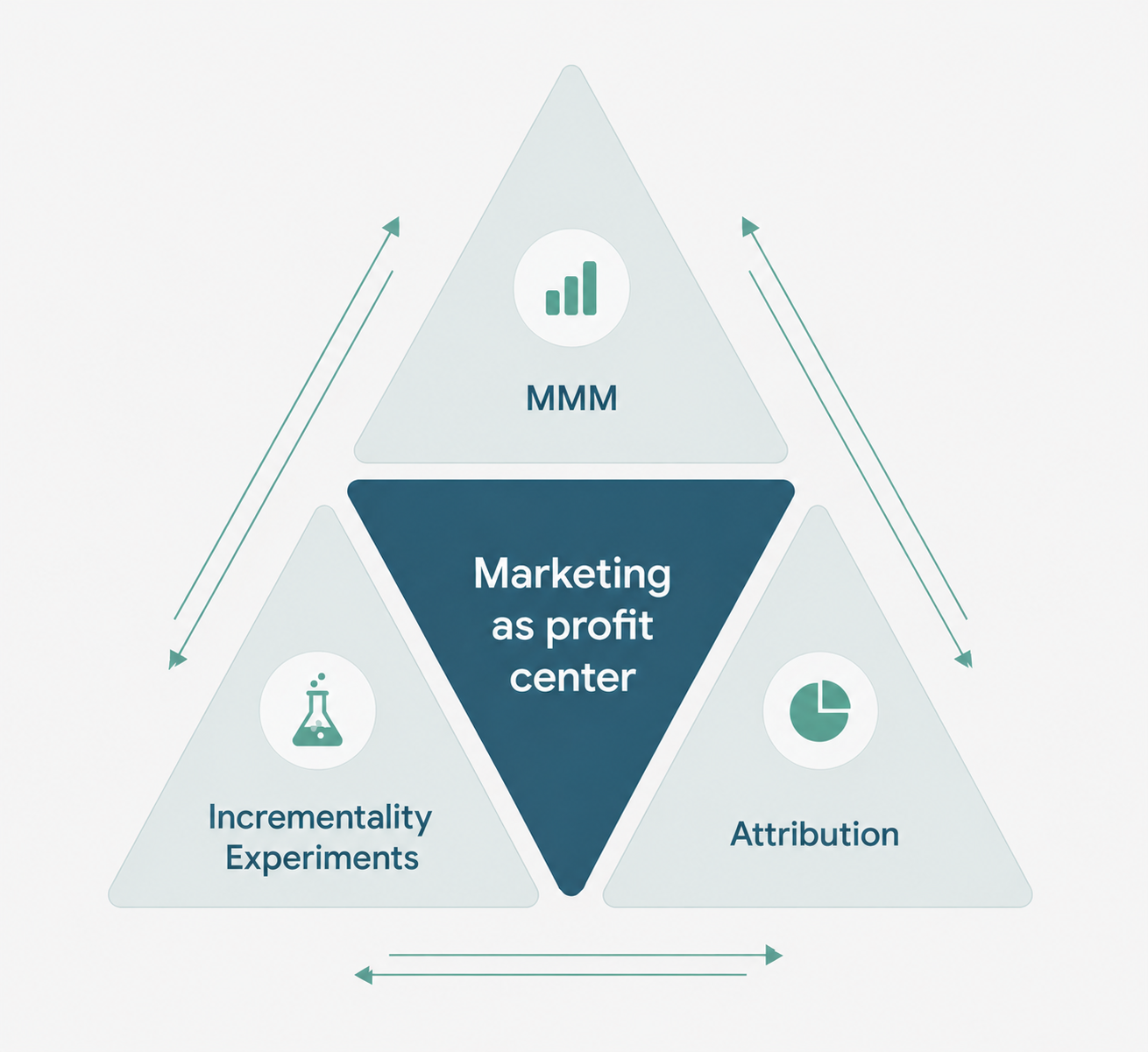
Sellforte follows Google's Modern Measurement approach
Sellforte's results are based on incrementality-based measurement, following the approach described in Google's Modern Measurement playbook. This combines three layers that work together. Experiments — such as geo lift tests, conversion lift studies, and A/B tests — provide the most direct evidence of what a channel actually causes, by pausing it in some regions or for some users and comparing sales against those where it kept running.
Marketing Mix Modeling uses daily data across every channel and market to fill the gaps that experiments can't cover, giving an always-on view of what each channel is contributing. Attribution correction then takes what MMM and experiments have learned and applies it to the granular data from Google, Meta, and other platforms, so you get true incremental ROAS all the way down to the campaign and ad-set level.
Why this matters for your budget
Because platforms take credit for sales that would have happened anyway, decisions based on platform-reported ROI usually push spend toward channels that sit close to the point of purchase, like paid search and retargeting, and away from channels that build demand earlier, like upper-funnel display, video, TV, and out-of-home. Incrementality-based measurement puts every channel on the same footing and shows what each one is truly adding, which is what you want when deciding where to spend the next euro of budget.
Platform-level reporting stays important, because it gives you campaign-level and ad-set-level detail that MMM on its own cannot provide. In Sellforte, this granular platform data becomes the execution layer. Once corrected with the incrementality signals from MMM and experiments, it shows true incremental ROAS at a level of detail you can act on day-to-day, while staying anchored in what the higher-level measurement has proven. So rather than replacing platform reports, incrementality-based measurement corrects them and puts them to work.