
Geo Lift is a geo-based incrementality experiment that measures the causal impact of a marketing activity by comparing treated regions against a synthetic control built from untreated regions.
This article covers what makes Geo Lift distinctive, when to use it, and how to set one up. For methodology, see Sellforte Experiments: Methodology. For interpreting results, see Sellforte Experiments: How to Read the Results Dashboard.
What makes Geo Lift distinctive
No data upload required
Geo Lift uses data that is already in Sellforte. If a customer's data has been configured for Geo Lift, the experiment can be set up directly in the UI without any file preparation or upload. Test and control regions are selected from the data already available on the platform.
Independent from MMM data granularity
Geo Lift can run at a more granular geographic level than the MMM model. If Sellforte holds regional or sub-national data for a customer, that data can be used in Geo Lift even if the MMM runs at country level. The key requirement is that the data is available at the right geographic level on both the media and KPI sides.
Geographic groups, but not always
Geo Lift is named for the most common use case — geographic splits — but the approach is not limited to geography. In principle, any dimension where the treatment can be cleanly isolated from non-treated groups can work: product categories, store tiers, or other segmentations. Geography remains by far the most common case.
Causal ground truth
Because the treatment is applied geographically, spillover effects between test and control regions are generally low. This makes Geo Lift one of the most credible forms of incrementality measurement available, and results are widely accepted as a strong causal evidence base for budget decisions and MMM calibration.
When to use Geo Lift
Geo Lift is usually the right choice when:
- A campaign ran in some regions but not others
- You increased, decreased, or paused spend in selected markets
- You have enough regional variation in both media and KPI data
- You want a credible treated-versus-untreated comparison without preparing external data
- You want results that can feed directly into MMM calibration
Geo Lift works best when there is a clear treatment, a clean separation between test and control regions, and a KPI that can be tracked consistently over time at the selected geographic level.
When Geo Lift may not be the right fit
Consider an alternative when:
- The relevant experimental data does not exist in Sellforte's data pipeline
- The treatment split is not geographic — for example, a customer segment split or a platform-level A/B test
- The geographic granularity needed for the experiment is not currently configured in Sellforte
In these cases, an A/B Test using uploaded data may be more appropriate.
Before you start: what makes a strong Geo Lift design?
A well-designed experiment matters more than simply running more experiments.
A strong Geo Lift setup typically includes:
- Clearly defined test and control regions with no treatment overlap
- Sufficient treatment intensity to produce a detectable effect
- Enough duration to observe impact, including any carry-over effects
- Good pre-treatment comparability between test and control regions
- Reliable KPI and media data at the selected geographic level
If the test is weakly designed, the result may still run, but it will be less useful for decision-making and less suitable for MMM calibration.
How to create a Geo Lift experiment
1. Open the Experiments module
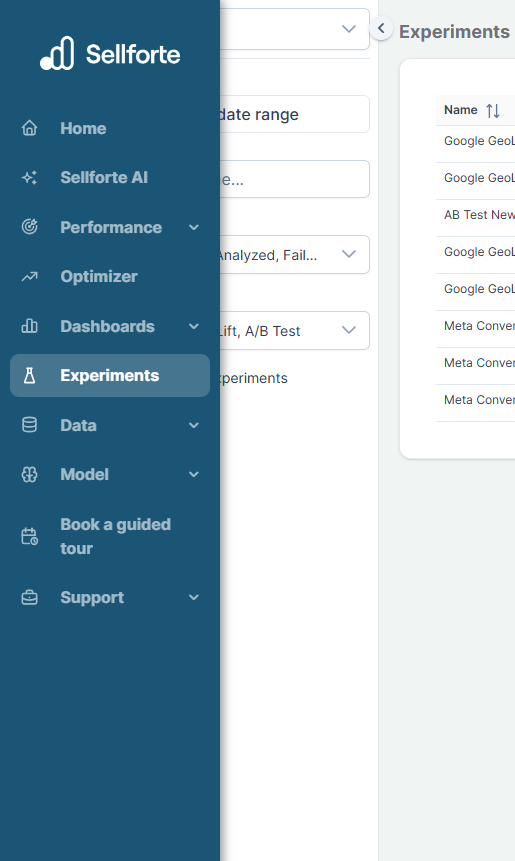
From the left navigation menu, go to Experiments. This opens the Experiment Library.
2. Create a new experiment
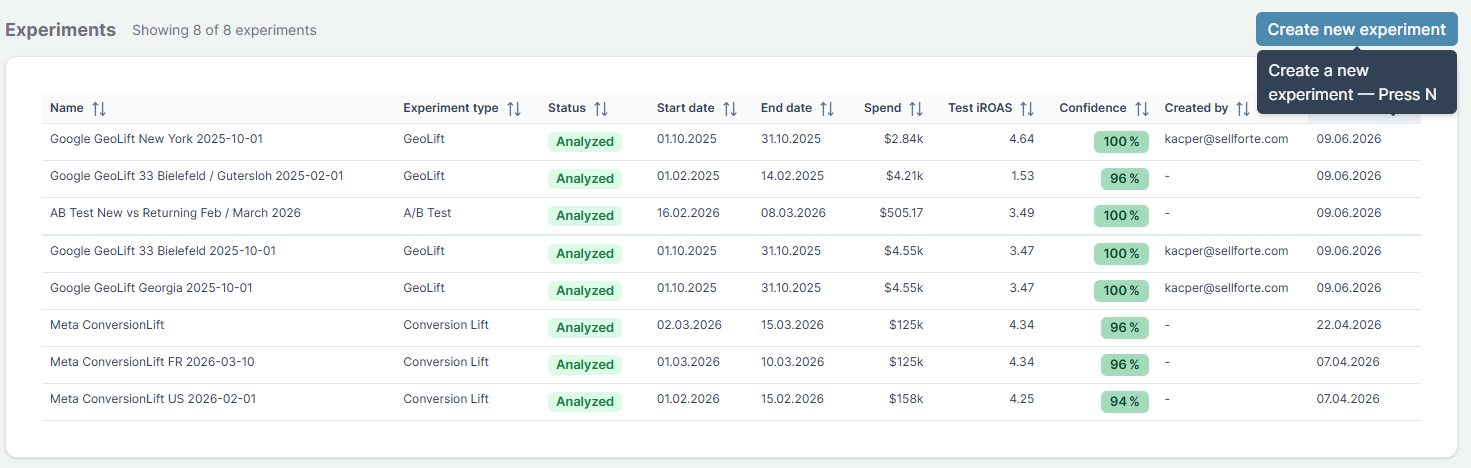
Click Create new experiment and select GeoLift as the experiment type.
3. Define the experiment setup
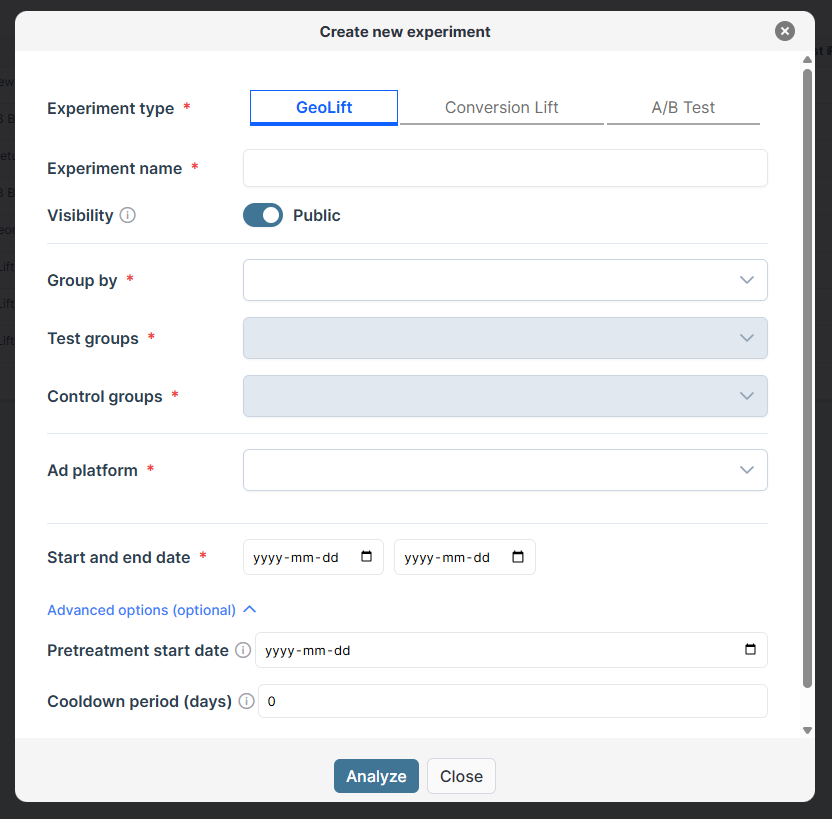
Fill in the required fields:
Experiment name — Use a structured naming convention, such as channel + region + date.
Group by — Choose the geographic aggregation level, such as region, state, or market.
Test groups — Select the treated regions — those that received the intervention.
Control groups — Select the regions that will be used to construct the synthetic control. These should not have received the treatment.
Ad platform / tested channel — Select the channel being tested.
Start and end date — Define the treatment period.
4. Run the analysis
Click Analyze to generate the result. Analysis typically completes within a minute. The platform then generates an AI summary automatically.
Using Geo Lift results to calibrate MMM
High-quality Geo Lift experiments can improve your MMM by providing real-world ROI anchors and informative priors for Bayesian modeling. This connection between experimentation and ongoing measurement is one of the core reasons to run Geo Lift regularly.
Only use high-quality experiments for calibration. Good indicators include a strong R-squared, high confidence, clear treatment intensity, and an adequate test duration. More experiments do not automatically improve MMM — better experiments do.
Best practices:
- Use clearly defined test and control regions with no treatment overlap
- Ensure treatment intensity is strong enough to produce a detectable effect
- Run the test long enough to observe both direct and carry-over effects
- Review the R-squared carefully — a weak pre-treatment fit reduces the reliability of the result
- Document findings and decisions using the comments feature
- Prioritise Geo Lift for channels where incrementality learning could materially affect spend decisions