
A geo lift experiment compares marketing performance between regions that receive a deliberate change in spend and regions that don't, giving you a clean read on incremental impact that you can use to validate or calibrate your Marketing Mix Model.
Prerequisites
Before designing the experiment, make sure you have Marketing Mix Modeling implemented for the geographic regions you plan to test in. MMM provides the baseline you'll compare your results against, and it lets you translate test findings into improved model calibration. You'll also need the ability to control media spend at the regional level on the platforms you want to test — typically through geo-targeting in the ad platform's campaign settings.
1) Design your experiment
Define your objective
State clearly what you want to learn and why. Common objectives include measuring the true incremental return of a specific channel, testing whether a planned spend increase generates proportional sales lift, or validating that an MMM result reflects real-world impact. A specific objective makes every downstream choice easier — channel selection, test length, treatment size — because each decision can be checked against it.
Define channels to test
Choose which channel or platform you want to test, for example Meta prospecting, Meta retargeting, YouTube, or a specific Google Ads campaign type. The size of the channel materially affects statistical significance: smaller channels produce smaller absolute changes in sales, which are harder to distinguish from background noise. Pick a channel with enough spend that a realistic treatment will create a detectable signal in the regions you're testing.
Select participating geographic regions
Pick geographies large enough to produce statistically reliable results. Some will act as control regions and some will receive the treatment. Regions should be roughly comparable in baseline sales, customer behaviour, and seasonality so that any difference observed during the test can reasonably be attributed to the treatment rather than to underlying differences between markets. All participating regions should have MMM implemented so that test results can be directly compared to model output.
Design the marketing intervention
The treatment is the change you apply to test regions. The simplest option is a hold-out test, where you switch the channel off entirely in test regions while leaving control regions untouched. Alternatives include a spend reduction such as -50%, or a spend increase such as +100%. Testing different spend levels can reveal information about marginal ROI and the shape of the saturation curve, but they're harder to execute cleanly and typically require more participating regions to reach the same level of confidence as a simple hold-out.
Define control markets and test markets
Assign each participating region to either the control group or the treatment group. A good split balances total baseline sales, customer mix, and historical channel performance across the two groups. Avoid putting all your largest markets on one side of the split — that's a common source of bias and makes results harder to interpret.
Define test period and length
Choose a study period long enough to capture the campaign's full impact, including any lag in consumer response. Channels with longer purchase cycles or strong brand-building effects need longer test windows than channels driving immediate response. As a rule of thumb, four to eight weeks is a typical range, but the right length depends on the channel, the category, and the size of the expected effect.
2) Implement the experiment
Execute the experiment in accordance with the design. The most important discipline during this phase is leaving the setup alone: don't shift budget between regions mid-flight, don't change creative selectively in test markets, and don't react to early signals by adjusting the treatment. Any in-flight change contaminates the comparison and makes the final analysis much harder to interpret. Keep a written log of anything unusual that happens during the test period — promotions, stock-outs, competitor activity, weather events — since these may need to be accounted for in the analysis.
3) Analyse
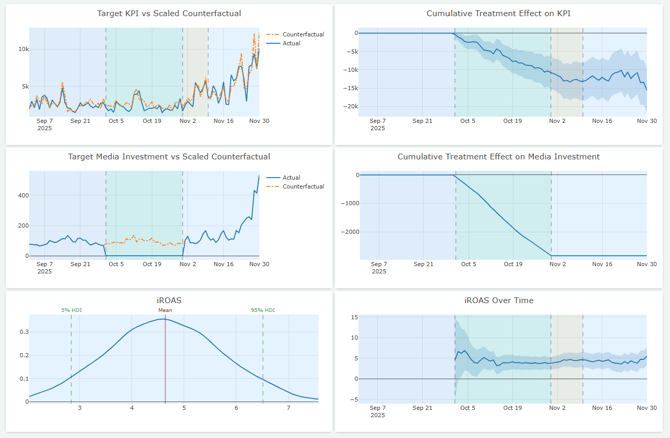
Use a rigorous analysis methodology to compare test and control regions over the test period. The goal is to estimate the counterfactual: what sales would have looked like in the test regions if the treatment had never happened, and how the actual observed sales compare to that counterfactual.
Sellforte customers can use Sellforte to analyse geo lift experiments directly against their MMM baseline. Read more here: Sellforte Experiments: Geo Lift
4) Take action
Once you have results, two paths are typically useful.
The first is validation. Compare the experiment's measured incremental impact to what MMM is telling you for the same channel and period. If the two are in the same range, that's a strong signal the model is well-calibrated for this channel, and you can trust its outputs for planning decisions.
The second is calibration. If the experiment result deviates meaningfully from the MMM result, feed that information back into the model as a prior. Improved calibration for one channel improves the quality of the whole model, because MMM allocates incremental sales across channels jointly — getting one channel right helps every other channel's estimate become more accurate too.
Result
You'll have a measured, in-market read on the incremental impact of a specific channel, and a clear path to either confirm your MMM as-is or improve it using the new evidence. Repeating this process across channels over time builds a steadily more accurate model and a stronger foundation for media planning decisions.