
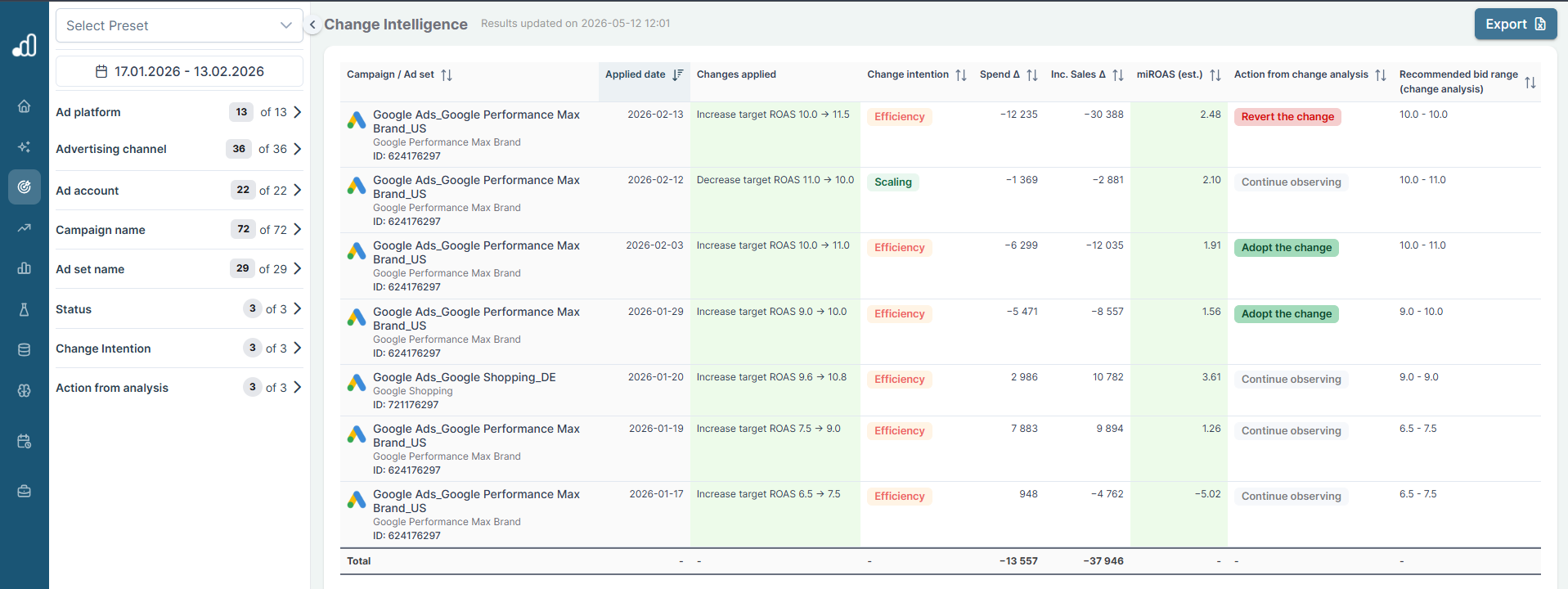
Change Intelligence is the learning layer of Sellforte Performance. Every time you adjust a target ROAS, a bid value, or a daily budget, you have made a decision. Change Intelligence treats that decision as a measurement event and works out whether it actually delivered the result you wanted — not by comparing what happened before and after, but by estimating what would have happened if you had left the campaign alone.
Why before-and-after is not enough
The natural way to evaluate a bid or budget change is to look at the campaign before the adjustment, look at it after, and see what moved. The problem is that sales fluctuate naturally, seasonality shifts, competitors react, and other channels move at the same time. Just because something changed after a target ROAS adjustment does not mean the adjustment caused it.
Change Intelligence upgrades this comparison into a causal measurement by adding one extra step: the counterfactual.
How Change Intelligence calculates impact
The logic runs in five steps. First, Change Intelligence detects the change — for example, target ROAS moving from 5 to 7 on a Google Search campaign. Second, it measures spend and incremental sales in the period before the change and in the period after. The sales figures here are incrementality-corrected from the MMM, not platform-reported. Third, it estimates the counterfactual: what spend and incremental sales would have been in the post period if the target ROAS had stayed at 5. Fourth, it calculates the delta between the actual post-change figures and the counterfactual. Fifth, it expresses that delta as a marginal incremental ROAS — the return on the extra dollars spent or saved — and compares it to your business's required threshold.
The output is a single number that tells you whether the change moved the campaign closer to its optimal bidding range or away from it.
A change that worked
Imagine a campaign running at target ROAS 8.5. The efficiency requirement is strict, the campaign barely spends, and incremental sales are minimal — it is almost the same as not running the campaign at all. You lower target ROAS to 7. Spend rises from a few hundred dollars to several thousand, and incremental sales rise from a few thousand to tens of thousands.
Change Intelligence calculates the counterfactual for the post period, isolates the extra spend and the extra incremental sales caused by your change, and computes the miROAS of that additional investment. If it sits above the business's required threshold, the recommendation is clear: adopt the change. The campaign was previously constrained, and your adjustment unlocked profitable scale.
A change that overshot
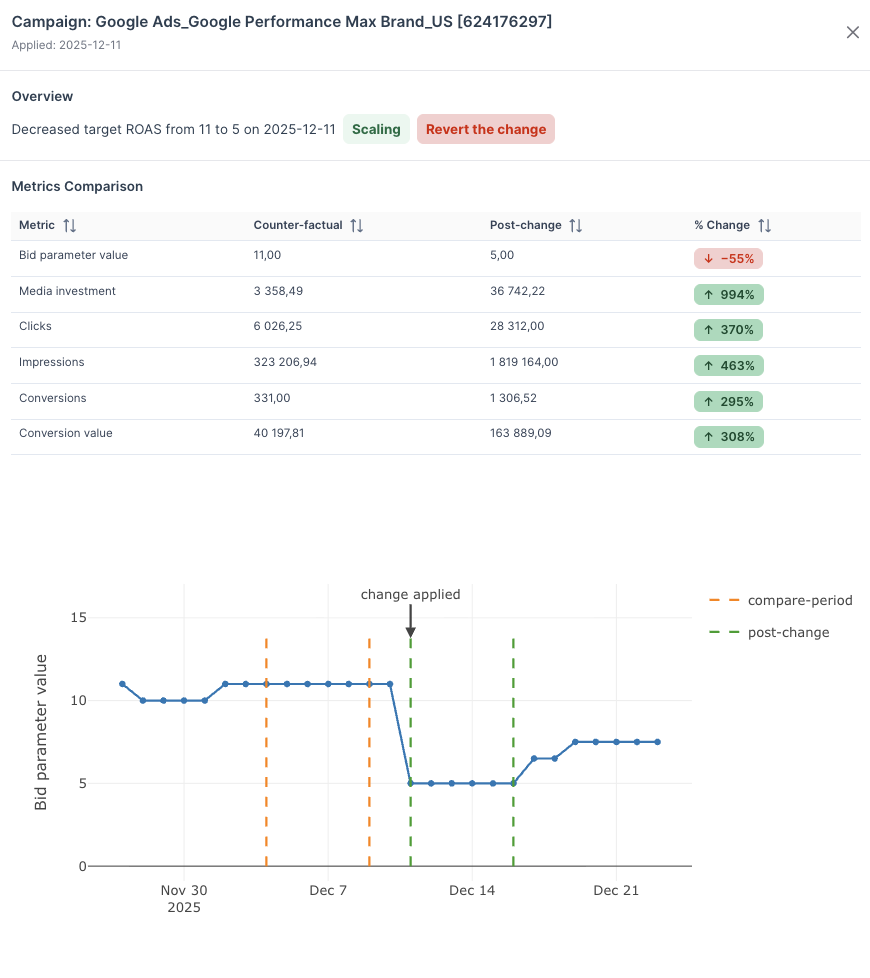
The same logic catches changes that went too far. If you cut target ROAS aggressively from 11 to 5, the algorithm spends more, clicks rise, and conversions grow. On the surface that looks like a scaling success. Change Intelligence then estimates what would have happened if target ROAS had stayed at 11 and measures the true incremental impact of the change. In this case, incremental sales did grow — but spend grew more, and the miROAS of the extra dollars falls below the required threshold.
Without the counterfactual, most teams would call this a win because sales went up. Change Intelligence makes clear that the last dollar spent was not worth it.
How Change Intelligence fits into your workflow
Change Intelligence sits at the end of the Performance loop. Recommendations suggests changes, you apply them through Performance Recommendations, and Change Intelligence evaluates what each change actually did once enough data has accumulated. The evaluation feeds back into the next round of recommendations, so future suggestions become more accurate over time. This is how Performance becomes a learning system rather than a static set of outputs.
Data requirements
Change Intelligence runs on top of your standard Sellforte setup. It needs your MMM results, your platform spend data, and a record of the bid and budget changes happening in your ad platforms. Once those are in place, Change Intelligence automatically picks up new changes as they occur — there is no need to manually flag adjustments for it to evaluate.